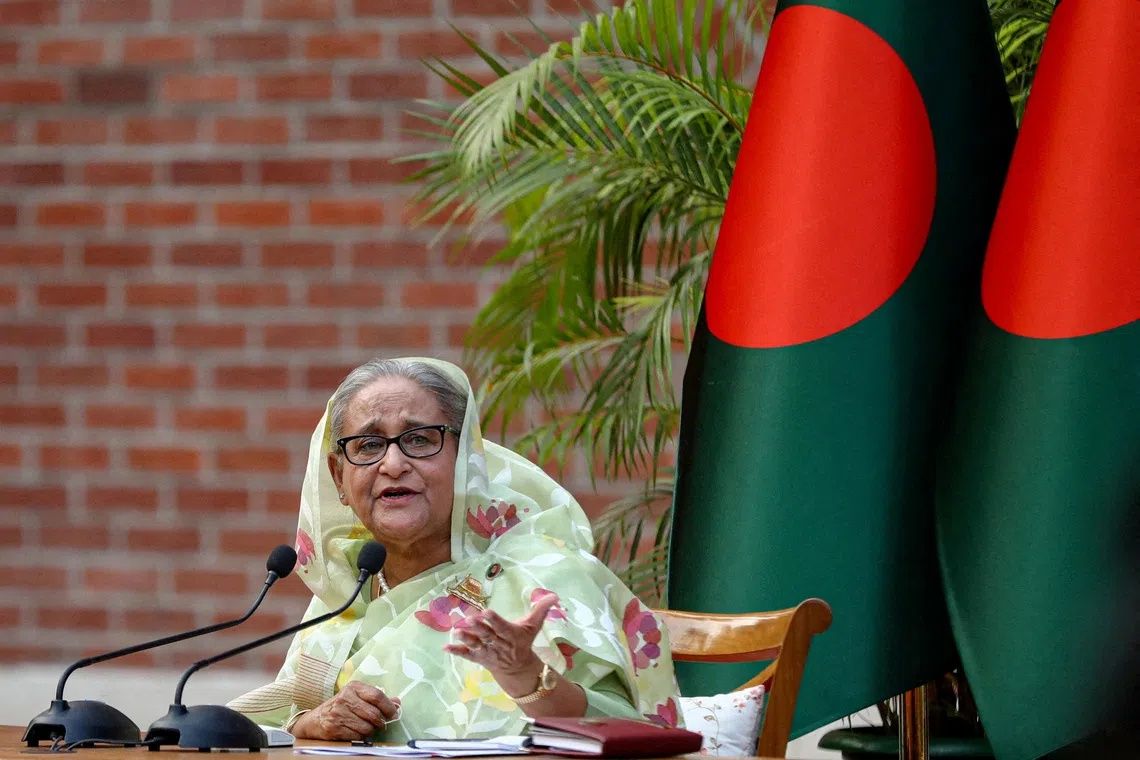
Bangladesh has formally sought clarification from India regarding exiled former Prime Minister Sheikh Hasina's planned virtual appearance at a New Delhi event, signalling concern that allowing the fugitive to conduct political activities from Indian soil could undermine the countries' recently improving bilateral relationship. The request marks Dhaka's first official response to Hasina's scheduled participation in an August 5 gathering hosted by the Foreign Correspondents' Club of South Asia, which will commemorate the second anniversary of the student-led uprising that brought down her government in August 2024.
Shama Obaed Islam, Bangladesh's State Minister for Foreign Affairs, articulated the government's position during a press briefing on Monday, emphasising that Dhaka views the matter as a potential obstacle to collaborative progress between the two neighbours. "We are moving forward with India with a forward-looking approach. We don't want that progress to be affected," she stated, before directly challenging New Delhi to take a definitive stance on the matter. The timing of this diplomatic overture is particularly sensitive, coming at a moment when both Bangladesh and India have begun signalling renewed commitment to strengthening their partnership following the transition to Tarique Rahman's administration after February's elections.
The controversy stems from Hasina's intention to address the New Delhi event via video link, an appearance that will be shared with her son, Sajeeb Wazed Joy, and other speakers. While the Foreign Correspondents' Club of South Asia confirmed the 78-year-old's participation, the organisation has not yet responded to queries regarding the concerns raised by Bangladesh's government. This silence from the club reflects the diplomatic sensitivity surrounding what might otherwise be considered a routine media engagement.
Bangladesh has maintained an active extradition case against Hasina since she fled to India following the collapse of her government. The former premier has resided in New Delhi throughout this period, and despite her legal jeopardy at home—including a death sentence issued in 2025 for crimes against humanity related to the 2024 crackdown on protests—she has expressed her intention to return to Bangladesh by December. The apparent contradictions in her statements underscore the complex political dimensions of her exile.
Shama Obaed Islam further elaborated that Dhaka has repeatedly communicated its concerns to Indian counterparts about Hasina and other Awami League figures making political statements from Indian territory. "We do not want India-Bangladesh relations to be harmed by statements from fugitive accused individuals," she said, reinforcing a message that she suggested India had itself previously communicated to Dhaka, namely that Indian soil should not be used as a platform for political fugitives to conduct activism. This appeal to India's own stated principles represents a calculated diplomatic strategy, positioning Bangladesh as merely asking New Delhi to apply its own established guidelines consistently.
While Islam acknowledged that the Foreign Correspondents' Club event is not officially organised by the Indian government, she indicated that Bangladesh would escalate the matter through formal diplomatic channels if necessary. This threat of formal complaint underscores Dhaka's determination to prevent what it views as an impediment to bilateral cooperation. The statement carries implicit weight given the fragility of recent diplomatic progress between the two countries.
The deterioration of India-Bangladesh relations following Hasina's removal from power has been a significant feature of South Asian geopolitics. However, both nations have demonstrated recent appetite for rebuilding trust and expanding cooperation, suggesting that the current dispute could be resolved through dialogue if both sides demonstrate flexibility. India's foreign ministry has not yet issued a public response to Bangladesh's concerns, leaving the precise contours of New Delhi's position unclear. This reticence may itself constitute a tacit acknowledgement of the diplomatic minefield surrounding Hasina's case.
The underlying complexities warrant careful examination. The 2024 crackdown that Hasina's government conducted against student protesters resulted in an estimated death toll of up to 1,400 people, according to United Nations assessments, lending substantial weight to the gravity of the accusations against her. Bangladesh's death sentence against Hasina reflects the intensity of public feeling regarding her administration's response to the uprising. Yet Hasina has categorically rejected the verdict, characterising it as legally void—a position that reflects her enduring political influence and the contested nature of justice processes in the post-transition environment.
For Malaysia and Southeast Asia more broadly, this dispute illuminates the complexities that arise when regional powers navigate questions of political asylum, extradition, and the appropriate boundaries of political activity by exiles. The situation also demonstrates how fragile diplomatic gains can prove when legacy issues remain unresolved. Bangladesh's measured but firm approach—avoiding inflammatory rhetoric while clearly delineating its expectations—offers a template for how neighbours might address similar tensions without allowing disputes to derail broader cooperation frameworks.
The coming weeks will prove instructive regarding whether India and Bangladesh can navigate this issue diplomatically or whether it will become a more significant flashpoint in their relationship. Should India permit Hasina's address to proceed without constraint, Bangladesh may interpret this as tacit support for opposition figures, potentially complicating the bilateral engagement that both countries have recently been cultivating. Conversely, should India impose restrictions on Hasina's speech, it would signal to Dhaka that New Delhi takes seriously Bangladesh's concerns about political fugitive activities on Indian soil, reinforcing the emerging partnership framework.

