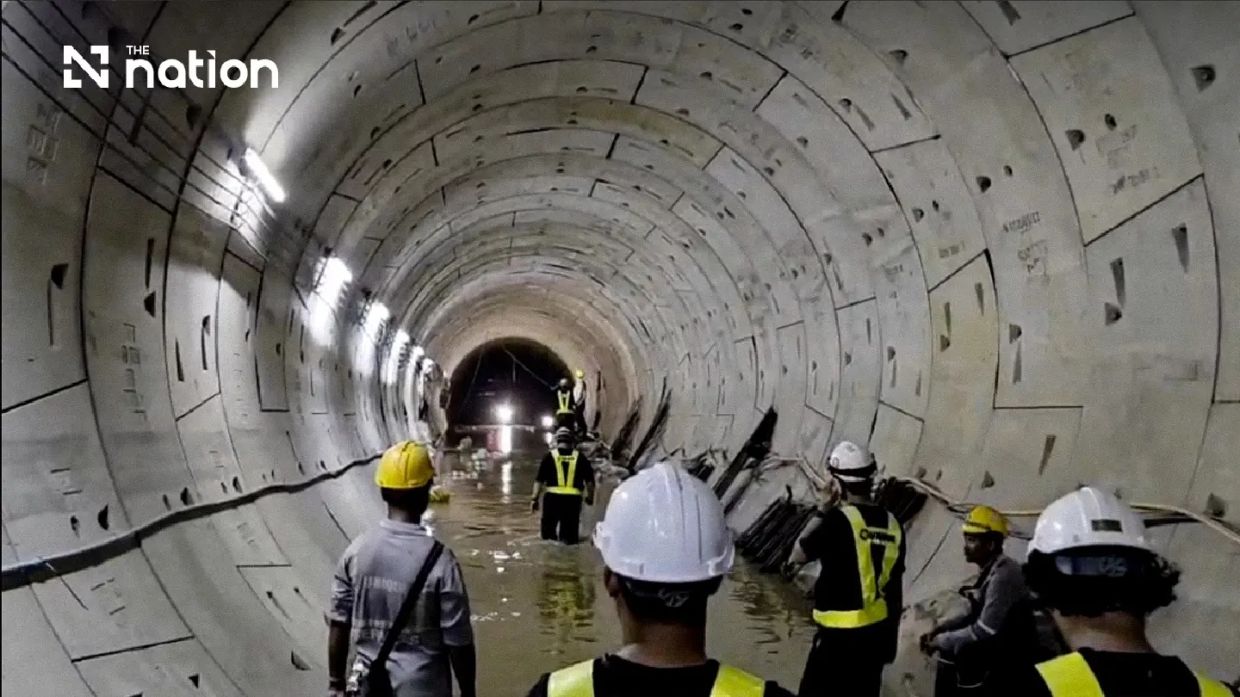
The discovery of water seeping into an underground construction shaft along Bangkok's Purple Line extension has triggered an extraordinary show of governmental force, with Prime Minister Anutin Charnvirakul descending on the Wongwian Yai site after midnight on Wednesday to personally oversee emergency response measures. The breach occurred within the tunnel section of the Tao Poon–Rat Burana project—part of the wider Kanchanaphisek Ring Road extension—following intensive rainfall that saturated the Bangkok area on July 8 and caused water levels at the worksite to climb steadily throughout the day.
The rapid escalation to prime ministerial involvement reflects deep institutional anxiety surrounding the Purple Line project, which has become a barometer of Thailand's engineering competence and infrastructure management credentials. The appearance of Deputy Prime Minister and Transport Minister Phiphat Ratchakitprakarn, multiple deputy transport ministers including Siripong Angsakulkiat, Phattharaphong Phatraprasit and Sanphet Boonyamanee, plus Deputy Interior Minister Worasit Liangprasit at the scene underscores the political sensitivity now attached to subsurface construction work in the capital. The presence of Gardphajon Udomdhammabhakdi, governor of the Mass Rapid Transit Authority of Thailand (MRTA), and Prasong Suviwattanachai, executive chairman of Unique Engineering and Construction Public Company Limited (UNIQ), the contractor executing the work, signals that senior technical expertise has been mobilised alongside political authority.
The problematic section belongs to Contract 4 of the southern extension, specifically the Saphan Phut–Dao Khanong segment valued at 14.982 billion baht (US$447.3 million). UNIQ is currently engaged in tunnel excavation and retaining wall construction at the location, activities inherently vulnerable to water infiltration during monsoon conditions. The contractor's performance record carries particular weight given Bangkok's fraught recent experience with tunnel failures, making any sign of structural vulnerability an immediate crisis trigger for transport authorities and political leadership alike.
Deputy Transport Minister Phattharaphong's initial damage assessment found the situation manageable at the inspection stage, yet he immediately prescribed an intensive monitoring regimen. He directed the MRTA and contractor to establish continuous surveillance, execute comprehensive technical evaluation, and pinpoint the precise origin of the leak with maximum urgency. The mandate extended to implementing corrective interventions without delay to eliminate threats to structural integrity, public safety, or construction timeline adherence. Regular reporting obligations to the Transport Ministry were imposed, with an explicit requirement that every remedial action conform rigorously to engineering and safety protocols—language reflecting concern that cost-cutting or procedural shortcuts may have contributed to the initial failure.
Anutin's characterisation of the response framework emphasised dual priorities: immediate repair execution combined with forward-looking preventive architecture. He noted that water accumulation inside the tunnel had not yet reached thresholds necessitating surface-level road closures, attempting to calibrate public messaging between transparency and reassurance. His repeated assertion that "at this stage, we can control the water level" sought to establish engineering competence even as officials rushed to seal a breach—a distinction dependent entirely on whether incoming water actually stabilises at manageable volumes or continues rising uncontrolled.
The prime minister explicitly distanced the Wongwian Yai incident from the catastrophic Vajira Hospital collapse of late September 2025, a ground failure that demolished tunnel integrity and pulled surface soil into subsurface voids—a structural nightmare that fundamentally altered public confidence in Bangkok's underground construction programme. Anutin argued that the current situation differed categorically because officials had detected the leak immediately and were containing it in real time, whereas the earlier disaster emerged as complete structural failure. Whether this distinction holds depends on whether the water intrusion represents a temporary problem from monsoon seepage or signals underlying design or construction defects that will generate progressive damage.
The MRTA has implemented instrumental monitoring of nearby buildings and structures to detect ground movement, with Anutin confirming that initial readings show no abnormal deformation. However, he pledged continued intensive surveillance of the zone, and suggested that the technical assessment would conclude relatively swiftly—language that may underestimate complexity if engineering teams identify systemic vulnerabilities requiring extensive remediation. The inspection process could prove unexpectedly protracted if diagnostic work reveals fractures, voids, or seepage pathways extending beyond the initial breach location.
Anutin's late-night site visit, ostensibly casual in origin (he announced his intention through a group chat), serves multiple political functions beyond crisis management. It demonstrates executive accessibility and crisis responsiveness at a moment when public confidence in infrastructure safety remains fragile following the Vajira collapse. It sends unambiguous signals to contractors and supervising engineers that performance lapses attract immediate high-level attention and intervention. It also allows the government to establish a public narrative of active problem-solving and engineering competence, pre-empting media speculation about cover-ups or institutional complacency.
The broader context illuminates why officials responded with such intensity to a water leak at a construction site. Thailand's rapid expansion of subway networks across Bangkok has excited international investment and national pride, yet structural failures generate catastrophic consequences for public trust, project timelines, and fiscal liabilities. The Vajira incident particularly damaged political credibility, requiring extraordinary political commitment to demonstrate that subsequent problems will be met with decisive action and transparent technical evaluation. Any suggestion that officials accepted mediocre engineering oversight or procedural shortcuts would reverberate across ongoing megaprojects and discourage future investment in Thai infrastructure.
Anutin's final assertion that "the most important issue is public safety" encapsulates the political stakes now embedded in Purple Line management. The project has transitioned from routine infrastructure development into a test case of governmental competence and institutional integrity. Water seeping into underground tunnels during monsoon season might appear routine in engineering terms, yet it triggers emergency protocols because the political environment makes even minor incidents potential harbingers of systemic failure. Officials must now demonstrate that they can identify problems early, respond decisively, and implement durable solutions—or risk extending public scepticism about Thailand's capacity to execute complex engineering projects reliably.
The coming hours and days will prove decisive for Purple Line credibility. If UNIQ and the MRTA successfully seal the breach and confirm no structural damage through rigorous technical assessment, the incident becomes a manageable construction management problem. If water levels continue rising despite containment efforts or if inspections reveal underlying design defects, the psychological and political damage could significantly impact public confidence and project momentum. The unprecedented mobilisation of ministerial resources at the Wongwian Yai site reflects an institutional understanding that infrastructure failures in Bangkok now carry amplified political weight, demanding that government respond with visible urgency and technical sophistication to maintain public trust in the nation's engineering capabilities.

