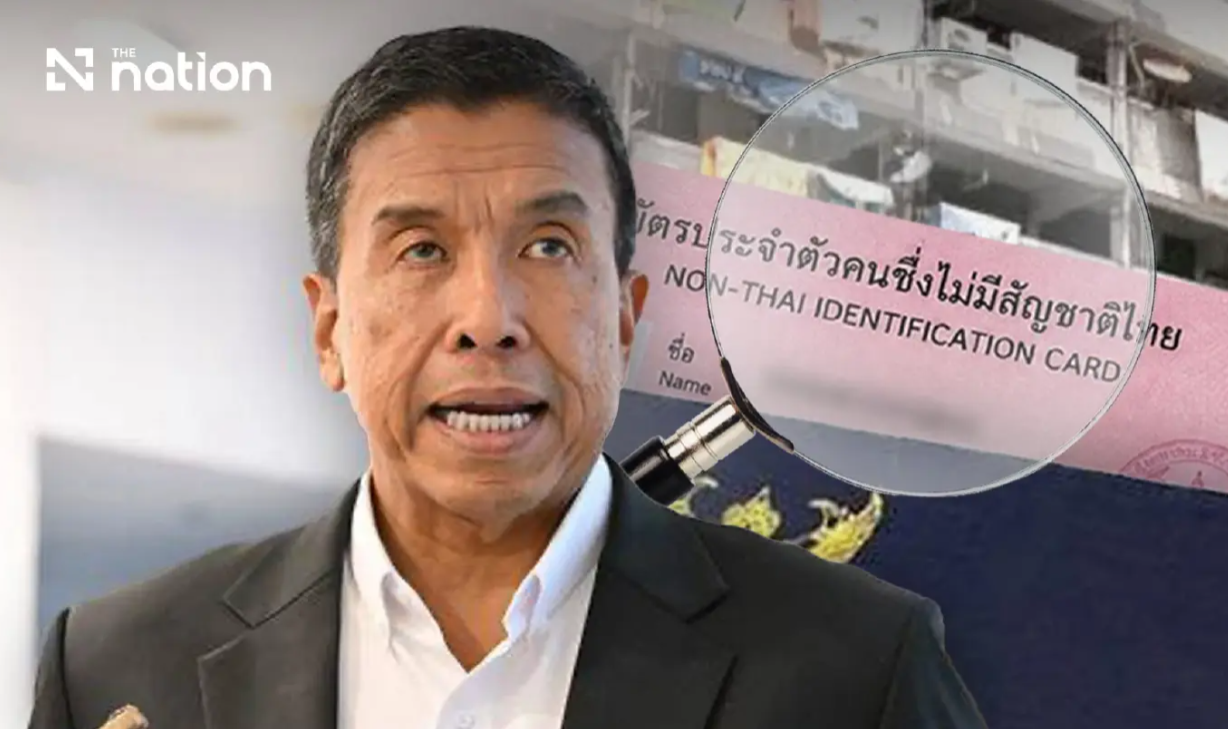
Bangkok Governor Chadchart Sittipunt has initiated a comprehensive decade-long examination of household-registration documents across all 50 district offices in the Thai capital, responding to evidence of systematic irregularities in the issuance of identification cards for non-Thai nationals commonly referred to as pink cards. The audit, which will scrutinise records stretching back to 2017, represents one of the most extensive reviews of Bangkok's civil-registration system in recent years and highlights vulnerabilities that authorities say have been exploited by criminal networks and corrupt officials working in tandem.
At the heart of the investigation lies evidence that individuals without Thai nationality were improperly registered into household documentation, which then served as the foundation for fraudulent pink-card applications. The schemes appear to have thrived by exploiting systemic weaknesses in how the Bangkok Metropolitan Administration handles identity verification and registration transfers. District officials have been directed to submit preliminary findings by August 21, establishing a tight timeline for initial compliance with the governor's directive.
The fraudulent methods identified by investigators reveal the ingenuity of those seeking to circumvent Thailand's identity system. One prominent technique involved birth certificates issued to children born in Thailand to foreign parents who subsequently returned to their home countries. These certificates remained in the Thai system and were allegedly repurposed to transfer unrelated individuals into household registrations under false identities. In other instances, names were transferred from centralised household registers into ordinary registrations or fabricated using fictitious parent-child relationships, operatives referred to as "phantom child" and "phantom father" arrangements by authorities investigating the scheme.
The irregularities first became unmistakably evident in Din Daeng district, where investigators discovered extraordinary concentrations of people listed at individual addresses. One property covering approximately 40 square metres contained between 40 and 45 registered residents, an impossibility that triggered closer scrutiny. Subsequent review of Din Daeng registrations identified more than 2,000 apparently suspicious address transfers during 2024 alone, suggesting the problem extends far beyond a single location or isolated incidents of administrative negligence.
The scope of the fraud remains uncertain but potentially substantial. Governor Chadchart cautioned that preliminary estimates suggest around 3,000 questionable registrations may be involved, though this figure has not yet been confirmed through detailed investigation. These cases appear distributed across multiple properties rather than concentrated at single addresses, complicating efforts to identify patterns and assess the true scale of the irregularities. To manage the initial screening process, the BMA will focus on properties listing at least 15 registered residents, with thresholds potentially lowered later to permit wider random sampling of individual households.
Four Bangkok Metropolitan Administration employees have been temporarily suspended pending disciplinary proceedings related to their involvement in the registration irregularities. A fourth employee from Din Daeng district was removed from service as the investigation expanded in scope. These administrative actions, while significant, represent preliminary measures rather than final determinations of culpability. Separate criminal proceedings are advancing through police channels, and authorities emphasise that suspension does not constitute proof of wrongdoing for every individual whose records come under review.
Governor Chadchart has indicated that the investigation will pursue evidence wherever it leads, potentially extending to senior-ranking officials and retired personnel who may have participated in or overseen the fraudulent schemes. The outcome will depend on the investigation's findings and application of relevant statutes. Crucially, the BMA has recognised that tracing financial links between suspected brokers and government employees requires police assistance, as the municipal administration lacks independent authority to compel non-government actors to provide information or submit to financial scrutiny. This cooperation will be essential to establishing whether money flowed between corrupt officials and the networks profiting from identity fraud.
The Bangkok authorities have simultaneously launched structural reforms designed to prevent recurrence of the vulnerabilities that permitted such extensive fraud. The BMA plans to disperse approval authority for registration applications across multiple officials, requiring district directors and section heads to share responsibility rather than concentrating power in individual officers. Administrative personnel working in sensitive registration positions will be subject to periodic rotation, reducing opportunities for entrenched relationships and corruption to develop over time. These procedural safeguards address longstanding concerns about concentrated authority in low-level positions within Thai government offices.
Beyond immediate administrative changes, the BMA intends to expand existing anti-corruption policies and emphasise civil-registration procedures. Working protocols will be reviewed to enhance transparency and reduce procedural loopholes that enabled registration irregularities. The BMA has committed to ensuring that tighter oversight does not unfairly penalise legitimate applicants seeking proper identification documentation. An investigative committee will be established to examine the registration records comprehensively and assess the conduct of individuals involved in the suspected schemes.
For Southeast Asian observers, the Bangkok pink-card fraud case underscores persistent challenges within civil-registration systems across the region. Identity documentation serves as the foundation for accessing government services, employment, and financial systems, making vulnerability to fraud consequential for entire economies. Thailand's experience demonstrates how concentrated administrative authority, insufficient inter-departmental oversight, and inadequate technological safeguards can create opportunities for systematic abuse. Similar vulnerabilities likely exist in other jurisdictions throughout Southeast Asia, warranting increased investment in digital registration infrastructure and stronger procedural protections.
The investigation's findings may carry particular relevance for Malaysia and other regional governments concerned with undocumented migration and irregular residence. The willingness of Bangkok authorities to conduct an extensive historical audit reflects growing recognition that identity fraud poses serious governance risks. Malaysian policymakers might consider whether comparable vulnerabilities exist within Malaysia's own civil-registration and identity systems, particularly in districts with high concentrations of migrant workers or undocumented residents. The Bangkok case illustrates how seemingly isolated administrative irregularities can, upon closer examination, reveal systematic patterns requiring substantial institutional response and sustained investigation.

