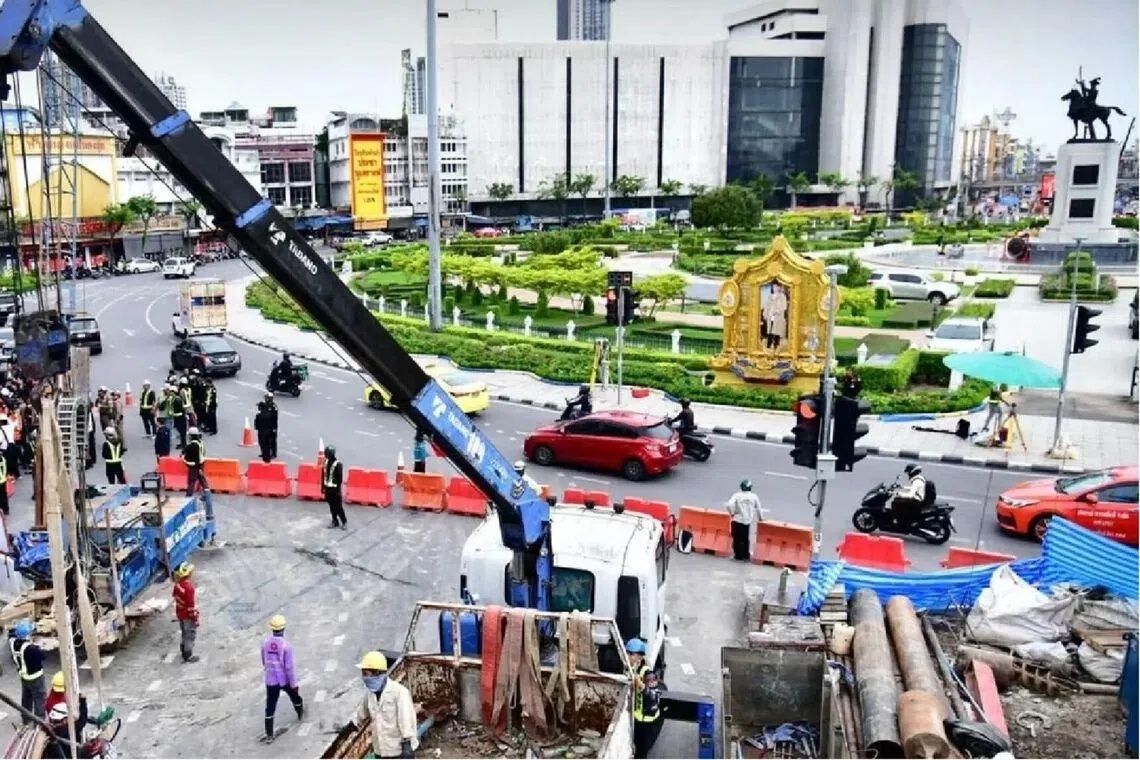
A critical infrastructure failure at a mass transit construction site in Bangkok has forced the temporary displacement of dozens of residents and triggered the most comprehensive emergency response the Thai capital has mounted since a similar subway-related collapse near Vajira Hospital. The evacuation of roughly 60 people from three commercial buildings within 30 metres of the subsidence site near Wongwian Yai represents an escalating concern about the structural integrity risks associated with the Purple Line's expansion into densely populated urban areas.
The underlying cause appears straightforward but serious: water seeping into a drainage sump at the lowest point of the southern Purple Line construction tunnel has created a progressive failure mechanism. As groundwater entered the sealed underground chamber, it overwhelmed the sump's capacity and began forcing soil particles from the surrounding earth into the tunnel itself. This soil migration—a phenomenon engineers term suffusion—gradually reduced the bearing capacity of the ground above, eventually creating a visible depression and cracks in Prajadhipok Road's surface. The subsidence, while not catastrophic by infrastructure standards, has raised alarms about potential further collapse and structural damage to the commercial buildings anchored above the affected zone.
Responding with visible urgency, Bangkok governor Chadchart Sittipunt arrived at the site on July 9 alongside deputy governor Wisanu Subsompon and deputy permanent secretary Kanokwan Iamlim to oversee initial assessments. Their presence underscores the political sensitivity of construction-related incidents in Bangkok, where subway expansion has become both a symbol of modernisation and a source of recurring public safety incidents. The governor's inspection, widely reported in local media, served to reassure citizens that senior leadership was engaged while simultaneously acknowledging the seriousness of the situation.
The evacuation protocol implemented reflects standard Thai emergency procedures adapted to this specific risk profile. Residents were transferred to temporary accommodation—primarily hotels—at the expense of the Mass Rapid Transit Authority of Thailand's contractor, alongside compensation arrangements and other support costs. Authorities have advised that displaced persons should prepare for roughly one week away from their buildings, though this timeline remains fluid pending structural assessments. This cost-bearing arrangement by the contractor, rather than shifting financial responsibility to the Bangkok Metropolitan Administration, suggests contractor culpability may already be partially accepted in preliminary investigations.
To prevent cascading failures in surrounding structures, engineers have deployed two Rescue Guardian monitoring units—advanced real-time sensing equipment designed to detect tilting and movement in adjacent buildings. Positioned within 30 metres of the visible road cracks, these sensors continuously measure structural deflection and transmit data to centralised monitoring systems that trigger immediate alerts if abnormal movements occur. This technological approach represents a significant escalation in Bangkok's crisis management capability, moving beyond traditional visual inspections toward continuous instrumental surveillance that can theoretically predict failure before it becomes catastrophic.
The Thai government's national Urban Search and Rescue team has augmented local response efforts, lending engineering expertise to evaluate structural stability and ensure that remediation work meets both engineering standards and public safety protocols. This multi-agency coordination—involving the BMA, the MRTA, the contractor, district authorities, police, and emergency medical teams—has been formalised through a forward command centre established near the subsidence point. The comprehensive mobilisation reflects the lessons learned from the earlier Vajira Hospital collapse, which exposed deficiencies in inter-agency communication and resource coordination.
Immediate remedial priorities focus on sealing the water leak and preventing additional soil from being hydraulically drawn into the tunnel. Continuous monitoring instruments track road surface elevation, soil movement patterns, water infiltration rates, and building condition indicators simultaneously. This multi-parameter surveillance approach acknowledges that subsidence-related failures rarely follow a single mechanism; rather, they typically involve complex interactions between hydrological, geotechnical, and structural factors that must be monitored in parallel.
The practical impact on Bangkok's transportation network has been severe. A 200-metre section of Prajadhipok Road between Ban Khaek intersection and Wongwian Yai—a major arterial route connecting key districts—has been completely sealed to outbound traffic as a precaution against further vibration-induced destabilisation. Two inbound lanes have been converted to temporary outbound use, creating a bottleneck that diverts motorists arriving from Memorial Bridge and Phra Pok Klao Bridge toward alternative routes including Itsaraphap, Lat Ya, and Somdet Chao Phraya roads. For commuters familiar with Bangkok's congestion patterns, this represents a significant routing challenge during peak hours.
The longer-term traffic implications extend beyond immediate closure periods. The affected corridor sits near major educational institutions including Suankularb Wittayalai School and Suksanari School, creating a compounding challenge during school hours when parent-driven shuttle services amplify vehicular volume. Governor Chadchart has indicated that Bangkok may implement measures previously deployed following the Vajira Hospital incident, potentially including supplementary school shuttle services to reduce private vehicle entries into the congested area. Such interventions, while increasing municipal costs, represent pragmatic responses to the reality that infrastructure failures inevitably cascade into broader economic disruptions.
The coincidence that this subsidence occurred on the same Purple Line alignment as the earlier Vajira Hospital collapse—though under different contractor management—has intensified public scrutiny of the entire line's construction quality and risk management protocols. This second major incident within the same project corridor raises questions about whether common design standards or geological conditions may predispose the route to similar failures. The fact that different contractors are responsible for different sections complicates attribution of systemic versus isolated problems.
Authorities have explicitly tied any easing of restrictions to formal engineering confirmation that buildings, roads, and surrounding infrastructure meet safety standards. This cautious approach reflects the irreversible consequences of premature reopening; a second collapse following official clearance would represent not merely an engineering failure but a profound breach of public trust. The government's reputational stake in getting the recovery process right—both technically and communicationally—exceeds the immediate financial costs of extended closure.
As monitoring continues around the clock and remediation specialists work to seal the subsidence source, Bangkok residents and commuters face the uncomfortable reality that urban infrastructure expansion inevitably carries residual risks that engineering expertise, while powerful, cannot entirely eliminate. The evacuation and closure represent not failures of response capability but rather the fundamental unpredictability inherent in large-scale underground construction through dense urban terrain. How quickly this particular crisis resolves will significantly influence public confidence in the broader Purple Line expansion project and in Bangkok's capacity to manage the infrastructure demands of a mega-city.

