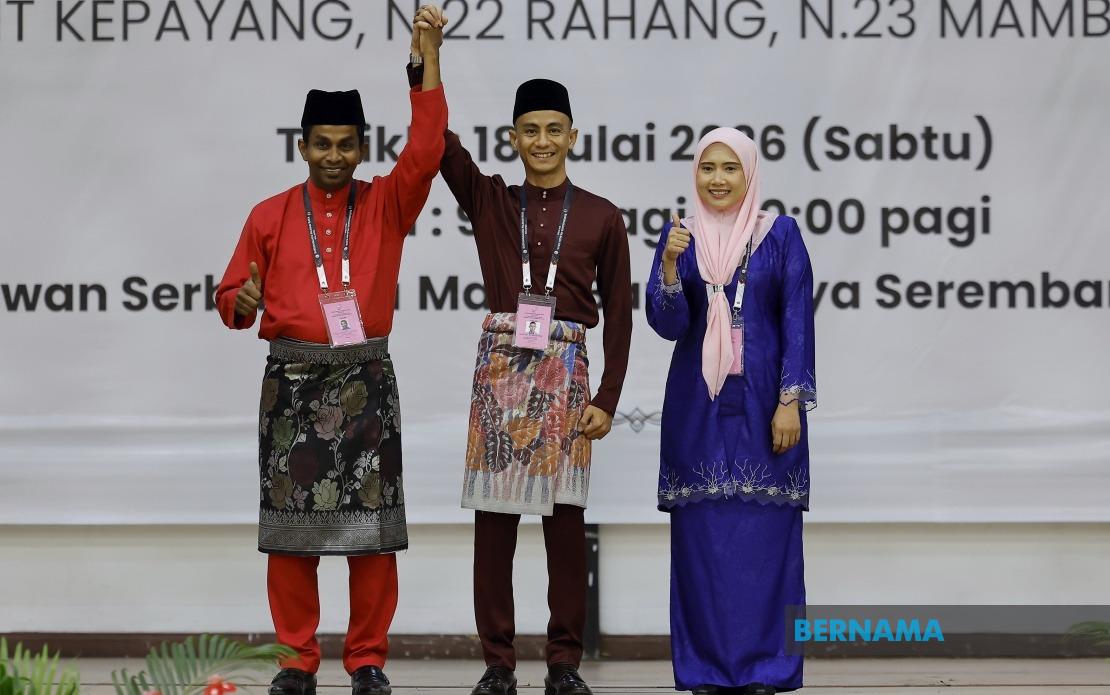
Datuk Ahmad Faez Abdul Razak stepped forward as Pakatan Harapan's standard-bearer in the Labu state seat for the 16th Negeri Sembilan election, framing his candidacy as both a personal milestone and a chance for the coalition to recapture ground lost in 2023. The PKR nominee acknowledged the weight of contesting for the first time, describing his emotional state as mixed between enthusiasm and apprehension, yet expressing measured confidence in his prospects after nearly three years of ground engagement within the constituency. His nomination came as the 16th state election campaign intensified across Negeri Sembilan, with voting scheduled for August 1 following early polling on July 28.
Ahmad Faez's entry into electoral politics represents a strategic choice by PH to field a candidate with commercial expertise in a rapidly transforming constituency. As a property developer by profession, he positioned his business background as a crucial asset for navigating the complex development challenges facing Labu. The constituency, home to approximately 32,884 registered voters according to the Election Commission's May 2026 roll, has emerged as one of the state's fastest-growing areas, attracting sustained residential and industrial investment. This growth trajectory creates both opportunity and tension within local communities, where expansion and preservation of existing lifestyles often collide.
The candidate's manifesto reflects awareness of Labu's demographic composition and emerging needs. He has identified the absence of dedicated youth facilities as a critical gap, proposing to establish both a community centre and recreational hub specifically designed for younger residents. Such infrastructure proposals resonate with constituencies undergoing rapid urbanisation, where traditional social structures may struggle to keep pace with population influx. Ahmad Faez's emphasis on youth amenities suggests PH's broader strategy to appeal to younger voters and families relocating to growth areas, segments that have proven volatile in recent Malaysian elections.
Central to Ahmad Faez's pitch is his claim to reconcile development imperatives with community protection, a balancing act that will define Labu's trajectory over coming years. The constituency sits within the Malaysia Vision Valley development corridor, a massive project spanning between 11,000 and 12,000 hectares designated for industrial and residential purposes. This corridor, straddling Negeri Sembilan and adjacent areas, represents one of Malaysia's significant economic expansion initiatives, intended to generate employment and attract manufacturing and logistics operations. However, such large-scale transformation inevitably disrupts established settlement patterns, agricultural land use, and social arrangements, creating friction between boosters emphasising economic benefits and residents concerned about livelihood displacement and environmental quality.
Ahmad Faez's positioning as someone capable of managing this tension derives credibility from his professional familiarity with development processes and real estate markets. He articulated the challenge explicitly: development in Labu must proceed, but its pace and character require careful calibration to preserve community well-being and protect existing residents' interests. This framing acknowledges that opposition to development itself would be politically untenable in a growth-oriented state, while simple endorsement would alienate those fearing unwanted change. His approach attempts to occupy pragmatic middle ground, suggesting that experienced hands can steer development toward broader benefit distribution rather than concentrated gain for investors and outsider migrants.
The incumbent MP, Mohamad Hanifah Abu Baker of Bersatu, won the seat in 2023 with a 1,640-vote majority over PH-PKR's Datuk Ismail Ahmad, who garnered 10,021 votes. That result demonstrated capacity for coalition politics and sufficient local support to make the seat contestable, though Bersatu's control proved resilient. The current three-cornered contest introduces Barisan Nasional's Siti Nur Umaira Hasim into the equation, complicating vote distribution calculations. In Malaysian state elections, three-way contests often produce unpredictable outcomes, where consolidation of support becomes paramount and marginal shifts in tactical voting patterns can produce disproportionate results.
Ahmad Faez's narrative of steady ground engagement over nearly three years suggests PH's longer-term strategic investment in the constituency beyond single-election cycles. Building name recognition and trust within a constituency typically requires sustained presence, community work, and visible responsiveness to local concerns. His extended engagement period, communicated during his nomination interview, implied that PH recognises Labu as winnable but only through disciplined, methodical constituency work rather than parachuted campaigns. This approach contrasts with candidates arriving as election cycles commence, and may signal organisational commitment that could prove valuable in mobilising supporters during the campaign proper.
The government's alignment of Negeri Sembilan state policies with federal government initiatives also featured prominently in Ahmad Faez's comments, reflecting broader PH messaging that state and federal coordination produces superior outcomes for constituents. This messaging attempts to amplify the benefits of single-coalition control across multiple governmental tiers, arguing that divided government creates coordination failures and bureaucratic friction. In Malaysian federalism, such integration claims carry genuine weight, as state governments do depend on federal funding, regulatory cooperation, and alignment on major projects. Ahmad Faez's invocation of this alignment suggests PH strategists believe voters increasingly recognise this interdependence and reward unified governance.
The Labu contest will ultimately test whether Ahmad Faez's combination of professional credentials, community investment, development expertise, and coalition backing can overcome Bersatu's incumbent advantages and BN's traditional organisational machinery. His candidacy reflects broader PH efforts to field candidates whose professional accomplishments and sectoral expertise provide independent credibility beyond partisan affiliation, potentially appealing to swing voters and younger professionals prioritising competence and demonstrable track records. The August 1 polling date will clarify whether Labu voters reward PH's investment in the constituency and Ahmad Faez's promise of development management, or whether Bersatu successfully defends the seat in the three-cornered contest.

