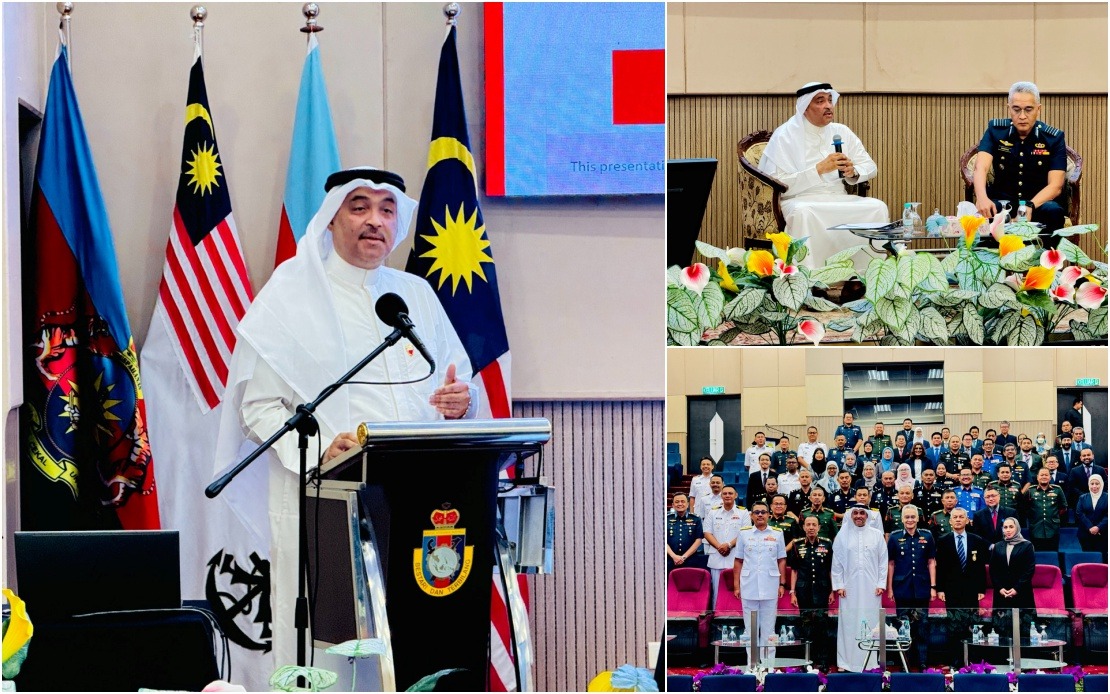
The relationship between Bahrain and Malaysia is entering a new phase of substantive engagement, with both Gulf state and Southeast Asian nation committed to broadening collaboration across multiple sectors. Speaking at Malaysia's National Resilience College in Putrajaya, Bahrain's Ambassador to Malaysia Dr Waleed Khalifa Al Manea underscored the strategic depth of the partnership, emphasizing how joint efforts are translating into concrete outcomes that benefit both populations.
The foundation for this expanding cooperation rests squarely on the personal rapport between the two monarchs. His Majesty King Hamad bin Isa Al Khalifa, King of Bahrain, and His Majesty Sultan Ibrahim, King of Malaysia, have fostered an environment conducive to bilateral advancement. Equally significant are the parallel efforts of their respective prime ministers—His Royal Highness Prince Salman bin Hamad Al Khalifa of Bahrain and Datuk Seri Anwar Ibrahim of Malaysia—who are actively channelling diplomatic momentum into institutional cooperation. This leadership alignment creates the political will necessary for substantive progress beyond ceremonial exchanges.
One striking manifestation of this deepening partnership involves motorsport and global visibility. Malaysia's hosting of the 2026 Formula 1 Gulf Air Bahrain Grand Prix represents far more than a sporting event; it signals Bahrain's confidence in the Malaysian relationship and provides both nations with a prestigious platform to showcase themselves to a worldwide audience. Such high-profile collaborations serve as visible anchors for bilateral sentiment and create soft-power opportunities that traditional diplomacy alone cannot achieve.
During his address to an audience comprising senior military figures, defence officials, and parliamentary representatives, Al Manea articulated Bahrain's comprehensive approach to regional security architecture. The kingdom's framework integrates several pillars: robust defence of sovereign territory, safeguarding civilian populations, factual documentation of cross-border incidents, and sustained diplomatic engagement coupled with multilateral coordination mechanisms. This holistic perspective acknowledges that security threats in the contemporary Middle East cannot be addressed through military means alone but require institutional coordination and transparent communication.
The Iranian dimension looms large in Bahrain's regional calculus, and Al Manea did not shy from addressing it directly. Repeated Iranian attacks targeting Gulf Cooperation Council member states—encompassing civilian areas, critical energy and water infrastructure, and commercial shipping lanes—have created cascading effects that extend beyond the immediate region. Maritime disruption in the Persian Gulf and surrounding waters carries profound implications for global trade and energy security, affecting distant economies including Malaysia's, which relies on stable shipping corridors for its commercial lifeline.
Bahrain's activism within the United Nations Security Council during its April presidency demonstrates proactive diplomacy in response to regional turbulence. The kingdom leveraged its temporary seat to galvanize international attention on safeguarding maritime navigation, protecting essential infrastructure, and establishing norms against civilian targeting. This approach reflects Bahrain's conviction that rules-based international systems, however imperfect, remain essential for constraining state behaviour and protecting vulnerable populations.
Malaysia's co-sponsorship of UN Security Council Resolution 2817 holds particular significance within the bilateral context. By endorsing a measure that reaffirmed state sovereignty, emphasized civilian protection, and called for cessation of attacks, Malaysia aligned itself with the Gulf state's security concerns and demonstrated that Southeast Asian perspectives on Middle Eastern stability warrant serious consideration. This partnership at the Security Council level indicates Malaysia's willingness to engage substantively on security matters beyond its immediate region, reflecting a mature foreign policy that recognizes global interdependence.
For Malaysian policymakers and security professionals, Bahrain's experience offers instructive lessons. The kingdom's emphasis on protecting freedom of navigation resonates with Malaysia's own interests as a maritime nation dependent on unrestricted access to international waterways. Furthermore, Bahrain's articulation of how regional conflicts generate ripple effects across continents validates the ASEAN perspective that stability in distant regions has direct bearing on Southeast Asian prosperity and security.
The venue for Al Manea's remarks—the National Resilience College as part of Malaysia's National Defence Studies Centre—underscores the seriousness with which both nations approach this dialogue. Attendance by Major General Dr Abdul Karim Ahmad as Commandant, along with senior officers from the Malaysian Armed Forces, Royal Malaysia Police, and Maritime Enforcement Agency, signalled institutional buy-in at the highest defence and security levels. Parliamentary representation among the audience further indicated governmental commitment to integrating this partnership into Malaysia's broader strategic planning.
The convergence of Bahrain's security concerns and Malaysia's regional interests creates natural opportunities for enhanced intelligence sharing, joint training exercises, and coordinated responses to maritime challenges. As Asian economies become increasingly integrated into Middle Eastern energy and trade networks, the security landscape of the Gulf directly influences Asian stability. Bahrain's role as a sophisticated interpreter of regional dynamics, combined with Malaysia's growing voice within ASEAN and the broader Asian context, positions the bilateral relationship as a potential model for bridging Middle Eastern and Southeast Asian security communities.
Looking forward, the partnership appears structured for longevity beyond the current leadership cycle. By establishing cooperative mechanisms across defence establishments, parliamentary channels, and intellectual exchanges through institutions like the National Resilience College, both nations are building institutional muscle memory that transcends individual personalities. This approach suggests recognition that genuine strategic partnerships require deep organizational linkages rather than episodic diplomatic gestures.

