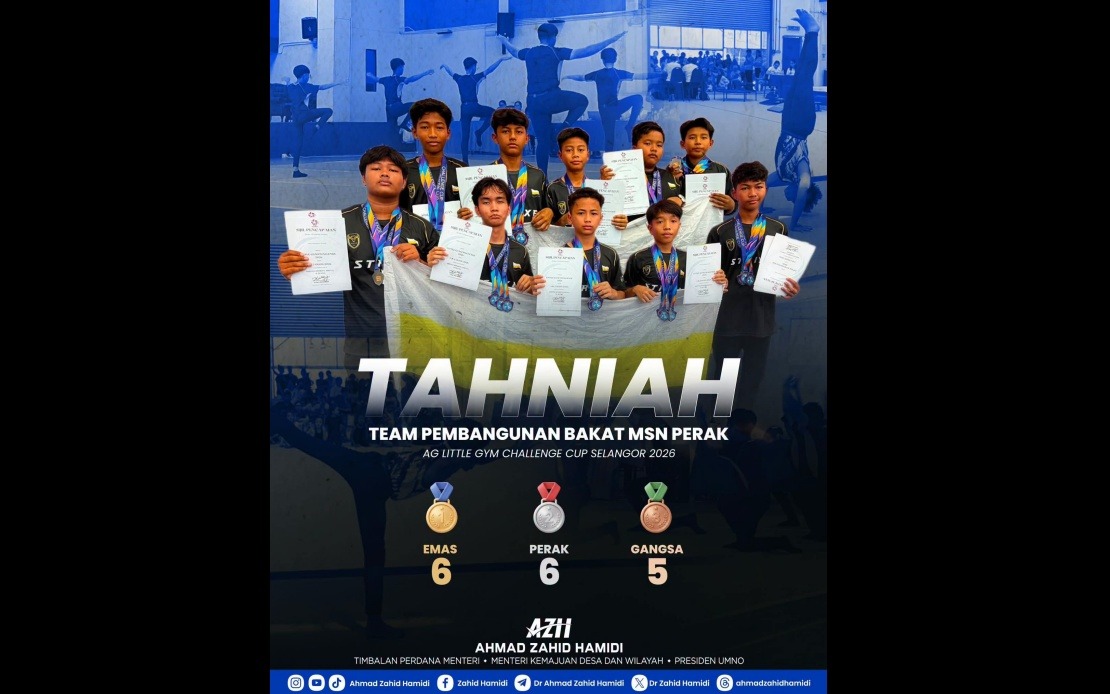
Young gymnasts representing Bagan Datuk have etched their names into the district's sporting history by delivering an outstanding performance at the AG Little Gym Challenge Cup Selangor 2026, which concluded on August 1 in Kajang. The squad accumulated an impressive medal haul comprising six gold medals, six silver medals, and five bronze medals—a result that underscores the emerging talent pool in the constituency and signals a positive trajectory for grassroots sports development in the region.
The accomplishment resonated beyond the gymnasium when Deputy Prime Minister Datuk Seri Dr Ahmad Zahid Hamidi, who represents Bagan Datuk as Member of Parliament, took to social media to celebrate the athletes' success. His public endorsement carries significance not merely as a gesture of civic pride, but as an indication of how competitive sports achievements are increasingly integrated into the broader narrative of community development and national identity at the parliamentary constituency level.
In his message, Ahmad Zahid underscored a crucial dimension of youth development that extends beyond medal counts. He articulated that the gymnasts' performance demonstrates the multifaceted capabilities of young people from his constituency—suggesting that academic excellence and sporting prowess are complementary rather than competing pursuits. This framing reflects a growing recognition among Malaysian political and social leaders that a rounded approach to youth development, encompassing both intellectual and physical development, produces more resilient and accomplished individuals.
The deputy premier's emphasis on the role of "proper opportunities, guidance, and support" carries particular relevance for discussions around sports infrastructure and mentorship in secondary towns and suburban constituencies. Bagan Datuk, while not among Malaysia's largest urban centres, has produced athletes capable of competing at regional championships, suggesting that investment in coaching structures and training facilities at the local level can yield significant returns. This model may offer valuable lessons for other constituencies seeking to develop grassroots sporting talent.
The Bagan Datuk Generasi Muda Gymnastics Club, the organisation behind these athletes, framed the medals not as a destination but as validation of a longer journey. Their statement emphasised the virtues of discipline, perseverance, and continuous self-improvement—values that extend well beyond the confines of competitive sport. The club's declaration that this represents "another milestone" rather than a finish line suggests a maturing competitive philosophy focused on sustained excellence rather than one-off victories.
For Malaysian sports development, the success carries broader implications. Gymnastics, requiring significant investment in equipment, facilities, and qualified coaching personnel, has historically concentrated in better-resourced urban centres. When clubs in constituencies like Bagan Datuk produce medallists at regional competitions, it indicates either improved resource allocation to grassroots gymnastics programmes or the emergence of particularly dedicated coaching staff willing to work in less centralised locations.
The timing of this achievement—documented in August 2026—arrives at a moment when Malaysian sports authorities are increasingly focused on identifying and developing young talent through competitive pathways. Regional challenge cups serve as critical screening grounds where emerging athletes can be identified for potential inclusion in state and national development squads. The success of six gold medallists from a single club suggests that coaches and selectors will likely monitor the Bagan Datuk team closely for future talent identification initiatives.
Social media's role in amplifying these achievements cannot be overlooked. By sharing results through Facebook, both political leadership and the gymnastics club itself have created a public record that motivates not only the athletes themselves but also other young people in the constituency who might consider taking up the sport. This democratisation of information about sporting achievements, compared to previous eras when such results might only appear in specialist sports publications, has fundamentally altered how communities engage with and celebrate athletic accomplishment.
The gender composition of medal winners—though not explicitly detailed in the announcement—remains an important consideration. Gymnastics in Malaysia, like many sports, operates within specific gender participation patterns. If the Bagan Datuk club has achieved balanced representation across male and female competitors, this would underscore progress toward more inclusive sports participation, an objective that national sports policies increasingly emphasise.
For parents in Bagan Datuk and neighbouring areas, the visibility of local sporting success may influence decisions about enrolling children in gymnastics programmes. Each gold medal effectively serves as a demonstration of what is possible with commitment and proper coaching, potentially triggering a virtuous cycle where success attracts new participants and resources, which in turn produces further achievements.
The contribution of parents and supporting adults, acknowledged in both the deputy premier's remarks and the club's statement, deserves recognition as an often-overlooked foundation of youth sports success. Transportation, fees, time commitment, and encouragement from family networks constitute essential infrastructure for young athletes, particularly in constituencies where training facilities might require travel to centralised locations.
Looking forward, the momentum generated by this achievement creates opportunities for the Bagan Datuk gymnastics programme to seek enhanced funding from state-level sports councils or private sponsors drawn by the prospect of supporting a demonstrably successful club. The medals, while symbolically important, should ideally catalyse practical improvements in training infrastructure that allow the club to build on this success in subsequent competitions.
The broader significance of the Bagan Datuk gymnasts' triumph extends into questions about regional sports development in Malaysia. Success stories emerging from constituencies outside major urban centres remind policymakers that talent is distributed geographically, and that investment in grassroots facilities and coaching in secondary locations can yield results comparable to or exceeding those achieved in traditionally dominant sporting hubs. As Malaysia continues to develop its sports ecosystem, examples such as this provide both inspiration and practical evidence that decentralised excellence is attainable.

