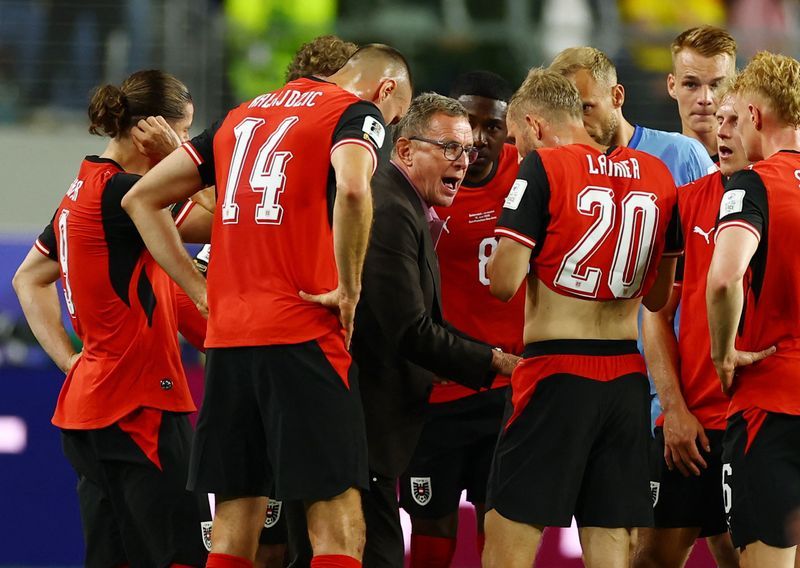
Austria's passage into the next stage of the World Cup came at the cost of a somewhat unconvincing performance, as the Austrians overcame Jordan 3-1 in their Group J fixture in Santa Clara, California on Tuesday. The margin of victory only became assured when substitute Marko Arnautovic converted a penalty deep into second-half stoppage time—the 92nd minute—though Austria had taken the lead earlier in the match. This relatively comfortable scoreline masks a reality that concerned many observers: Jordan, making their World Cup debut, repeatedly exposed weaknesses in Austria's defensive shape and refused to be intimidated by their more established opponents.
The significance of Austria's unconvincing display becomes sharper when viewed against their recent continental achievements. Their impressive Euro 2024 campaign had raised expectations considerably among supporters and analysts alike, prompting predictions of a strong World Cup run. Yet the performance against Jordan suggests those hopes may require adjustment. The Austrian team showed flashes of quality but appeared disjointed for long stretches, creating openings for a Jordanian side that could have extracted a different result on another afternoon. For Austrian supporters accustomed to the team's recent progress, Tuesday's victory felt more hollow than celebratory.
Rangnick, however, demonstrated notable magnanimity in his post-match assessment, redirecting conversation away from Austria's shortcomings and toward Jordan's achievement. When questioned about his team's laboured performance, the Austrian coach quickly pivoted to praising the opposition. He acknowledged that Jordan had prepared thoroughly and executed their tactical plan with discipline and courage, refusing to accept the familiar narrative that a World Cup debutant should simply defer to more experienced opponents. This perspective reflects a broader shift in modern football thinking—one increasingly recognized across Southeast Asia and the developing football world—that underestimating less-established nations represents both a tactical and analytical error.
Rangnick's words carry particular weight given his standing in European football circles. He emphasized that Jordan had "exceeded expectations" and displayed "very brave football" throughout the ninety minutes. The Austrian coach rejected the assumption that his team entered as obvious favourites, suggesting instead that the gap between traditionally stronger nations and emerging football countries has narrowed considerably. This assessment aligns with observable trends at the tournament, where surprise results have proliferated. He pointed specifically to Spain's inability to overcome Cape Verde, Australia's victory over Turkey, and Haiti's competitive showing against Scotland as evidence that the tournament's expanded format to 48 teams has genuinely levelled the playing field.
The World Cup's expansion to 48 competing nations represents a pivotal moment for global football development. Rather than viewing this change as a dilution of tournament quality, Rangnick characterized it as "an enriching experience," acknowledging that increased participation brings fresh perspectives and genuine competition from nations historically excluded from World Cup participation. This philosophical stance reflects an understanding that football development operates on generational timescales—countries that have invested in youth academies and professional infrastructure over the past fifteen years are now producing players capable of competing at the highest level.
Rangnick's specific assertion that smaller nations have "really caught up" over the past decade and a half carries significant implications for Asia-Pacific football development. The investments made by countries like Australia in professionalization, coaching development, and player pathways have demonstrably paid dividends. Similarly, teams from the Middle East, including Jordan, have benefited from substantial financial resources directed toward football infrastructure. For Malaysia and other ASEAN nations aspiring to greater World Cup participation, Rangnick's endorsement of long-term developmental investment provides both encouragement and a template.
The Austrian coach's refusal to attribute his team's struggles to opponent weakness distinguishes his perspective from more dismissive contemporary attitudes. Rather than explaining the unconvincing victory through familiar tropes about "not performing," Rangnick positioned Jordan as a genuine force that kept Austria under sustained pressure. This framing respects both the Jordanian achievement and Austrian supporters' intelligence. It suggests that competitive football at the World Cup level increasingly demands respect for all participants, regardless of their historical pedigree or FIFA ranking.
Austria now faces Argentina, who top Group J following a commanding 3-0 dismissal of Algeria. The challenge ahead contrasts sharply with Jordan's emerging competence. Argentina bring proven tournament experience and attacking potency, creating a far more familiar examination for an Austrian team seeking to establish themselves as genuine contenders. Rangnick's team will need to demonstrate that their Euro 2024 form remains accessible; Tuesday's performance raises legitimate questions about their consistency at this level.
The broader narrative emerging from Austria's narrow escape involves a recalibration of World Cup expectations in an age of expanded participation and global football democratization. Rangnick's magnanimous assessment of Jordan reflects an understanding that modern international football contains fewer guaranteed outcomes. Teams invest seriously in development; coaching improves worldwide; tactical sophistication spreads across continents. The gap between nations once considered disparate in quality has compressed considerably. For Malaysian football observers particularly, this message carries resonance: smaller nations, properly supported and strategically developed, can compete meaningfully at the world's premier tournament. Jordan's World Cup debut demonstrated that reality conclusively.