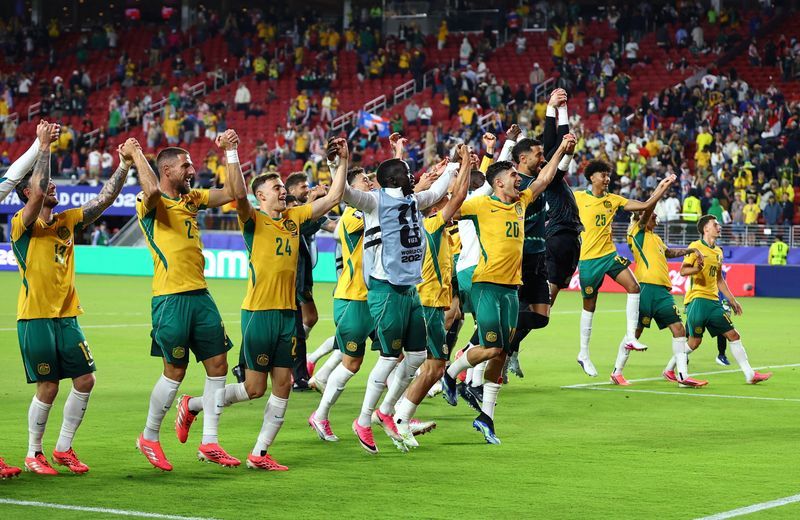
Australia have secured their passage to the World Cup's knockout round following a tightly contested 0-0 stalemate with Paraguay on Thursday evening in Santa Clara, California. The result guarantees the Socceroos a place in the round of 32 for the third time in their World Cup history, continuing their resurgence at international football four years after their previous knockout appearance in Qatar. Manager Tony Popovic's side finished as runners-up in Group D, trailing only the tournament's co-hosts the United States, and will face the runner-up from Group G in their next assignment.
The encounter at the San Francisco Bay Area Stadium embodied the cautious, somewhat disjointed nature of a fixture where both teams appeared reluctant to take excessive risks. Australia dominated lengthy passages of the opening period but struggled to convert their territorial advantage into genuine scoring opportunities, while Paraguay gradually worked themselves into the contest as the match progressed. For the South Americans, the outcome leaves their qualification prospects hanging in the balance as they occupy fourth position in the group with four points accumulated. Their advancement hinges on whether their tally proves sufficient to claim one of the eight available slots reserved for the highest-finishing third-place finishers across the tournament's groups.
Popovic implemented a bold tactical reshuffle for this crucial fixture, introducing six alterations to the starting lineup that reflected his determination to inject greater attacking verve into the Socceroos' performance. The recall of Nestory Irankunda and the inclusion of Cristian Volpato in the forward configuration signalled the coach's intention to pursue a more aggressive approach. Additionally, Jordan Bos shifted from his customary left-back berth to the right flank to accommodate the absence of injured defender Jacob Italiano, a positional adjustment that would later prove consequential in generating attacking opportunities down that channel.
Australia's early dominance translated into a series of promising ventures forward, particularly down the right side where the repositioned Bos combined effectively with attacking players. Within the opening minutes, Volpato fashioned a clear chance for Jackson Irvine at the penalty area's right corner, yet the midfielder's attempt swerved directly toward Paraguay goalkeeper Orlando Gill without troubling him sufficiently. Further opportunities materialised for both Bos and Volpato before the interval, with both efforts drawing responses from Gill, though neither represented a genuine test of the keeper's competence. Conversely, Paraguay's attacking output during the opening 45 minutes amounted to minimal threat, registering just a solitary shot on target throughout the period.
Paraguayan coach Gustavo Alfaro responded to the territorial imbalance by introducing the Brazilian-born forward Mauricio at the interval, a substitution intended to freshen the visitors' attacking impetus. The change bore immediate results as Mauricio struck from distance five minutes into the second half, yet his ambitious attempt drifted harmlessly away from the target. As the contest matured, Paraguay increasingly found their rhythm, with energetic midfielder Julio Enciso emerging as a particularly disruptive influence capable of penetrating Australia's defensive organisation repeatedly. Enciso squandered one of Paraguay's more promising opportunities eight minutes from full-time when his low drive sailed well wide of the left post, highlighting the visitors' improved penetration as the match reached its conclusion.
The final stages developed into an enthralling back-and-forth encounter that tested the resolve of both defensive units. Bos produced the most electrifying moment of the closing exchanges when, in the 89th minute, he surged forward from the right side of the pitch, splitting two opposing defenders before entering the penalty area and launching a shot that flashed past the far upright with goalkeeper Beach observing helplessly. Moments later, Mauricio threatened briefly by discovering space at the edge of Australia's box, only to dispatch a weak, low effort that the Australian goalkeeper managed comfortably. Australia ultimately held firm to secure qualification, though their advancement owed more to pragmatic defending and resilience than to any particularly compelling attacking football.
The result carries broader implications for the tournament's Group D configuration and the broader knockout stage landscape. With Australia advancing as group runners-up, they have established themselves as formidable competitors in the knockout phase, a status that reflects the considerable progress the national team has made in recent years. Paraguay's fate now rests upon developments in other groups, as the tournament moves toward its climactic group-stage matches on Friday when Egypt face Iran and Belgium meet New Zealand. The uncertainty surrounding the Paraguayan squad's qualification represents a significant contrast to Australia's confirmed passage, underscoring the competitive balance that characterises modern international football competitions.
For Malaysian football enthusiasts and observers across Southeast Asia, Australia's progression represents a significant milestone for the Asia-Pacific region, reinforcing the Socceroos' established reputation as the strongest footballing nation in the Oceania confederation. Their consistent qualification and advancement through World Cup tournaments demonstrates the depth of investment in player development and tactical sophistication that has elevated the national program. The contrast between Australia's assured progression and the precarious position occupied by Paraguay—a team with previous World Cup quarter-final pedigree—illustrates how tournament dynamics can shift dramatically based on group composition and fixture outcomes. As the knockout stage approaches, the Socceroos will face the formidable task of challenging elite opposition, yet their qualification itself represents an achievement of considerable merit in an increasingly competitive global footballing environment.

