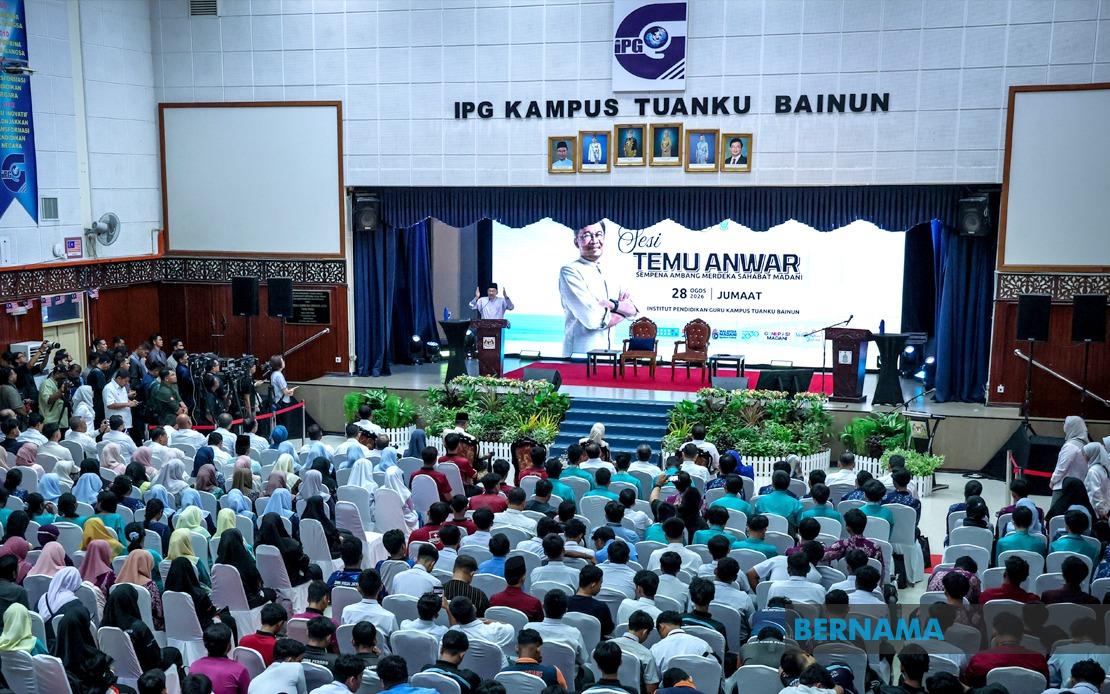
Prime Minister Datuk Seri Anwar Ibrahim has positioned the abolition of the Universities and University Colleges Act 1971 (AUKU) as a transformative step to unlock student potential and reshape Malaysia's intellectual culture. Speaking during a community engagement session in Bukit Mertajam, Anwar framed the controversial repeal not merely as a legal formality, but as a philosophical shift that recognises the capacity and rights of young Malaysians to participate meaningfully in national discourse.
The PM's argument rests on a fundamental inconsistency he identified in Malaysian governance. At eighteen years of age, students gain the constitutional right to vote in general elections, yet the AUKU historically prohibited them from engaging in political expression, organising advocacy, or publicly criticising government policies. Anwar questioned this paradox directly, asking why the state would grant voting rights while simultaneously gagging students' voices. This rhetorical positioning challenges the paternalistic assumptions embedded in half a century of university regulation, suggesting that democratic maturity cannot be compartmentalised.
Anwar's emphasis on fostering creativity and critical thinking reflects broader regional concerns about Malaysia's intellectual competitiveness. Southeast Asian economies increasingly depend on innovation and knowledge creation rather than manufacturing and resource extraction. When universities become spaces where students self-censor rather than rigorously interrogate ideas, the nation loses competitive advantage. The PM's framing thus appeals not only to liberal democratic values but also to pragmatic economic arguments about human capital development that resonate with policymakers across the region.
The statement also acknowledges that student expression need not be infallible to be valuable. By explicitly noting that young people's opinions "may not always be right," Anwar preempts criticism that repealing AUKU unleashes reckless radicalism. Instead, he articulates a model of intellectual development through debate and discourse where incorrect views encounter counter-arguments rather than state suppression. This reflects international educational philosophy emphasising that critical thinking develops through engagement with diverse and challenging perspectives, not through enforced conformity.
Education Minister Datuk Seri Fadhlina Sidek's presence at the event signals governmental alignment on this policy direction, suggesting coordination between the Prime Minister's Office and the Education Ministry on implementation. Their joint appearance provides institutional legitimacy to the repeal and suggests that detailed operational frameworks for student conduct will flow through the education bureaucracy. This matters practically for Malaysian universities, as they now navigate the transition from AUKU's restrictive clarity to a framework emphasising responsibility without legal prohibitions.
The timing of this announcement during a Temu Anwar session reflects the government's broader engagement strategy with youth constituencies. By directly addressing a student interested in entering politics, Anwar demonstrates openness to youth political participation and positions his administration as different from predecessors who treated student activism with suspicion. This messaging carries weight in Malaysian politics, where generational divides have widened and younger voters express dissatisfaction with institutional constraints on their agency.
For Malaysian universities specifically, the AUKU repeal creates both opportunities and management challenges. Institutional autonomy increases, allowing universities to develop their own student conduct frameworks rather than operating under blanket national restrictions. However, this decentralisation means consistency across the higher education sector cannot be assumed. Some universities may adopt permissive approaches encouraging maximum student expression, whilst others may maintain restrictions through internal regulations. The quality of this transition depends significantly on university leadership's understanding of academic freedom principles.
Regionally, Malaysia's move carries implications for other Southeast Asian nations grappling with balancing stability and student freedom. Thailand, Indonesia, and the Philippines have all experienced tensions between authorities seeking to maintain order and students demanding participation in governance debates. Malaysia's experiment with AUKU repeal may provide a tested model that other governments observe, potentially influencing their own policies. Conversely, if campus unrest intensifies following the repeal, neighbouring governments may cite this as justification for maintaining restrictions on student activism.
The AUKU repeal also addresses international perceptions of Malaysian higher education. Global university rankings increasingly incorporate academic freedom metrics, and international students consider campus culture when choosing institutions. By removing one of Asia's most restrictive university legislation frameworks, Malaysia enhances its appeal to international students and improves its standing among global academic communities. This dimension connects educational policy directly to Malaysia's aspirations within the knowledge economy and its ability to attract talent.
Implementation will reveal whether the AUKU repeal achieves Anwar's stated objectives. Universities must develop alternative mechanisms for addressing genuine disciplinary issues whilst avoiding recreating restrictions through different legal instruments. Student organisations will need to exercise their newfound freedoms responsibly, recognising that public perception of campus activism influences political support for maintaining liberal policies. The next phase involves translating the philosophical commitment to student voice into practical institutional practices that genuinely advance critical thinking rather than simply removing prohibitions.

