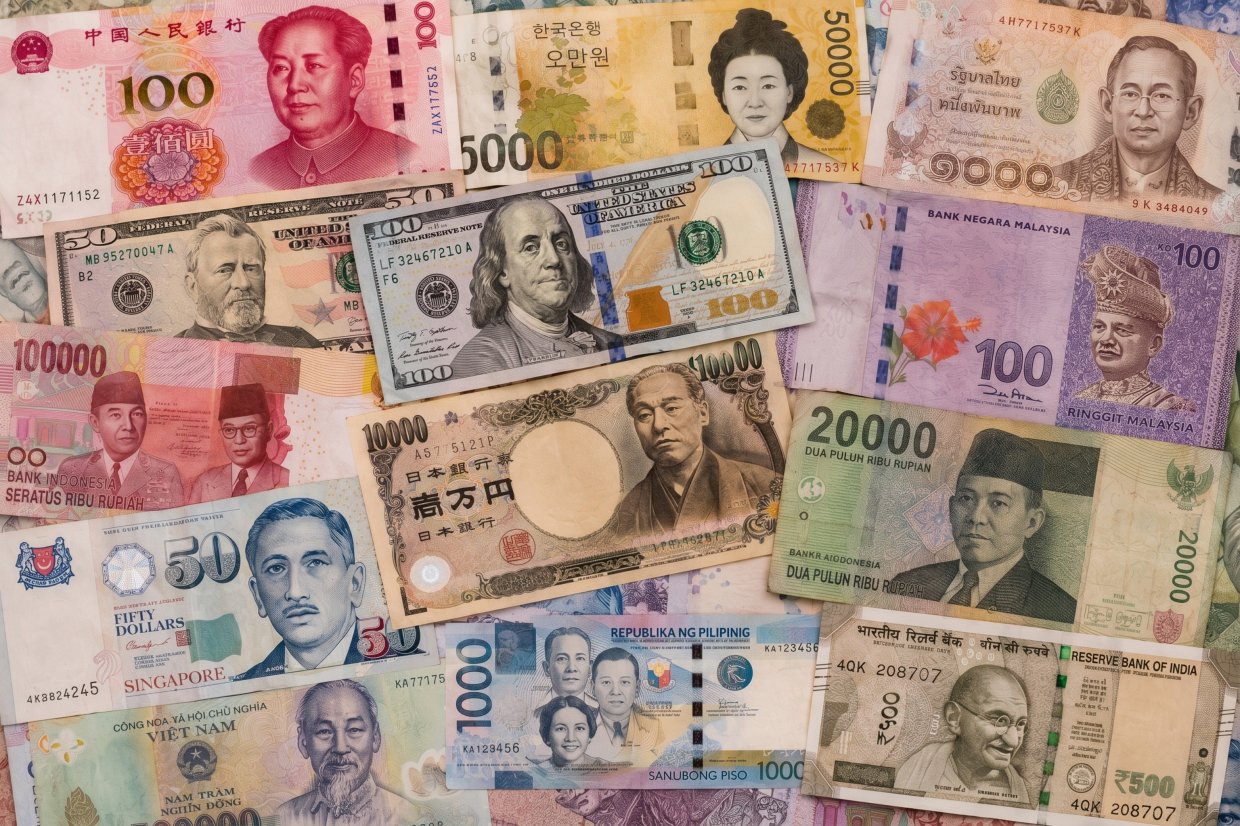
Regional financial markets convulsed on Monday as escalating tensions in the Middle East rekindled fears of sustained inflation and prompted a broad retreat from riskier assets across emerging Asia. The renewed geopolitical friction sent crude oil prices climbing 4%, a development that rippled through currency markets and equity indices throughout the region, exposing fault lines in what had otherwise been a resilient year for Asian investors. The U.S. dollar strengthened its position against a basket of major currencies as traders favoured safety, while central bank expectations of potential rate hikes further unsettled emerging market assets already struggling with inflation pressures.
Currency weakness was particularly pronounced in the region's developing economies, which bear greater vulnerability to external shocks. Indonesia's rupiah deteriorated to 18,140 per dollar, marking its poorest performance in over a month and reflecting broader concern about commodity-dependent economies facing higher energy costs. The South Korean won similarly slipped to 1,507.9 against the greenback, caught between the Middle East crisis and domestic equity market turbulence. These movements signal that investors are reassessing their exposure to currencies perceived as risky, a classic response when geopolitical uncertainty combines with inflation worries.
South Korea's equity market suffered the region's most dramatic selloff, with the benchmark KOSPI index plunging 7.96% to its lowest level in ten weeks, forcing trading halts as circuit breakers kicked in to prevent panic selling. The decline was dominated by semiconductor stocks, particularly SK Hynix, which crashed 13% as investors rushed to lock in gains following the chipmaker's impressive debut on the U.S. market the previous Friday. This reversal underscores the treacherous nature of momentum-driven markets, where rapid gains often precede equally sharp corrections as retail and institutional investors exit simultaneously.
The semiconductor sector's vulnerability extends beyond simple profit-taking. Market participants have grown increasingly sceptical about the sustainability of extraordinary earnings growth predicated on surging demand for artificial intelligence-related memory chips. Questions have emerged regarding whether the major cloud and technology companies driving AI adoption—often termed hyperscalers—can maintain the capital spending levels that have powered chipmaker revenues skyward. Additionally, some of these firms have become more disciplined in their procurement patterns, suggesting that the explosive growth phase may be moderating. This fundamental uncertainty, combined with the technical pressure from highly leveraged exchange-traded funds concentrated in single stocks, has created dangerous volatility in the sector.
Despite the sharp decline, the KOSPI has nevertheless preserved remarkable year-to-date gains of 63%, even though it has surrendered approximately 25% since touching record highs on June 22. This paradox illustrates how swiftly market sentiment can shift, particularly in technology-dominated exchanges where valuation multiples expand and contract based on narrative changes. The index's performance remains among the world's strongest, yet the recent selloff signals that Korean investors are reconsidering whether recent gains adequately price in economic risks and sectoral headwinds.
Malaysia presented a contrasting picture in which political developments competed with external macroeconomic factors for investor attention. The ringgit weakened to 4.0780 per dollar in tandem with broader regional currency depreciation, yet the equity market managed to rally toward three-week highs, suggesting that local equities retain appeal despite currency headwinds. However, this apparent strength masks underlying political tensions that could undermine investor confidence. Prime Minister Anwar Ibrahim's coalition suffered a significant electoral setback in Johor state on Saturday when the bloc lost ground to a key constituent partner, raising questions about the stability of the federal government and the cohesion of the ruling alliance.
The electoral reversal carries genuine implications for Malaysia's investment climate. Goldman Sachs analysts have cautioned that deteriorating coalition cohesion and uncertainty about the continuity of the government's economic policy agenda could erode the policy stability premium that has supported Malaysian assets. Should political fragmentation accelerate or early elections materialise, foreign investors might reassess their commitment to the market. Nonetheless, Goldman's team noted that the central bank's June measures designed to encourage foreign exchange inflows should help mitigate excessive ringgit depreciation, providing some backstop against disorderly currency movement even if political risk persists.
The Malaysian situation illustrates a broader dynamic affecting emerging Asian markets: political stability and policy continuity have become increasingly valuable to international capital, which can rapidly reallocate when confidence erodes. Malaysian policymakers have worked assiduously to rebuild credibility following earlier political turbulence, making recent electoral disappointments particularly concerning if they signal the beginning of renewed instability. The tension between supportive macroeconomic fundamentals and political uncertainty creates a precarious balance that could tip either direction depending on coming developments.
Other regional markets registered more modest movements but nonetheless reflected the cautious mood. Philippine equities edged higher while Indonesian shares gained 0.5%, suggesting that smaller Southeast Asian markets are absorbing external shocks with relative composure. Taiwan's index inched lower, while Singapore's benchmark declined as much as 0.7%, snapping a remarkable seven-session streak of record closings. The interruption of Singapore's winning streak, however brief, signalled that even the region's most stable and internationally-integrated market is not immune to the contagion effects of geopolitical tension and inflation concerns.
The week ahead promises multiple catalysts that will test the resilience of Asian markets. Singapore's advance second-quarter economic growth figures will offer the first comprehensive picture of the region's largest financial hub's health, while U.S. inflation data will help determine whether Middle East tensions translate into sustained price pressures. South Korea's central bank is scheduled to make its latest interest rate decision, and Malaysia will release inflation and economic output figures that could influence both policy expectations and currency markets. These events, arriving amid geopolitical uncertainty, will likely determine whether the current market weakness represents a healthy correction or the beginning of a more sustained downturn.

