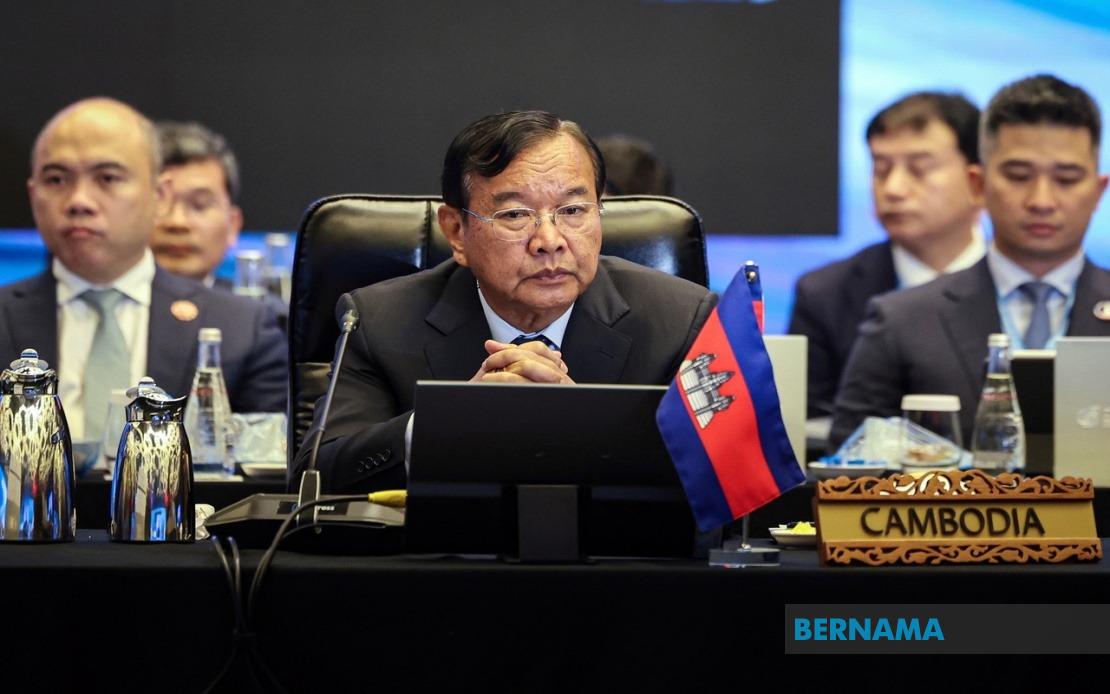
Cambodia's Foreign Minister and Deputy Prime Minister Prak Sokhonn has underscored ASEAN's continuing role as the cornerstone of regional stability, declaring that the ten-member bloc cannot afford to adopt a reactive posture as it confronts an increasingly volatile international environment. Speaking on the occasion of the Association of Southeast Asian Nations' 59th anniversary, Sokhonn stressed that the bloc must transition from merely responding to global developments towards actively participating in shaping the course of regional and international affairs.
Sokhonn's remarks arrive at a moment when Southeast Asia faces mounting external pressures. The region is navigating a landscape marked by resurgent armed conflicts in various parts of the world, intensifying great-power competition, and what he characterised as mounting strain on established frameworks of international law and multilateral cooperation. These challenges, he suggested, demand a more proactive and unified response from ASEAN rather than a fragmented or hesitant approach.
The Cambodian minister pointed to ASEAN's historical trajectory as evidence of the organisation's transformative potential. Over its nearly six decades of existence, he noted, ASEAN has facilitated the metamorphosis of Southeast Asia from a region fractured by competing interests and geopolitical uncertainty into one increasingly characterised by structured dialogue, coordinated cooperation, and expanding prosperity. This evolution, he implied, offers a template for how the bloc might navigate present-day challenges.
Central to Sokhonn's vision is ASEAN's adherence to its founding principles, particularly the ASEAN Charter and the Treaty of Amity and Cooperation (TAC). These instruments, he maintained, provide the philosophical and legal foundations upon which the organisation's unity and effectiveness rest. He emphasised that Cambodia remains committed to upholding both documents in practice as well as principle, signalling that genuine commitment requires more than rhetorical support.
Cambodia's own trajectory within ASEAN deserves attention. Having joined the bloc in 1999, Cambodia has transitioned from a nation recovering from decades of conflict and international isolation to an active participant in regional affairs. Sokhonn's remarks reflect Cambodia's evolving confidence in regional institutions and its stake in preserving the multilateral framework that has enabled its rehabilitation and economic integration.
The timing of these comments carries particular weight given contemporary geopolitical dynamics. With major powers competing for influence across Southeast Asia, and with traditional alliances being tested, ASEAN's collective voice and unified position have become increasingly valuable commodities. Countries within the bloc hold divergent relationships with external powers, yet ASEAN's institutional framework theoretically provides a space where these differences can be managed without undermining regional stability.
Sokhonn's call for proactivity rather than passivity reflects a growing recognition within ASEAN capitals that the bloc's future relevance depends on demonstrating agency. Rather than positioning itself as a passive arena where external powers conduct their competition, ASEAN risks losing influence and credibility if it appears unable or unwilling to chart its own course. This distinction—between shaping outcomes and being shaped by external forces—represents a subtle but significant evolution in how ASEAN leadership frames the organisation's role.
The bloc's composition has evolved considerably since its 1967 founding by Thailand, Indonesia, Malaysia, Singapore, and the Philippines. The subsequent accession of Brunei, Vietnam, Laos, Myanmar, and Cambodia, followed by Timor-Leste's admission, expanded ASEAN's geographical reach and economic weight. However, this expansion also introduced greater internal diversity in economic development, political systems, and strategic orientations, making unity more challenging to maintain.
Sokhonn's emphasis on ASEAN's unity and centrality speaks to concerns that geopolitical fragmentation could erode the bloc's effectiveness. As individual members develop stronger bilateral relationships with major powers, the risk of ASEAN becoming a collection of separate national foreign policies rather than a genuine regional organisation grows. Maintaining institutional cohesion while respecting member states' legitimate interests represents an ongoing tension within the organisation.
The reference to international law and multilateralism carries implications for how ASEAN might position itself regarding maritime disputes, economic partnerships, and security arrangements. With several ASEAN members engaged in maritime disagreements and with competing regional security architectures being proposed, the bloc's commitment to rules-based approaches and institutional mechanisms becomes particularly significant.
Looking forward, Sokhonn's message suggests that Cambodia views ASEAN as essential infrastructure for navigating an uncertain future. For Malaysian policymakers and businesses, this reaffirmation of ASEAN's importance carries implications for regional investment, trade arrangements, and security cooperation. A stronger, more proactive ASEAN could provide greater predictability and opportunity, whereas a fragmented or weakened bloc would create openings for external disruption.
The challenge for ASEAN leadership, including Cambodia, will be translating these aspirational statements into concrete mechanisms for collective action. Moving from reactive to proactive governance requires not just rhetorical commitment but institutional capacity, member-state consensus on priorities, and sufficient economic and diplomatic resources to shape outcomes rather than merely observe them.

