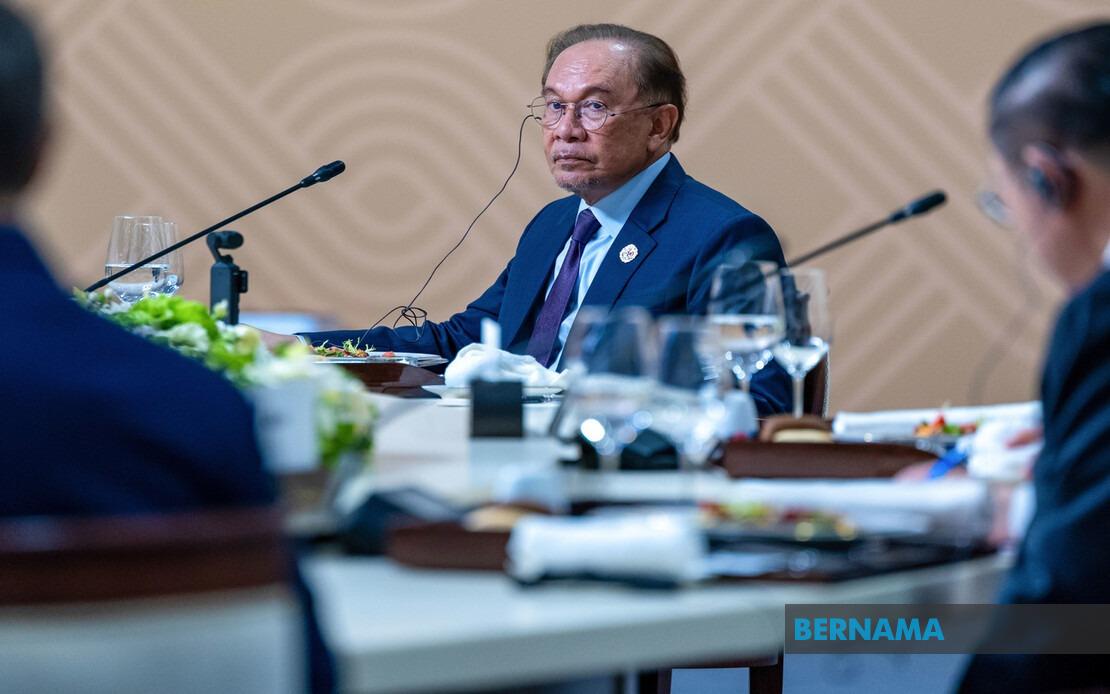
Prime Minister Datuk Seri Anwar Ibrahim has called for closer collaboration between ASEAN and the Shanghai Cooperation Organisation in tackling transnational crime and advancing energy security, arguing that effective responses to these complex challenges demand coordinated regional action. Speaking during an ASEAN-Russia working lunch in Kazan on June 18, Anwar emphasised that both regional groupings possess the foundational structures necessary to deepen cooperation and should now move swiftly toward implementation of concrete initiatives that yield tangible progress within realistic timeframes.
The two organisations already maintain a 2005 memorandum of understanding that establishes frameworks for cooperation across multiple domains including counter-terrorism, narcotics control, money laundering prevention, economic and financial matters, and energy initiatives with particular emphasis on hydroelectric development and bio-fuel advancement. Rather than creating entirely new mechanisms, Anwar suggested that ASEAN and the SCO should strategically concentrate resources on priority sectors where collaborative efforts can demonstrate clear results, transforming existing agreements from aspirational statements into operational realities that address pressing regional concerns.
Acknowledging the evolving nature of contemporary threats, Anwar highlighted how online fraud schemes, illegal financial transactions, and human trafficking operations now transcend borders with unprecedented speed, outpacing the capacity of individual nations to respond through purely domestic enforcement mechanisms. He argued persuasively that regional intelligence sharing and capacity-building initiatives represent the most viable pathway forward, enabling member states to combine investigative expertise, technological capabilities, and legal frameworks into coordinated response systems. The acceleration of cross-border crime through digital networks has fundamentally altered the calculus of security cooperation, making bilateral efforts insufficient and rendering collaborative regional architecture not merely advantageous but essential.
On energy matters, Anwar noted that the Shanghai Cooperation Organisation encompasses major energy producers and possesses concentrated expertise in energy technologies, thereby creating unique opportunities for advancing shared objectives around energy security and transitioning toward lower-carbon sources. Malaysia's positioning within these discussions reflects a pragmatic focus on practical energy cooperation mechanisms rather than ideological positioning, encompassing efficiency improvements, grid infrastructure resilience, liquefied natural gas and conventional gas markets, renewable energy integration, and institutional learning regarding safety standards and system reliability. The energy sector represents a domain where technological advancement, commercial incentives, and environmental imperatives align, creating natural momentum for meaningful cooperation.
Beyond bilateral ASEAN-SCO relations, Anwar extended his framework for regional cooperation to encompass the Eurasian Economic Union, noting that ASEAN and the EAEU possess comparable institutional architecture and existing procedural agreements. He advocated that these formal mechanisms should evolve from paper commitments into genuine commercial partnerships, requiring particular attention to cultivating business sector engagement and reducing structural impediments to trade and investment flows. The distinction between having institutional frameworks and actually utilising them remains critical; many regional organisations maintain elaborate agreements that remain dormant due to insufficient follow-up mechanisms and weak private sector participation.
The Prime Minister identified private sector engagement as the initial priority, recommending that enterprises from both regions significantly increase their participation in each other's commercial events and trade exhibitions. He specifically referenced the ASEAN-EAEU Business Dialogues scheduled during the Eastern Economic Forum and St Petersburg International Economic Forum as valuable platforms for expanding business networks and identifying investment opportunities. Such gatherings serve dual functions by simultaneously building commercial relationships and generating political momentum for government-level cooperation, as successful business outcomes create constituencies within each economy advocating for deeper integration.
Addressing concerns about competitive disparities, Anwar argued that smaller enterprises require targeted support mechanisms to participate meaningfully in cross-regional commerce. This encompasses facilitating market access through tariff reduction and regulatory harmonisation, transferring requisite technologies to increase productivity and competitiveness, and developing skill bases that enable effective deployment of advanced technologies. Without deliberate capacity-building initiatives, integration risks reproducing existing inequalities whereby larger corporations and developed economies capture disproportionate benefits while smaller firms remain marginalised. Malaysia's emphasis on equitable development across the region reflects both principled commitment and pragmatic recognition that sustainable cooperation requires broad-based participation.
Anwar highlighted emerging areas of convergent interest between ASEAN and the EAEU, particularly the digital economy, artificial intelligence applications, cybersecurity infrastructure, and food security challenges. These newer domains offer opportunities for first-mover advantages in establishing cooperative standards and frameworks before divergent national approaches become entrenched. The digital economy and AI sectors particularly warrant joint investment in research and development, as both regions possess relevant expertise and growing domestic markets that could absorb innovative products and services. Cybersecurity cooperation carries immediate practical importance given the interconnected nature of digital infrastructure and the asymmetric vulnerabilities facing developing economies.
Food security represents a crucial yet often underappreciated dimension of regional stability, particularly as climate change patterns increasingly affect agricultural production across Asia. ASEAN and Eurasian cooperation on agricultural innovation, supply chain resilience, and emergency response mechanisms could substantially enhance regional food system stability. The geographic distribution of production capacity and consumption centres across these two groupings creates natural complementarities that could be systematically developed through coordinated policy frameworks and technology sharing initiatives.
Anwar's framing of regional cooperation emphasises pragmatism over ideological alignment, focusing on specific sectoral challenges where clear gains appear achievable through collaborative effort. His proposals reflect Malaysia's positioning as a bridge economy capable of facilitating dialogue between major powers whilst advancing concrete national and regional interests. The emphasis on moving beyond framework agreements toward implementation and on building private sector engagement suggests recognition that sustainable regional cooperation requires transforming institutional structures into functioning mechanisms that generate tangible economic and security benefits for participating populations.
The Prime Minister's visit to Kazan for the ASEAN-Russia Commemorative Summit provided the setting for these remarks, underscoring Russia's continued engagement with Southeast Asian institutions despite geopolitical tensions elsewhere. ASEAN's maintenance of relations across multiple major powers represents both a strategic asset and an ongoing balancing challenge, requiring careful diplomacy to advance cooperation without appearing to align with particular blocs. Malaysia's advocacy for expanding practical cooperation across multiple regional groupings reflects this centrist positioning within an increasingly multipolar regional order.