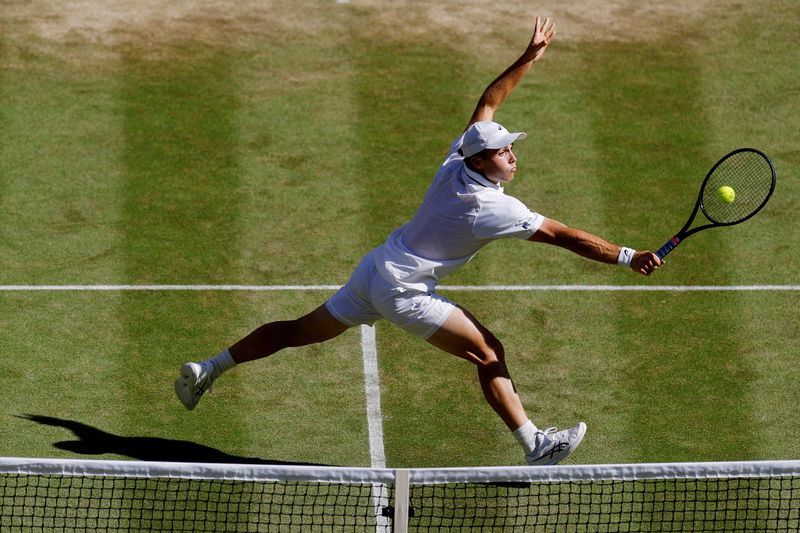
Arthur Fery's improbable Wimbledon journey has captivated British sporting audiences, with the France-born but London-raised wildcard entry now representing the home nation's best chance for men's singles glory at the Championships. The 24-year-old has conjured back-to-back five-set epics to storm into the quarterfinals, defying expectations of a player who entered the tournament ranked 114th globally and carrying the weight of a nation that has seen 15 of its 19 singles competitors eliminated in the opening round. His trajectory through the draw reads like sporting fiction, yet Fery's performances on grass have been unmistakably real, combining grit, technical excellence, and the kind of mental resilience that separates champions from also-rans.
Fery's path to prominence gained momentum during his third-round encounter against Belgium's Zizou Bergs on Saturday, when he orchestrated an unlikely comeback from the brink of defeat. Trailing two sets to one and facing a double break down in the fourth set, the British player staged a remarkable revival to secure victory in what became the longest match of the entire tournament. The physical and mental toll proved evident—Fery suffered a series of nosebleeds throughout the contest—yet his refusal to yield demonstrated the character now defining his campaign. This triumph set the stage for an even more dramatic Monday encounter on Centre Court, where millions of British television viewers remained emotionally invested in his fate.
His second-round victory over fellow wildcard Grigor Dimitrov represented the kind of moment that transcends ordinary sporting achievement. The 35-year-old Dimitrov, a former world number three who has graced tennis's highest stages for decades, appeared destined for victory as he took command in the fourth set, establishing a 4-3 lead complete with a service break. The crowd energy—amplified by lingering euphoria from England's World Cup last-16 victory over Mexico that had concluded just hours earlier in Mexico City—created an almost unprecedented atmosphere at the All England Club. When Fery produced his stunning fightback to clinch the match 7-5, 3-6, 4-6, 6-4, 7-6 in front of tennis legend Roger Federer watching from the Royal Box, the roar that erupted was reportedly as thunderous as any heard at Wimbledon in recent memory.
The timing of this victory carries particular poignancy for Fery, as he turns 24 on Sunday, the exact day of the men's singles final. Should his improbable run continue through his quarterfinal meeting with Italy's world number 10 Flavio Cobolli—a player he previously defeated at this year's Australian Open—Fery could potentially spend his birthday on Centre Court competing for tennis's most prestigious prize. This narrative arc, improbable as it seems, has captured public imagination in a nation starved of homegrown male singles talent at the sport's highest level. The contrast between his emergence and the wholesale elimination of other British competitors underscores both the unpredictability of tournament tennis and the rare convergence of form, opportunity, and circumstance required for such breakthrough moments.
Fery's Stanford University education distinguishes his pathway from many contemporary players, representing an alternative route into professional tennis that has gained traction among American and increasingly British participants. His decision to compete at Stanford while developing his professional game provided technical grounding and competitive experience that now manifests in his tactical sophistication and match intelligence. The American connections have proved valuable, with men's sixth seed Taylor Fritz providing an intriguing character endorsement that preceded Fery's breakthrough. Fritz practised extensively with Fery ahead of the 2024 World Tour Finals and witnessed firsthand the British player's capacity to outplay even top-ranked competitors during training blocks.
Fritz's assessment of Fery's capabilities proved prescient and candid, the American recalling how Fery defeated him consistently during their training week despite Fritz then advancing to the Turin finals. Fritz highlighted the technical foundation underpinning Fery's tennis, particularly emphasizing an imposing serve and exceptionally strong forehand that belies his physical frame. Such recognition from elite peers carries significant credibility, suggesting Fery's recent performances represent not merely a temporary hot streak but rather the emergence of a player whose underlying technical and physical gifts had been underestimated by broader tennis rankings and public consciousness. This expert validation lends credence to the notion that Fery's Wimbledon run might herald the beginning of a sustained rise through professional tennis's rankings rather than a isolated fortnight of inspired play.
The broader context of British tennis's current state makes Fery's emergence particularly significant for the sport's health in the United Kingdom. The wholesale elimination of homegrown competitors in the early rounds has created a concerning narrative about the pipeline of male players capable of competing at elite levels on the sport's grandest stage. Fery's presence as the standard-bearer carries responsibility beyond his own ambitions, embodying hopes that British tennis might yet produce players capable of challenging the sport's established hierarchies. His journey also speaks to the unpredictable nature of tournament tennis, where wildcards—players granted entry outside conventional ranking qualifications—occasionally produce performances that validate the selection committee's faith in their potential.
Fery himself has demonstrated admirable perspective regarding his extraordinary situation, acknowledging both the surreal nature of his circumstances and the ephemeral quality of peak competitive moments. In discussing his experience thus far, he emphasized his intent to cherish memories of playing Centre Court while maintaining realistic awareness that such opportunities may never recur. This balanced attitude—neither overconfident nor defeatist—reflects maturity unusual in players of his age and ranking, suggesting psychological resilience that might sustain him through the increasing pressures of playing deeper into major tournaments. His reflection on witnessing British sporting excellence at the world level, specifically referencing England's football achievements, demonstrates awareness of how national sporting narratives intersect and influence broader cultural consciousness.
The statistical arc of Fery's ranking progression underscores the magnitude of his achievement in concrete terms. Entering Wimbledon at 114th globally, his quarterfinalist status and anticipated ranking points will propel him inside the top 70, representing an extraordinary transformation over a single fortnight. Such rapid ranking elevation carries implications for his future tournament seeding, scheduling opportunities, and the broader competitive landscape of men's professional tennis. Should Fery progress further, each additional victory compounds his ranking advancement and establishes him as a permanent fixture among the circuit's ranked competitors rather than a provisional entry dependent on tournament allocation of wildcards.
Looking forward, the most immediate challenge confronting Fery remains Cobolli, a player against whom he possesses a recent head-to-head advantage but who represents significantly more established ranking credentials and career experience. Cobolli's position as world number 10 reflects sustained excellence across multiple tournament surfaces and competitions, whereas Fery's breakthrough remains confined to the grass courts of Wimbledon. This distinction suggests that Fery must navigate not merely physical challenges of extended match play but also the mental complexities of competing against opponents with deeper tournament success and corresponding confidence reserves. His ability to synthesize the technical excellence and mental fortitude demonstrated against Dimitrov and Bergs while absorbing the pressure accompanying favorites' status will substantially determine whether his Wimbledon campaign extends toward additional majors or concludes as an extraordinary but contained breakthrough.

