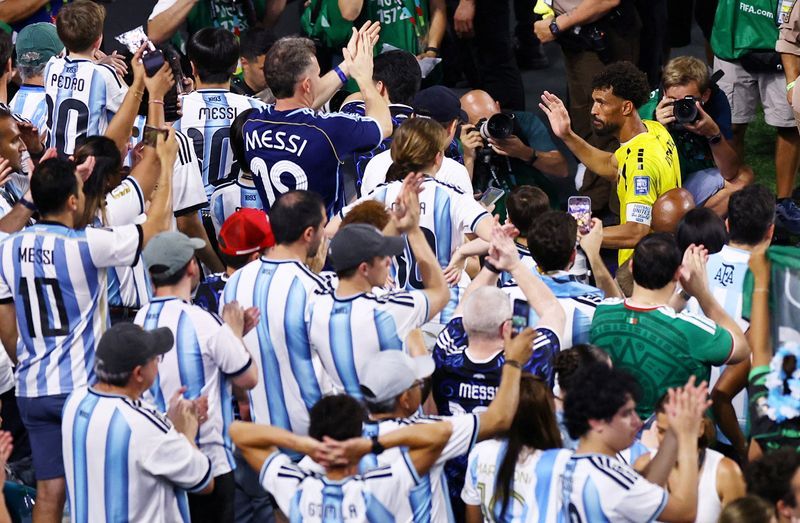
Argentina moved into the World Cup's final 16 on Wednesday with a 3-2 extra-time victory over Cape Verde in Kansas City, but the margin of their advancement masked uncomfortable truths about the defending champions' vulnerabilities as they prepare for increasingly formidable opposition. What was anticipated as a straightforward passage for Scaloni's squad became a tense battle that exposed gaps in their defensive organization and pressing intensity, prompting soul-searching among analysts and observers about whether South America's dominant force is entirely equipped for the tournament's later stages.
Cape Verde's spirited performance represented a remarkable achievement for any debutant nation, yet it served as a cautionary tale for Argentina's coaching staff. The West African side twice clawed their way back into the contest, demonstrating resilience that contradicted their status as World Cup newcomers. Cristian Romero ultimately settled the affair with a header that deflected off opponent Diney Borges into the net, but the manner of Argentina's struggle suggested deeper structural issues than a single slip-up. Coach Lionel Scaloni had actually warned beforehand that Cape Verde possessed genuine threat, having drawn against established European powers Spain and Uruguay during group play, yet few anticipated such sustained resistance.
The context of Argentina's group stage performance compounds the current concerns. Prior to facing Cape Verde, the reigning champions had dispatched Algeria, Austria, and Jordan with emphatic efficiency, posting scorelines of 3-0, 2-0, and 3-1 respectively. That unblemished record had generated confidence among supporters, but it simultaneously masked a critical gap: the team's defensive line had never confronted meaningful sustained pressure from dangerous attacking players. The narrow escape in Kansas City thus represents an uncomfortable reckoning. Veteran analyst Marcelo Gallardo, who captained Argentina in the 1998 and 2002 World Cups and later managed River Plate, characterized the match as beneficial despite its uncomfortable nature, suggesting the scare would catalyze necessary adjustments before the knockout round against Egypt scheduled for Atlanta on Tuesday.
Lionel Messi, now 39 years old and leading Argentina as captain, personally netted his record-extending 20th World Cup goal during the opening period, yet even his contributions could not mask the team's collective struggles with shape and positioning. In a candid assessment following the match, the football legend acknowledged the physical exhaustion that accumulated during Cape Verde's resistance, particularly highlighting how Argentina failed to establish effective pressing in the middle third. His observation that "the lines were too far apart" and that the team "couldn't press them properly" pointed to specific tactical deficiencies rather than individual lapses. For a side built on controlling matches through aggressive ball recovery and quick transition play, such observations represented a significant concern.
Scaloni's response to the criticism balanced pragmatism with confidence in his squad's character. The manager acknowledged room for improvement while emphasizing that his players demonstrated the resilience required to overcome adversity, ultimately taking control of decisive moments when it mattered most. His pre-match statement that no World Cup fixture should be considered straightforward proved prescient, though Argentina's performance suggested the team is still adjusting to the tournament's psychological and physical demands. The coach's philosophy centers on the squad's ability to respond when circumstances turn difficult, a quality they demonstrated in extra time despite earlier vulnerabilities.
Two defenders whose recent injury histories added poignant symbolism to Argentina's advancement proved instrumental in securing progression. Lisandro Martinez, recovering from an anterior cruciate ligament injury sustained early in 2025, scored Argentina's second goal in a performance that validated his selection despite fitness concerns. Cristian Romero, meanwhile, overcame earlier knee problems that had sidelined him during the group stage to provide the decisive contribution. Both players represented human stories of resilience mirroring their team's struggle against Cape Verde, with Martinez describing his comeback as vindication of efforts by his club and national team medical staff. Their contributions embodied how Argentina ultimately seized their opportunities despite organizational deficiencies.
The psychological dimension of this narrow victory extends beyond mere statistics. Cape Verde's refusal to capitulate and their ability to twice equalize created a psychological challenge that world-class teams might relish rather than endure. Facing Egypt in Atlanta presents a qualitatively different test: opponents who will enter confident they can exploit the same defensive spaces Cape Verde discovered. Egypt brings greater technical sophistication and World Cup experience, meaning Argentina cannot rely on the superior talent differential that ultimately prevailed against the tournament debutants. The narrow margin of Argentina's advancement provides unexpected motivation for Scaloni's preparation during the training week in Miami.
The broader implications for Argentina's World Cup trajectory suggest a team that, despite formidable attacking capability and experienced leadership, remains susceptible to consistent, organized opposition. The reigning champions succeeded through resilience rather than dominance against Cape Verde, reversing the pattern from their group stage displays. As the knockout tournament proceeds, opponents will study this match and identify actionable tactical approaches. Argentina's journey toward retaining their title has suddenly become more complicated than pre-tournament expectations suggested, with defensive organization and pressing intensity emerging as critical variables determining their ultimate destination.

