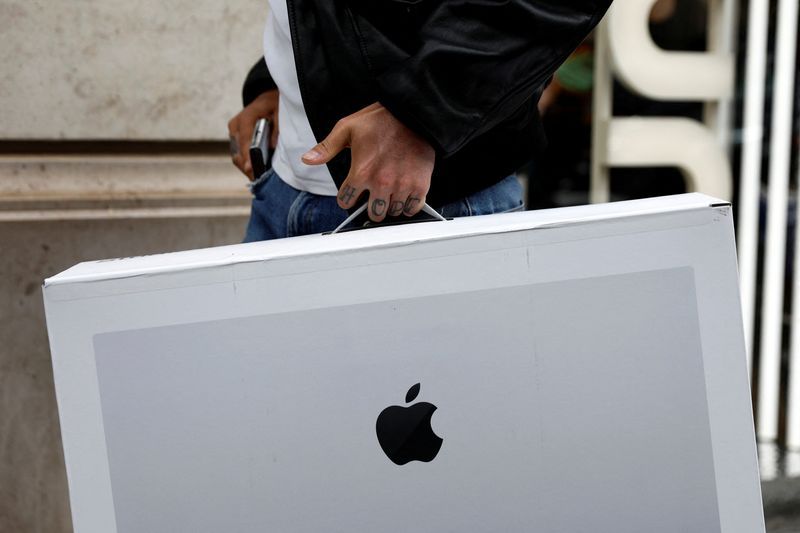
Apple has reclaimed the title of world's most valuable company, overtaking graphics chipmaker Nvidia on Friday with a valuation of $4.88 trillion, marking a significant reordering of the technology sector's hierarchy as investors recalibrate their expectations for artificial intelligence development and deployment. Nvidia's value slipped to approximately $4.86 trillion following a 3.5% decline, ending the company's reign at the top that had lasted nearly twelve months. This reshuffling of the technology giants' rankings underscores a critical inflection point in how the market perceives the trajectory and profitability of the artificial intelligence revolution that has dominated investor sentiment since late 2022.
The changing of the guard reflects a broader pivot in investor thinking away from the most obviously positioned beneficiaries of artificial intelligence adoption towards companies with alternative pathways to monetisation and profit generation. Toni Meadows, head of investment at BRI Wealth Management, characterises the sentiment shift as fundamental: Apple had long been dismissed by market observers as trailing in the race to develop cutting-edge artificial intelligence models, partly because the Cupertino-based company declined to engage in the capital-intensive spending that rivals like Nvidia undertook to build foundational AI systems. However, investor conviction now appears to rest on Apple's strategic positioning as a company less burdened by the exponential capital requirements that plague pure-play chip designers and model developers, instead leveraging its installed user base and services ecosystem to commercialise artificial intelligence in less speculative but arguably more durable ways.
Apple's ability to extract value from artificial intelligence rests fundamentally on its ecosystem lock-in, the durability of its installed base across iPhones, iPads, and Mac computers, and the recurring revenue model embedded in its services division. Rather than betting on the uncertain returns from developing and selling foundational models or competing directly with Nvidia in the graphics processor market, Apple can monetise AI through hardware upgrades that justify price increases to existing customers, through premium services that leverage on-device artificial intelligence capabilities, and through the incremental features that appeal to a notoriously loyal consumer base. This strategic difference appears to have registered with sophisticated investors seeking companies with defensible competitive positions and predictable earnings trajectories, rather than those placing bets on speculative upside that remains contingent on continued exponential growth in chip demand.
The milestone carries particular symbolic weight as Apple prepares for a leadership transition that many observers view with uncertainty. Chief Executive Officer Tim Cook is preparing to hand over the reins to John Ternus, a hardware engineering veteran, in September. How investors and analysts interpret this moment in Apple's trajectory—whether the return to the top spot represents validation of Apple's strategic direction under Cook or presages a new era under Ternus—will likely influence perceptions of the company's future trajectory. Last month, Apple unveiled a substantially redesigned Siri voice assistant that the company had been developing for an extended period, a move the company positioned as critical to narrowing the artificial intelligence capability gap with competitors and emerging artificial intelligence startups that had garnered outsized attention from investors and technology observers.
Underlying Apple's potential artificial intelligence advantage lies an asset that few competitors can match: the vast repository of personal data residing on every iPhone worldwide. Analysts have characterised this data trove as an artificial intelligence gold mine, capable of powering far more contextual, useful, and capable versions of Siri and other services. The challenge confronting Apple is considerable, however. The company has built its brand reputation partly on privacy commitments, encrypting user data in ways that make it inaccessible even to Apple itself. Unlocking the commercial value of this data without compromising the privacy commitments that distinguish Apple in an increasingly privacy-conscious marketplace represents a genuine strategic tension that the company must navigate carefully.
Nvidia's displacement from the top position does not necessarily portend a lasting diminution of its market influence or its role in the artificial intelligence infrastructure buildout that continues across the global technology sector. The company's graphics processors remain the dominant computing engines powering generative artificial intelligence systems, from the massive data centres operated by cloud providers to research institutions and corporate enterprises deploying their own artificial intelligence infrastructure. Sentiment shifts rapidly in technology markets, and should investor confidence waver regarding Apple's artificial intelligence strategy or the durability of its business model, Nvidia could readily reclaim the position of most valuable company. Benjamin Hall, vice president of alpha research at Segal Marco Advisors, notes that no fundamental distinction exists between the two companies' prospects, with Nvidia remaining a likely significant participant in whatever artificial intelligence landscape emerges over coming years.
Apple's own circumstances present complications that could constrain future growth. The company has implemented price increases across its product portfolio to offset rising manufacturing and component costs, a strategy that carries inherent risks to demand, particularly among price-sensitive customer segments and in emerging markets where Apple has pursued aggressive expansion. Should consumer demand weaken in response to higher prices, the valuation metrics that currently favour Apple relative to Nvidia could shift rapidly in the opposite direction.
The artificial intelligence enthusiasm that propelled both Nvidia and Apple to stratospheric valuations has begun distributing itself across a considerably wider range of semiconductor companies and technology enterprises. Memory chipmakers such as Micron have emerged as unexpected winners in the artificial intelligence infrastructure race, with Micron crossing the $1 trillion market value milestone in May as investors recognised the critical importance of memory systems in supporting artificial intelligence workloads. South Korea's SK Hynix expanded the competitive landscape further by listing on the Nasdaq earlier in July, introducing another sophisticated player into the competition for investor capital and attention.
The expansion of profitable artificial intelligence plays beyond the narrowly focused Magnificent Seven technology companies reflects a maturation of investor thinking about artificial intelligence's likely development path. Rather than concentrating capital in the companies expected to capture the largest share of artificial intelligence-related value creation, institutional investors increasingly appear to be diversifying their bets across the semiconductor supply chain and across different strategies for monetising artificial intelligence capabilities. As Hall observes, the emergence of new participants in the artificial intelligence infrastructure market could disperse investor focus away from the pure-play names that dominated artificial intelligence discourse in 2023 and early 2024, distributing opportunity and risk across a broader cross-section of the semiconductor and technology industries.
The enthusiasm underlying the semiconductor sector rally encountered significant headwinds in July as investors began reassessing the sustainability and timeline of the artificial intelligence buildout that had justified extraordinary valuations. The Philadelphia Stock Exchange Semiconductor Index declined almost 19% from its all-time peaks, a steep pullback that signals investor caution about extrapolating recent semiconductor sector performance indefinitely into the future. Notably, despite this substantial correction, the semiconductor index has performed better than Nvidia specifically, suggesting that the sector-wide pessimism focuses less on artificial intelligence demand generally and more on the sustainability of Nvidia's particular valuation multiples relative to the broader industry. For Malaysian and Southeast Asian investors and businesses engaged with the technology sector, these dynamics carry significant implications, as the region's semiconductor companies, technology services providers, and hardware manufacturers position themselves to participate in the artificial intelligence value chain that continues to reshape global technology markets.

