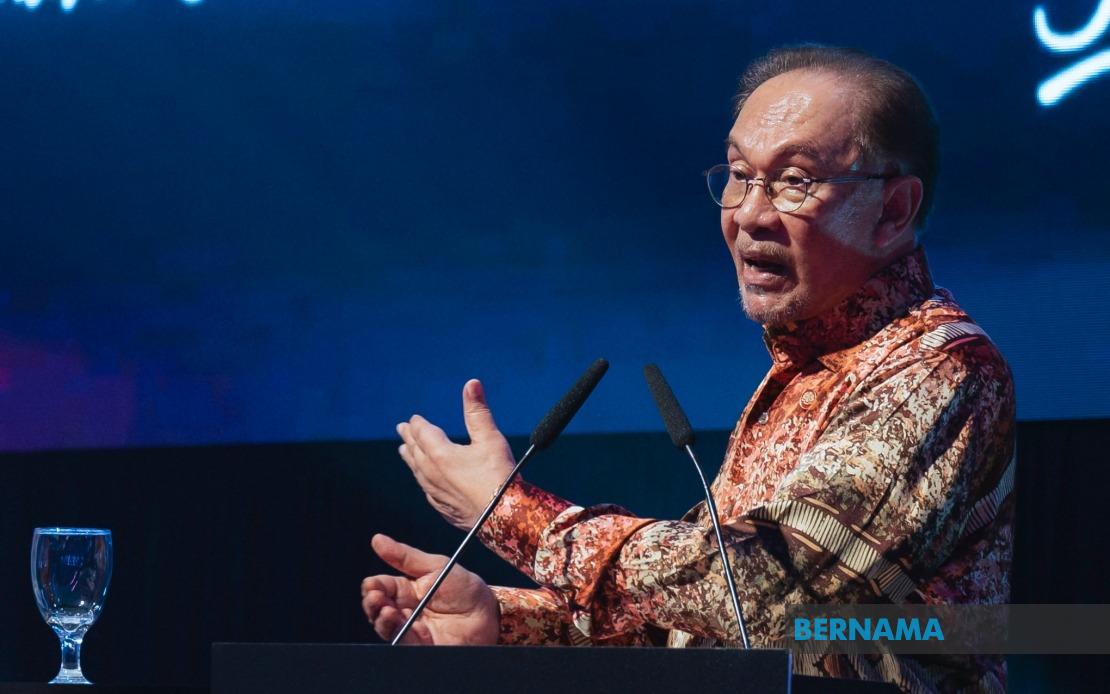
Prime Minister Datuk Seri Anwar Ibrahim's recent comments regarding Taiwan have sparked considerable debate, with some interpreting his words as controversial. Yet closer examination reveals his statement emphasises sovereignty and deterrence strategy rather than championing military intervention. The substance of his argument rests on a fundamental principle of statecraft: governments naturally resist territorial dissolution, and maintaining credible defensive capacity forms an essential component of deterrence strategy rather than a precursor to conflict.
Anwar's framing drew an explicit parallel to Malaysia itself, suggesting that no rational government would acquiesce to the fragmentation of its federation without mounting some form of resistance. This analogy anchors his position in recognisable domestic politics. Just as Malaysia would defend its territorial cohesion, he argued, China pursues similar imperatives regarding Taiwan. The comparison offers insight into how nation-states think about existential threats to their political unity, transcending whether one agrees with Beijing's characterisation of the Taiwan question as fundamentally an internal matter.
Critically, the Prime Minister's remarks do not advocate initiating military action as a preferred policy. Rather, he articulates a distinction between possessing force and wielding it. Negotiation, legal frameworks, and political settlement represent the primary avenues for dispute resolution in his formulation. Force remains a reserve position, contemplated only when other mechanisms have been exhausted. This sequencing aligns with Malaysia's longstanding diplomatic preferences and its role within ASEAN as a champion of peaceful resolution mechanisms.
The deterrence logic underlying Anwar's position reflects orthodox strategic thinking. A credible threat of response to territorial challenges discourages potential challengers from testing resolve, paradoxically reducing the likelihood that force must actually be deployed. Conversely, publicly renouncing the capacity or willingness to resist encroachment can invite precisely the aggression one seeks to prevent. This creates the central paradox of deterrence: maintaining military readiness and the demonstrated capacity to respond actually serves peace by making conflict appear costly and unwise to potential adversaries.
Anwar's position sits comfortably within Malaysia's established One China policy. Kuala Lumpur maintains formal diplomatic recognition of the People's Republic of China while eschewing recognition of Taiwan as a separate sovereign state. Simultaneously, Malaysia sustains robust economic relationships and people-to-people exchanges with Taiwan that serve mutual interests. This dual framework has provided Malaysia with stability and prosperity for decades. Within this context, acknowledging Beijing's perspective on territorial integrity becomes logically consistent rather than contradictory.
However, Taiwan itself rejects this framework entirely, viewing the territory as a sovereign, independent democracy rather than a breakaway province awaiting reunification. From Taipei's vantage point, any Malaysian reference to China's willingness to employ force carries implicit endorsement of coercion against the island's population. This fundamental disagreement in how the Taiwan situation is characterised ensures that Anwar's remarks, however carefully calibrated, carry different meanings depending on the audience and their own political commitments.
The distinction between deterrence and advocacy warrants emphasis. Anwar did not champion warfare; he articulated why states preserve the option of armed response. China's strategic position similarly rests on maintaining uncertainty about costs, which purportedly deters separatist movements or foreign intervention in support of independence. Whether this logic succeeds remains hotly contested among analysts and policymakers, but the internal coherence of the argument itself withstands scrutiny.
Malaysia faces genuine constraints in navigating these treacherous waters. A military confrontation across the Taiwan Strait would inflict catastrophic damage on regional commerce, semiconductor supply chains, and the broader stability upon which ASEAN prosperity depends. Malaysia's maritime trade routes and manufacturing sector would face severe disruption. These material considerations explain why Malaysian foreign policy maintains consistent advocacy for restraint, dialogue, and peaceful settlement mechanisms that extend beyond just China and Taiwan but encompass the international community broadly.
Balancing these competing imperatives requires sophisticated diplomacy. Malaysia must simultaneously uphold its One China policy, decline to endorse coercive approaches, and champion mechanisms for peaceful dispute resolution. This balancing act reflects neither weakness nor inconsistency but rather the complex demands of regional statecraft. Anwar's remarks should be understood within this careful equilibrium rather than as a dramatic shift in Malaysian positioning.
The core insight animating Anwar's argument remains fundamentally realist in character. States do not voluntarily pre-commit to accepting territorial dismemberment or political fragmentation. Preserving capacity for defence serves to ensure nations need not face such scenarios unprepared and vulnerable. This reflects not belligerence but elementary prudence in an international system where force remains a potential instrument of statecraft, even if it constitutes a last resort rather than a preferred option.
Malaysia's challenge going forward involves reinforcing this distinction between maintaining deterrent capacity and pursuing military solutions. Regional stability requires that all stakeholders—particularly major powers with capabilities to shape outcomes—understand the catastrophic costs of conflict while remaining committed to dialogue. Anwar's remarks, properly contextualised, contribute to this conversation by articulating why deterrence logically underpins rather than undermines peace, provided that deterrence remains directed toward preventing war rather than initiating it.

