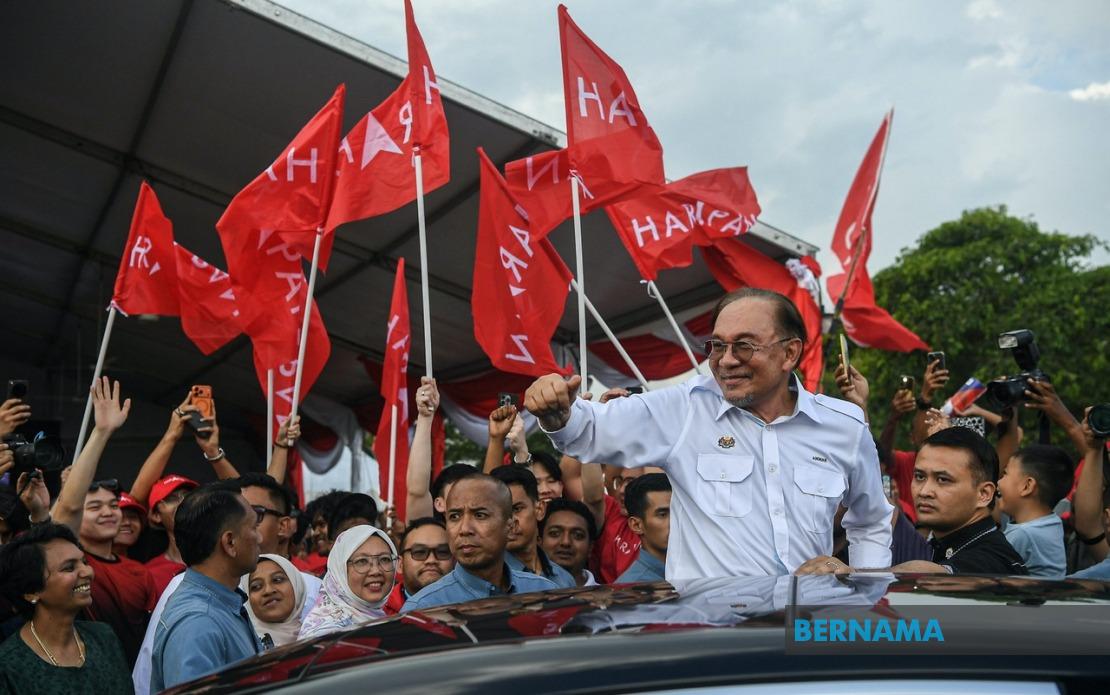
Prime Minister Datuk Seri Anwar Ibrahim's visible engagement in the Johor state election campaign has translated into tangible momentum for Pakatan Harapan, with party officials attributing the coalition's growing ground support to his direct involvement in mobilising voters ahead of Saturday's poll. Communications Minister Datuk Fahmi Fadzil, who has accompanied the Premier on several campaign stops, described the public reception as unexpectedly enthusiastic, reflecting broader acceptance of the ruling coalition's messaging in Malaysia's second-largest state by population.
The anecdotal evidence Fahmi cited underscores the symbolic weight of prime ministerial endorsement in state-level contests. During campaign events in Senggarang and Semerah within Batu Pahat district, ordinary voters made deliberate efforts to engage with Anwar, with one elderly resident reportedly conveying his wife via trishaw specifically to meet the Premier. Such encounters, while appearing modest in scale, carry disproportionate significance in Malaysian electoral dynamics, where personal connection between leadership and constituents remains a decisive factor in voter behaviour. The spontaneity of these interactions—unscripted expressions of support—matters greatly to campaign strategists seeking validation beyond controlled rallies.
Fahmi's dual role as both Communications Minister and PH's communications director positions him as a primary interpreter of campaign momentum for media and stakeholders. His assessment that community response reflects genuine interest rather than obligatory attendance carries weight within party circles, as it suggests the coalition's electoral message is resonating organically across diverse demographic segments. This distinction between synthetic enthusiasm generated by party machinery and authentic grassroots energy fundamentally shapes how political strategists calibrate subsequent campaign intensity and resource allocation.
Anwar's investment of personal political capital proved substantial over the July 4-5 weekend, when he participated in 15 campaign programmes distributed across Johor's geography. This saturation approach seeks to establish the Prime Minister's presence as inextricably linked with Pakatan Harapan's electoral brand, a strategy recognising that state elections in Malaysia frequently function as referendums on incumbent federal governments. By physically manifesting federal leadership commitment to Johor's local contests, Anwar signals that the state remains strategically important to Kuala Lumpur's broader governance agenda.
Pakatan Harapan's decision to field candidates in all 56 State Legislative Assembly seats represents an ambitious assertion of competitive strength across Johor's electoral landscape. This comprehensive candidacy strategy contrasts with selective fielding approaches some opposition parties employ, implying the coalition believes it possesses sufficient organisational capacity and voter appeal to mount viable campaigns even in traditionally challenging constituencies. The positioning of candidates across every seat also prevents opposition parties from easily claiming vacated ground or framing Pakatan Harapan as selectively present.
The broader electoral context involves 172 candidates competing for the 56 seats, a distribution indicating moderately fragmented competition. This multiplicity means voter choice operates across genuinely contested terrain rather than binary confrontations, potentially advantaging coalitions with cohesive messaging and coordinated campaign machinery—attributes Pakatan Harapan emphasises through Anwar's high-visibility participation. Early voting commenced on July 7, suggesting organisational readiness and voter mobilisation efforts preceding the July 11 polling day.
For Malaysia's political landscape more broadly, the Johor election serves as a significant indicator of federal government health. Johor historically leans towards established power structures, and the state's electoral outcome will substantially influence perceptions regarding Anwar's premiership trajectory and Pakatan Harapan's capacity to consolidate post-2022 election gains. Southeast Asian observers monitoring Malaysia's democratic stability similarly track state elections as bellwethers of institutional resilience and governmental legitimacy. Strong Pakatan Harapan performance reinforces the coalition's federal governance mandate; poor results potentially embolden opposition narratives questioning the administration's effectiveness.
The role of Communications Minister Fahmi in publicly articulating campaign momentum reflects a broader professionalisation of Malaysian political communication. Rather than allowing election reporting to proceed through traditional media channels alone, governing coalitions now employ ministers specifically tasked with narrative management and public perception shaping. Fahmi's statement to reporters outside Bernama's operations room strategically planted positive interpretations of campaign progress into news cycles, influencing how election observers and undecided voters processed emerging campaign dynamics.
Fahmi's assertion that community response demonstrates both support and broader interest in the electoral process touches on a crucial dynamic within Malaysia's democratic maturation. Elections function not merely as mechanisms for determining governance but as periodic opportunities for citizens to affirm their stake in democratic participation. When voters spontaneously seek engagement with political leaders—as Fahmi's anecdotes illustrate—they validate democratic processes themselves, irrespective of ultimate ballot choices. This normalisation of electoral engagement across multiple demographic strata suggests that Malaysian voters increasingly perceive state elections as legitimate forums for expressing political preferences rather than viewing them as peripheral contests dominated by established elites.
The timing of Anwar's intensive campaign activity immediately preceding early voting and the main polling date reflects classical electoral strategy, wherein leadership energy concentrates during final campaign phases when voter attention peaks and persuadable voters remain accessible to messaging. By clustering 15 programmes into a 48-hour window, Pakatan Harapan maximised media coverage density and voter exposure to prime ministerial endorsement. This concentrated approach generates news momentum that sustains media attention through polling day, maintaining coalition visibility amid electoral noise.
Looking ahead, Johor's election results will likely reshape calculations regarding federal-state power dynamics and governmental stability. A commanding Pakatan Harapan victory would strengthen Anwar's position domestically and internationally, validating his coalition's broader governance legitimacy. Conversely, disappointing results could invite scrutiny of governmental performance and provide opposition parties with ammunition for questioning the administration's electoral mandate. The state election thereby transcends parochial Johor concerns, functioning instead as a critical inflection point for Malaysia's political trajectory and democratic functioning across the broader Southeast Asian context.

