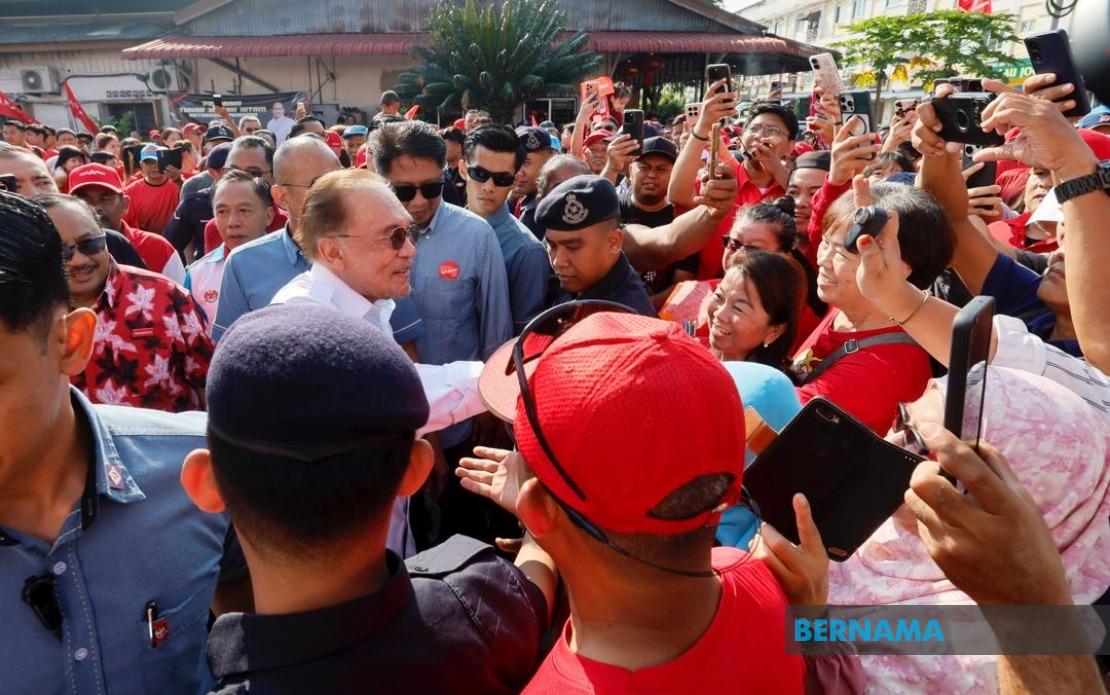
Prime Minister Datuk Seri Anwar Ibrahim's campaign engagement in the Johor state election has delivered a tangible boost to Pakatan Harapan's field operations, particularly in the competitive Machap and Layang-Layang constituencies. His presence during the campaign's critical ninth day at a community breakfast gathering in Simpang Renggam underscores the coalition's strategy of deploying top-tier leadership to consolidate support in marginal seats as the July 11 polling date approaches.
The visit carries symbolic weight beyond typical campaign theatre. For PH candidate Nur Hafiz Roslan contesting Machap, Anwar's personal appearance communicated both practical encouragement to campaign volunteers and a broader philosophical message about the campaign's underlying purpose. Nur Hafiz articulated this positioning distinctly, emphasising that the Prime Minister's intervention reoriented the machinery toward voter service rather than partisan scoring, a delicate messaging challenge in competitive state elections where cynicism about political motivation runs deep among undecided constituencies.
Anwar's messaging during the visit focused on translating electoral ambition into community-oriented governance frameworks. By reminding candidates about performing 'amal soleh'—righteous deeds—in their campaign conduct, the Prime Minister invoked religious and moral language that resonates across Malaysia's Muslim-majority and pluralistic voter demographics. This rhetorical approach attempts to differentiate Pakatan Harapan's campaign culture from opposition tactics, positioning the coalition as spiritually grounded rather than opportunistically transactional. For candidates like Nur Hafiz operating in constituencies with significant Indian Muslim and Hindu communities, this framing provides cover for inclusive governance pledges.
The geographic focus on Simpang Renggam parliamentary constituency and its two state subdivisions suggests a deliberate prioritisation of swing areas where ground organisation can shift outcomes. Layang-Layang and Machap are constituencies where small margins often determine representation, making intensive leadership engagement a calculated investment rather than ceremonial exercise. Nur Hafiz's reference to serving "all segments of the community" without prejudice indicates Pakatan Harapan's recognition that these seats encompass diverse voter constituencies requiring differentiated messaging delivered through the same candidate.
Guna Balakrishnan, contesting Layang-Layang for Pakatan Harapan, credited the Prime Minister's visit with strengthening his community engagement trajectory. His subsequent emphasis on intensifying outreach and avoiding complacency suggests that the constituency presents genuine competition, requiring sustained effort beyond the symbolic injection of momentum that leadership visits provide. Anwar's specific instruction to develop the area and support the local community if granted the mandate reflected the practical expectations voters increasingly impose on candidates in an era where post-election neglect of constituencies is well-documented and politically costly.
The public reception to Anwar's presence offers measurable data on coalition morale and voter sentiment in these critical constituencies. Over 1,000 residents attended the casual breakfast programme, suggesting accessible, non-confrontational engagement formats resonate with swing voters who feel alienated by conventional political theatre. The relaxed atmosphere Noor Takiyudin Salleh described—emphasising Anwar's approachable demeanour and the programme's informal setting—indicates that Pakatan Harapan is consciously cultivating a voter-centric brand positioning distinct from hierarchical, formal political presentations.
Individual voter testimonies provide texture to broader campaign dynamics. Chuan Chee Mei's statement that observing Anwar's direct engagement with candidates and constituencies strengthened family voting intention reflects how leadership visibility translates into household-level electoral decisions. In Malaysian campaigns where family networks often function as informal discussion forums determining vote choices, personal observations of candidate-leader relationships carry disproportionate persuasive weight. Noor Takiyudin's similar expression of voting intention following the visit suggests that the programme successfully converted neutral observation into affirmative electoral commitment.
The Johor state election framework itself—spanning 56 seats contested by 172 candidates—means these two constituencies represent approximately four percent of the electoral battlefield. However, their location within Simpang Renggam, a parliamentary constituency that shapes federal-level political calculations, elevates their significance beyond state-level implications. Pakatan Harapan's federal positioning, already strained by coalition management and governance pressures, depends partly on demonstrating capacity to consolidate state-level support. A strong Johor performance strengthens Anwar's hand in federal coalition dynamics and reinforces his authority within PKR specifically.
The campaign calendar—with early voting on July 7 and main polling on July 11—compresses the window for converting visible momentum into actual electoral support. Nur Hafiz and Guna's statements emphasising continued intensive outreach through this final week indicate awareness that Anwar's visit, while morale-elevating, initiates rather than concludes persuasion efforts. Voter recall of the Prime Minister's appearance will fade unless reinforced by consistent ground organisation and targeted messaging addressing specific constituency concerns about development, service delivery, and representation quality.
For Malaysian observers assessing Pakatan Harapan's organisational health and electoral prospects, this Johor campaign snapshot reveals coalition machinery functioning at operational baseline with leadership engagement providing directional boost. The candidate testimonies and voter responses suggest neither overwhelming momentum nor organisational crisis—rather, a coalition employing standard political mechanics to consolidate swing support in competitive terrain. The effectiveness of such efforts will ultimately register in polling day turnout and vote distribution patterns rather than pre-election campaign enthusiasm.

