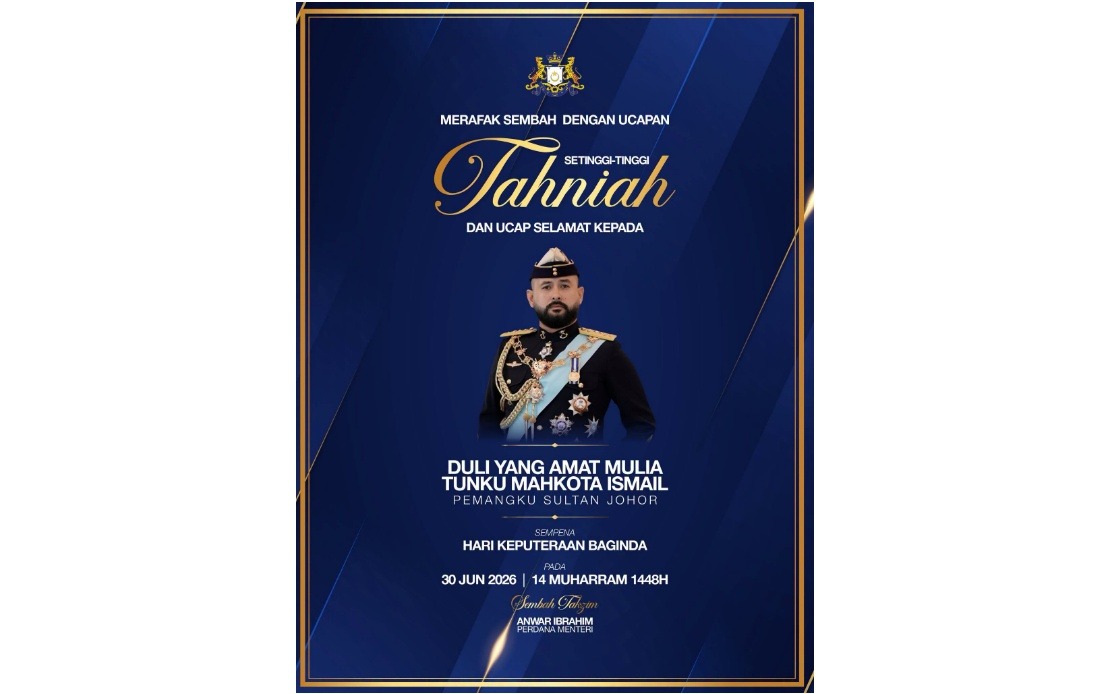
Senior government leaders have marked the birthday of Tunku Mahkota Ismail, the Regent of Johor, with formal expressions of goodwill and prayers for his wellbeing. Prime Minister Datuk Seri Anwar Ibrahim conveyed his congratulations through a Facebook post on June 30, joining Deputy Prime Minister Datuk Seri Dr Ahmad Zahid Hamidi in publicly acknowledging the royal occasion.
The exchange of birthday greetings between Malaysia's top political figures and the palace represents a continuing tradition of protocol and respect within the nation's constitutional framework. Anwar's message extended beyond mere formality, incorporating spiritual wishes for Tunku Mahkota Ismail to enjoy sustained good health, continued wellbeing, and divine grace moving forward.
Zahid's separate statement amplified similar sentiments, with the Deputy Prime Minister invoking religious blessings for the Regent's protection and longevity. His remarks carried particular significance given the symbolic importance of the role Tunku Mahkota Ismail holds within Johor's governance structure. The wishes expressed by Zahid specifically referenced the Regent's responsibilities in overseeing Johor Darul Ta'zim and safeguarding Bangsa Johor, underscoring the institutional weight attached to the position.
Johor's monarchy holds distinctive standing within Malaysia's federal framework. The state's rulers have historically wielded considerable influence over regional development, economic policy, and social matters affecting the sultanate's estimated 4.5 million residents. The Regent, as the designated heir to the throne, assumes growing significance in succession planning and the continuity of royal governance.
Public acknowledgment by senior federal ministers of important state royal occasions reinforces the collaborative relationship between Putrajaya and Johor's palace. Such gestures, while ceremonial, carry substantive weight in maintaining harmonious ties between federal and state power structures, particularly given Johor's status as one of Malaysia's most economically developed and strategically important regions.
The use of social media platforms like Facebook to convey these messages reflects contemporary protocols for official communication. Both Anwar and Zahid chose direct public channels to ensure broad visibility of their respectful engagement, a practice consistent with modern governance communication while adhering to traditional expectations of deference towards royalty.
Tunku Mahkota Ismail has assumed an increasingly prominent public profile in recent years, particularly through his involvement in economic initiatives, youth engagement, and regional development projects. His birthday observances typically generate wider acknowledgment from business leaders, cultural figures, and community representatives beyond the political establishment, reflecting his influence across Johor's social landscape.
The timing of such greetings during the middle of the year coincides with Malaysia's broader calendar of royal observances and state celebrations. For federal leaders, participating in these occasions represents both ceremonial duty and an opportunity to reinforce their commitment to constitutional monarchy and the federation's hierarchical respect for royal institutions.
Religious references embedded in both messages, invoking Allah's blessings and protection, align with Malaysia's Islamic governance framework and the traditional fusion of constitutional monarchy with Islamic principles that characterizes the nation's political system. Such language is customary in official communications involving the royal family and reflects broader cultural expectations within Malaysian political discourse.
The exchange also underscores the importance of maintaining functional relationships between federal and state leadership regardless of broader political differences or party affiliations. Birthday acknowledgments serve as occasions where formal protocol overrides other considerations, demonstrating institutional commitment to continuity and respect across Malaysia's layered governance structures.
For observers of Malaysian political dynamics, such interactions provide subtle indicators of state-federal relations and the stability of institutional frameworks governing the federation. The absence of controversy or notable tension in these routine courtesies suggests operational smoothness in federal-state coordination, an important baseline for national governance effectiveness.

