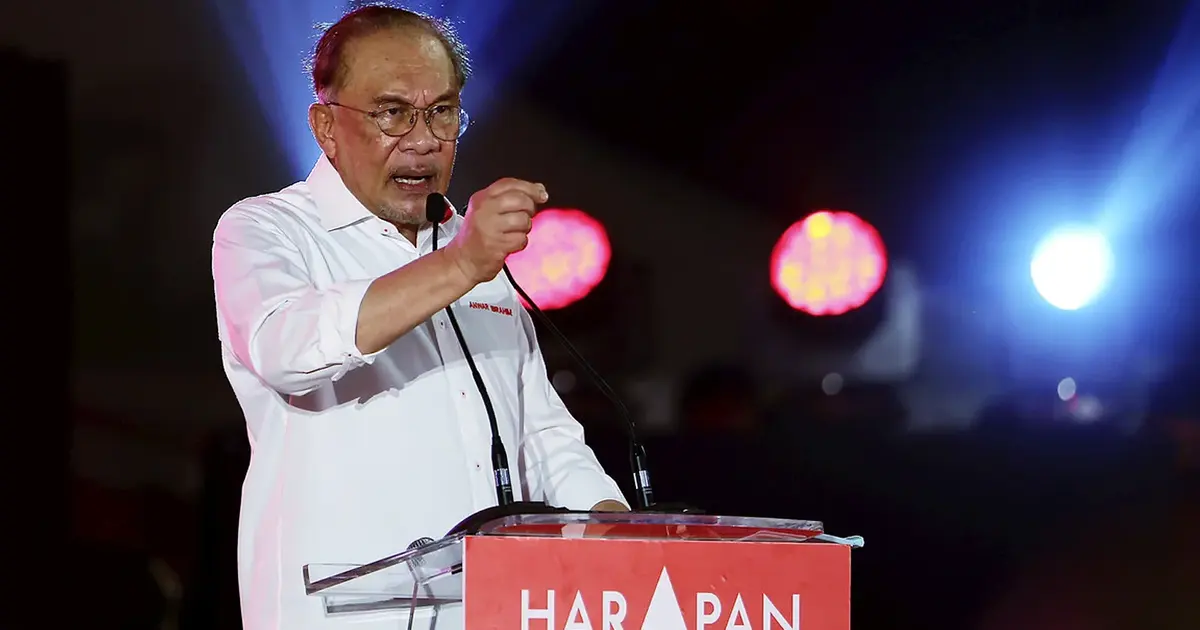
Prime Minister Anwar Ibrahim, in his capacity as Pakatan Harapan chairman, has issued a stern appeal to all contesting political parties to keep the Negeri Sembilan royal institution insulated from the intense campaigning expected during the state election. The warning reflects growing concern within the coalition about the potential for electoral competition to blur into territory traditionally considered off-limits in Malaysian politics.
Anwar's directive addresses a recurring tension in Malaysian electoral contests: the fine line between robust political debate and the protection of constitutional institutions that command reverence across the political spectrum. By explicitly cautioning against dragging the palace into campaign narratives, the premier is attempting to establish guardrails that preserve institutional dignity even as parties compete fiercely for voter support in the resource-rich state.
Negeri Sembilan's political landscape has proven volatile in recent years, with power shifting between coalitions and internal defections reshaping the state assembly's composition. The upcoming election occurs against this backdrop of flux, making the stakes particularly high for both government and opposition forces. Yet Anwar's intervention suggests that despite this competition, there remains recognition of boundaries that should not be crossed, particularly those surrounding the monarchy.
The royal institution occupies a constitutionally protected position within Malaysia's system of governance. The Yang di-Pertuan Agong at the federal level and the sultans at the state level serve as symbols of national and state unity respectively. Negeri Sembilan's royal house, with its own distinctive constitutional arrangements and historical significance, holds particular importance to residents of the state. Any attempt to weaponise palace-related issues for electoral advantage could undermine public confidence in these institutions.
Anwar's stance also carries implications for Malaysia's broader political culture. In recent years, critics have expressed concern about the increasing tendency of some political actors to exploit sensitive issues—including those touching on religion, royalty, and race—to energise their base. By taking a public position against such tactics, the prime minister signals that PH, despite its electoral vulnerabilities in Negeri Sembilan, will not descend into such strategies.
For opposition parties, the warning serves as a reminder of established norms, though it also implicitly acknowledges that some elements might be tempted to cross that line. In a state where control of government carries significant patronage benefits and policy influence, the temptation to use all available tools can be considerable. Anwar's preemptive statement attempts to inoculate the campaign against such temptations by establishing clear expectations beforehand.
The timing of the statement also matters. By raising the issue before the formal campaign period, Anwar frames respect for institutions as a foundational principle rather than a reactive complaint. This positioning is particularly important for PH, which, as the incumbent federal government, bears responsibility for modelling the political conduct it expects from others. A failure to maintain institutional boundaries could invite accusations of hypocrisy if the coalition later criticises opponents for similar transgressions.
Negeri Sembilan's electoral dynamics carry weight beyond the state itself. As one of Malaysia's smaller states by population, it nonetheless wields significance within the federal balance of power. Coalition composition at the state level can influence national political trajectories, and electoral outcomes in Negeri Sembilan often signal broader voter sentiment. This makes the need for a principled, bounded campaign particularly important—a state election conducted on substantive policy grounds rather than institutional provocation strengthens the legitimacy of the eventual government.
The appeal also reflects practical political wisdom. Campaigns that remain focused on deliverables—economic growth, infrastructure development, education quality—tend to produce more durable electoral mandates than those that rely on emotional appeals tied to sensitive institutions. Voters increasingly appreciate substantive engagement with their concerns, whether those concerns relate to job creation, cost of living, or quality of public services.
For Malaysian voters in Negeri Sembilan, Anwar's statement provides reassurance that the election will be conducted within established constitutional and cultural frameworks. It acknowledges that political competition, however intense, operates within boundaries that protect institutions fundamental to the nation's system. This reinforces the principle that elections determine which party governs, not which party threatens the constitutional order itself.
The implementation of this principle will require vigilance throughout the campaign period. Both PH and opposition parties will face moments of temptation when invoking palace-related narratives might yield short-term electoral advantage. Resisting these temptations, however difficult, remains essential for maintaining the distinction between legitimate political contestation and institutional transgression that Malaysian politics has traditionally observed.

