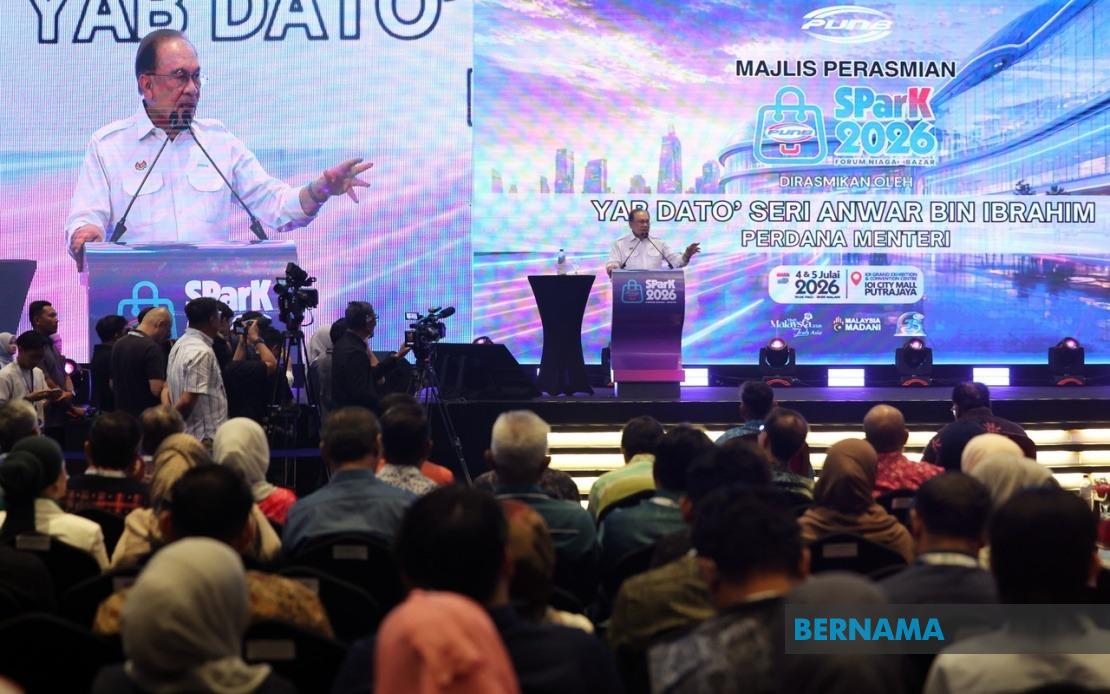
Prime Minister Datuk Seri Anwar Ibrahim delivered a forceful message at the SPaRK 2026 summit organised by Perbadanan Ushawan Nasional Bhd that Malaysia must fundamentally overhaul how government agencies distribute business financing. Speaking in his dual capacity as Prime Minister and Finance Minister, Anwar singled out the endemic practice of using letters of support and political patronage to secure loans and grants for entrepreneurs, characterising it as a systemic rot that has persisted for decades and actively undermines the nation's economic development.
The Prime Minister articulated a stark diagnosis of how these corrupt practices damage the public interest. When government agencies award financing based on political proximity rather than business fundamentals, Anwar explained, the inevitable consequence is a cascade of failed ventures that drain public resources and squander taxpayer money. He illustrated the problem through concrete examples, describing scenarios where recipients of government assistance immediately channelled funds into lifestyle improvements—upgrading to prestige office premises, purchasing luxury vehicles—rather than investing capital productively into their enterprises. These businesses predictably collapsed within months or years, having never been operationally sound to begin with.
The root cause, according to Anwar, traces back to a deeply entrenched culture of patronage networks. Entrepreneurs secured financing not because their business plans demonstrated viability or their credentials showed competence, but because they possessed the right political connections. Anwar used colourful language to describe these eligibility shortcuts, referring to "yellow, green, blue letters"—coded references to the various political faction letters that functioned as golden tickets to approval. He emphasised that this practice served primarily to shield government agencies from scrutiny, allowing officials to justify their decisions through the presence of an ostensible endorsement rather than rigorous assessment.
Crucially, Anwar distinguished between business failures attributable to legitimate market forces and those resulting from systemic corruption. The Prime Minister acknowledged that some enterprises inevitably fail due to macroeconomic conditions, sectoral downturns, or genuine market competition—outcomes that governments cannot and should not attempt to prevent. Malaysia's business environment, like all economies, experiences natural attrition where even well-conceived ventures sometimes falter due to circumstances beyond an entrepreneur's control. This category of failure represents an acceptable cost of a functioning market economy.
What Anwar refused to tolerate, however, was the systematic misallocation of public capital to individuals without genuine entrepreneurial commitment or capacity. He positioned transparency and genuine dedication as the twin pillars of whether an entrepreneur deserves government support. Agencies must conduct thorough due diligence into applicants' business plans, financial projections, industry knowledge, and track records. Funding decisions should rest on measurable criteria: demonstrated market need, realistic financial projections, the applicant's relevant experience, and clear evidence of capital commitment. By contrast, a letter from a politician or proximity to a government minister should carry zero weight.
For Malaysian entrepreneurs seeking government financing, Anwar's message carries significant implications. The traditional pathway of cultivating political connections and securing endorsement letters will no longer guarantee approval. Government agencies will face new accountability pressures to justify their lending decisions on objective grounds. This shift promises to level the playing field somewhat, allowing genuinely capable entrepreneurs from outside political networks to access support previously monopolised by connected insiders. However, it also raises the bar: applicants must now present compelling, professionally developed business cases rather than relying on patronage.
The broader context for Anwar's intervention reflects growing frustration within government circles at how extensively cronyism has compromised entrepreneurial development initiatives. Malaysia has invested substantially in programmes designed to nurture small and medium enterprises, yet default rates and failure rates have remained stubbornly high. Much of this underperformance stems directly from funding decisions made on political rather than commercial grounds. By attacking this root cause, Anwar is attempting to salvage return on investment from existing programmes and improve their effectiveness going forward.
For Southeast Asian observers, Malaysia's struggle with political patronage in business financing mirrors challenges across the region. Thailand, the Philippines, and Indonesia all grapple with similar dynamics where political connections frequently trump merit in determining access to government resources. Anwar's explicit commitment to meritocratic reform, should it be implemented rigorously, could establish a regional benchmark and create political space for neighbouring governments to pursue similar accountability measures. Conversely, if implementation remains inconsistent or if political pressure eventually erodes these new standards, the episode will reinforce perceptions that structural anti-corruption commitments remain largely rhetorical across Southeast Asia.
The success of Anwar's reform agenda depends critically on institutional capacity and political will. Government agencies responsible for entrepreneur financing must invest in rigorous assessment capabilities—hiring experienced evaluators, developing standardised evaluation frameworks, and creating transparent appeal mechanisms. Equally important will be shielding these assessments from political interference, which requires insulating agency heads from pressure and establishing clear performance metrics focused on portfolio quality rather than volume of approvals. Without these institutional supports, announced reforms risk becoming merely cosmetic adjustments that leave underlying patronage networks intact.
Anwar's initiative also speaks to a broader governance philosophy. His message suggests belief that government can and should actively shape the business environment through deliberate capital allocation, but that this power must be exercised according to rational, transparent criteria rather than factional interests. This represents a more sophisticated economic nationalism than simple protectionism—not blocking foreign competition, but ensuring Malaysian entrepreneurs compete based on merit while receiving support scaled to their genuine capabilities. Whether this aspirational vision can be operationalised across Malaysia's sprawling bureaucracy remains the critical open question.

