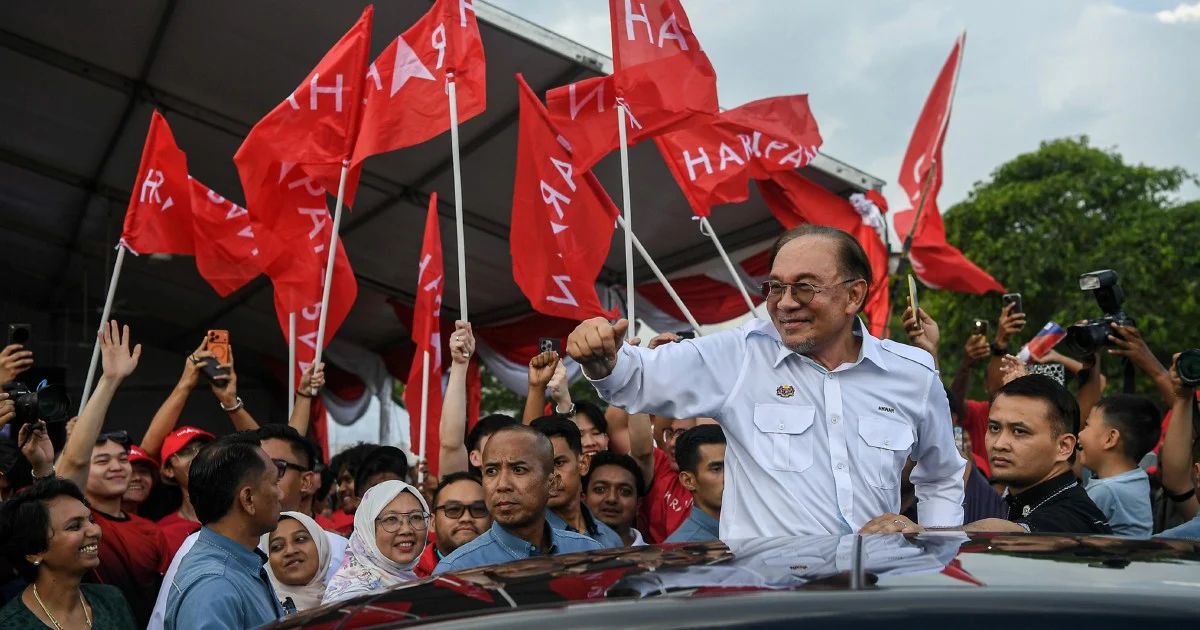
The leader of Pakatan Harapan has taken aim at fellow politicians who steadfastly refuse to engage with or appear alongside the Democratic Action Party, contending that such recalcitrant behaviour undermines the democratic process and disrespects the wishes of Malaysian voters. Speaking during a campaign event in Segamat, Datuk Seri Anwar Ibrahim expressed disappointment at what he characterised as an increasingly untenable political stance—one that prioritises personal grievances or ideological rigidity over the inclusive governance structures that electoral democracy demands.
Anwar's remarks signal growing frustration within the ruling coalition at what PH perceives as calculated efforts to isolate DAP despite its substantial representation in Parliament and its role as a cornerstone of the federal government. The implicit message carries particular weight given Malaysia's recent political volatility and the fragile coalitions that have governed the country since 2020. By calling out those who reject collaboration on principle rather than policy grounds, the Prime Minister is reinforcing the notion that democratic legitimacy—conferred through the ballot box—cannot be dismissed by MPs or party leaders simply because they disagree with a coalition partner's ideology or composition.
The criticism reflects deeper tensions within Malaysia's multiethnic political landscape. DAP, as a predominantly Chinese-led party, has historically faced opposition rooted in communal politics, with detractors questioning both its political motivations and suitability for governance roles. However, Anwar's intervention suggests that the PH leadership views such positions as increasingly untenable in a modern democracy where voters themselves have repeatedly endorsed multiracial coalitions. His appeal to respect electoral outcomes effectively reframes the debate: no longer is the question whether DAP should participate in government, but whether those who lost the election have the moral authority to unilaterally exclude a party that voters chose to elevate.
For Malaysian observers, this statement carries significant implications for coalition stability. The peripatetic nature of Malaysian politics—with MPs and parties switching allegiances with relative frequency—means that any coalition government must work continuously to maintain cohesion. Anwar's public rebuke of those refusing to share platforms with DAP serves a dual purpose: it appeals to internal PH discipline while also signalling to voters that the coalition remains committed to its multiracial, inclusive platform. This matters enormously in the context of upcoming state elections and the inevitable campaign for the 15th general election, where messaging around unity and democratic legitimacy will prove decisive.
The Segamat venue for these remarks is likewise noteworthy. The Johor constituency sits within a state where PH's electoral fortunes have fluctuated considerably and where communal sensitivities remain pronounced. By making such a bold statement in this context, Anwar was deliberately testing and shaping political discourse in challenging terrain. He was essentially telling voters—both those inclined toward PH and those considering alternatives—that respect for democratic outcomes supersedes partisan or communal reservation. This positioning potentially inoculates PH against accusations that it imposes DAP on unwilling constituencies, flipping the script to suggest instead that rejecting DAP means rejecting the voters themselves.
From a Southeast Asian perspective, Anwar's intervention also reflects a broader conversation about democratic maturation. In regions where multiethnic politics remains contested or where single-party dominance has prevailed for decades, the ability of losing parties or dissenting politicians to accept electoral verdicts and work constructively with partners they oppose represents genuine democratic progress. By insisting that Malaysian politicians rise above reflexive opposition to DAP, Anwar is positioning Malaysia as a democracy where results matter and where inclusive coalitions are non-negotiable outcomes of the electoral process rather than matters of personal preference.
The timing of these remarks warrants consideration as well. With Malaysia's political landscape remaining fluid and with various power brokers constantly assessing coalition configurations and electoral strategies, Anwar's words serve as a corrective to any narrative suggesting that DAP's position within PH remains contingent or negotiable. They represent a firm commitment to the party as an integral component of the coalition's identity and governance platform. This clarity becomes increasingly important as speculation continues about potential realignments ahead of the next general election.
Criticism of Anwar's position would likely centre on the argument that politicians should indeed have the freedom to choose which partners they collaborate with and which platforms they occupy. From this perspective, forcing or pressuring politicians to engage with parties they fundamentally oppose could be seen as undermining individual agency. However, Anwar's framing sidesteps this objection by anchoring his argument in democratic principle: if voters have chosen to create a multiracial coalition government, then that outcome deserves respect and implementation, regardless of politicians' personal preferences.
The remarks also carry implications for how Malaysia's civil society and institutional actors view coalition governance. If politicians can simply opt out of collaborating with constitutionally legitimate partners, the capacity of governments to function effectively diminishes considerably. Anwar's intervention therefore serves broader governance interests beyond mere coalition politics. He is articulating a vision of Malaysian democracy where election results translate into functional, inclusive governments rather than fragmentary arrangements riven by internal sabotage and non-cooperation. Whether his message resonates with audiences beyond the PH faithful remains an open question that will likely dominate political discourse in the months ahead.

