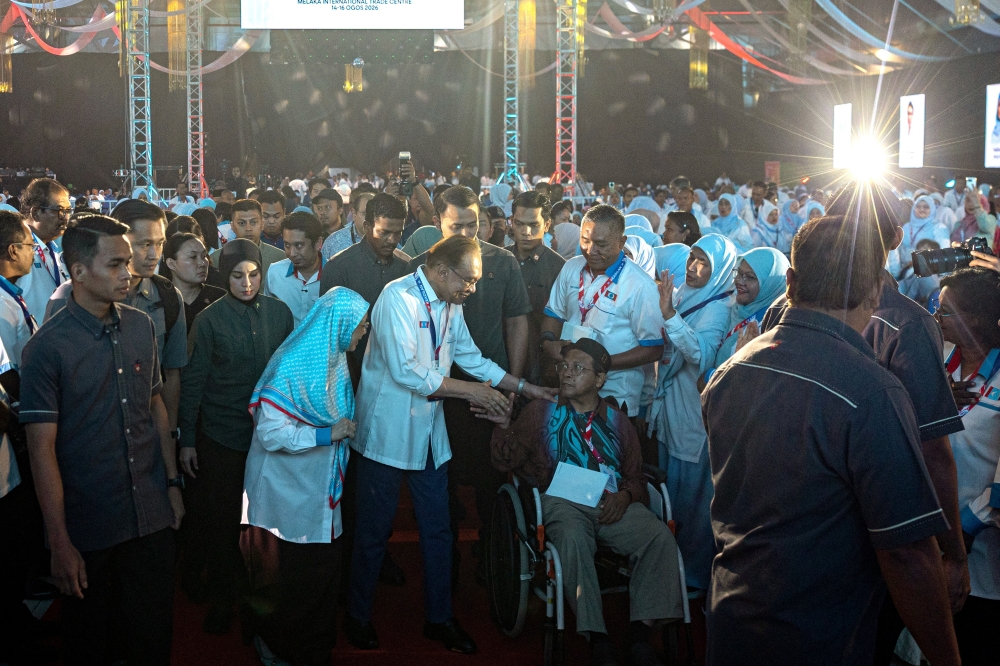
Prime Minister Datuk Seri Anwar Ibrahim has counselled PKR members to adopt a rational framework when evaluating potential arrangements with Umno, emphasising that policy choices affecting the nation's trajectory ought to be rooted in tangible benefits for Malaysians rather than emotional responses to historical disputes. Speaking at a gathering of party delegates in Melaka, the PKR president articulated a vision of coalition governance that transcends the personalised grievances and factional animosities that have characterised Malaysian politics for decades.
Anwar's intervention comes at a delicate juncture for the ruling coalition, where ideological tensions between modernist and traditionalist camps within the government continue to generate friction. The PKR leader's insistence on divorcing practical governance from sentiment-driven decision-making reflects a deliberate strategy to anchor coalition stability on institutional interests rather than the volatile terrain of party rivalries. This rhetorical move signals to grassroots party members that pragmatic flexibility, even with former adversaries, may be necessary to sustain the current political arrangement.
The question of Umno's role in the federal government remains one of Malaysia's most contentious political flashpoints. Umno, which governed the country for nearly seven decades before its 2018 electoral collapse, retains substantial organisational capacity and rural support networks. Yet within opposition parties and civil society circles, deep suspicion persists regarding Umno's historical record on governance standards and institutional accountability. Anwar's framing represents an attempt to navigate this paradox—acknowledging Umno's political weight while insisting that any collaboration must be judged by measurable outcomes for ordinary Malaysians.
The distinction Anwar draws between rational interest and emotional reaction carries particular resonance given the fraught personal and political history between PKR and Umno. Members of the reformasi movement, which PKR embodies, endured sustained conflict with Umno-dominated administrations during the 1990s and 2000s. For many PKR supporters, any accommodation with Umno evokes memories of those struggles. By explicitly urging delegates to subordinate such memories to collective welfare considerations, Anwar is attempting to reshape party culture and establish new norms around coalition governance.
From a Southeast Asian perspective, this approach reflects evolving patterns in regional coalition politics. Increasingly, countries across the region are experiencing fragmented parliaments where no single party commands majority control, forcing leaders to construct governing coalitions across ideological boundaries. Thailand, Indonesia, and the Philippines have all grappled with similar challenges of forging stable multi-party governments. Malaysia's experience with coalition management thus holds instructive lessons for neighbouring democracies navigating comparable terrain.
The emphasis on people's welfare as the ultimate arbiter of political decisions also addresses a substantive governance challenge. Malaysia's economy faces structural headwinds including persistent inflation, volatile currency markets, and competitive pressures from regional competitors. Energy transition imperatives, demographic shifts, and fiscal constraints demand coherent policy responses that transcend factional squabbling. Anwar's rhetoric positions coalition stability as instrumental to addressing these material concerns rather than an end in itself.
Yet the underlying tension in Anwar's argument warrants scrutiny. Asking party members to separate emotion from interest-based calculations understates how deeply partisan identities intersect with personal identity and sense of political community. For committed PKR activists, skepticism toward Umno may reflect not merely sentiment but considered judgments about institutional cultures and values. The rhetorical move to position such concerns as illegitimate "anger" risks delegitimising legitimate critiques of governance standards and democratic institutions.
The PKR president's intervention also reflects awareness that coalition durability depends on managing grassroots expectations. If ordinary members perceive their leaders as capitulating to former enemies without securing substantive concessions, morale deteriorates and party cohesion fractures. By framing pragmatic accommodation as serving the public interest, Anwar attempts to repackage flexibility as principled governance rather than mere opportunism.
Moreover, Anwar's emphasis on welfare-focused decision-making connects to broader debates about what constitutes legitimate political competition in Malaysian democracy. The argument that national interest ought to supersede factional rivalry reflects aspiration toward institutional governance norms comparable to established democracies. Yet Malaysia's political culture has historically been more personalised and faction-driven, complicating efforts to institutionalise such norms.
Looking forward, how effectively Anwar can embed these principles within PKR will substantially influence the stability and coherence of Malaysia's coalition government. If party culture shifts toward results-oriented evaluation of political partnerships, it could facilitate more pragmatic approaches to governance challenges. Conversely, if members interpret such messaging as leadership attempts to override legitimate concerns about principles and institutional accountability, backlash may undermine the very coalition stability Anwar seeks to strengthen.
The PKR president's comments ultimately constitute an attempt to reorient Malaysian coalition politics toward substantive governance outcomes rather than historical grievances. Whether this aspirational vision can survive contact with the complex realities of managing multi-party governance remains an open question requiring sustained attention and implementation.

