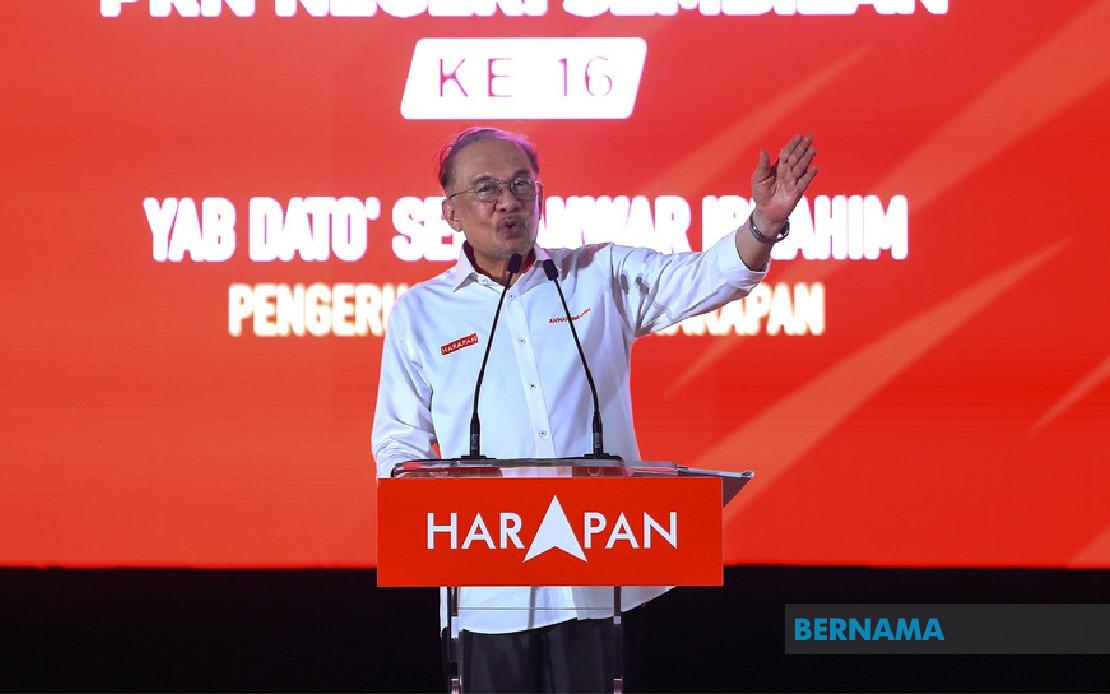
Prime Minister Datuk Seri Anwar Ibrahim has made a direct appeal to voters in Negeri Sembilan to grant Pakatan Harapan another mandate in the upcoming state election, positioning continuity of development as a central campaign message ahead of polling on August 1st. Speaking through social media on July 16, Anwar framed the electoral choice as pivotal for maintaining the trajectory of infrastructure and public service improvements that the state has experienced under the current administration.
As both Prime Minister and chairman of Pakatan Harapan, Anwar highlighted the productive working relationship between the state government and Federal administration as a crucial factor enabling major development initiatives. He stressed that while substantial progress has been achieved through this collaborative approach, significant work remains unfinished. The messaging reflects a broader PH strategy across contested states: leveraging federal-state synergies to demonstrate tangible governance benefits to voters who might otherwise be tempted by alternative coalitions.
Anwar's remarks centred on praise for Menteri Besar Datuk Seri Aminuddin Harun, whom he credited with steering Negeri Sembilan since 2018 with integrity and humility. The Prime Minister's use of the informal honorific "Tok Min" suggested an attempt to build personal connection and credibility around the incumbent leadership. This approach implicitly positions PH not merely as a political coalition but as custodians of responsible, principled governance—a messaging strategy increasingly important as Malaysian voters grow more performance-oriented in their electoral calculus.
The appeal carried an implicit warning about potential disruption to development momentum should voters shift allegiance. Anwar cautioned against allowing "the progress we have built together come to a halt halfway," a phrase designed to invoke concern about losing accumulated gains and reverting to earlier patterns of slower or misaligned development. For a state like Negeri Sembilan, which has competed with more developed neighbours for economic investment and infrastructure spending, this narrative of continuous improvement holds particular resonance.
Anwar framed voting for PH as guaranteeing stable, clean administration focused on public welfare. This emphasis on governance quality reflects lessons from Malaysia's recent political volatility, where coalitional instability and administration changes have disrupted planning cycles and project implementation. By positioning PH as the custodian of predictable, ethical governance, Anwar addresses voter anxiety about political uncertainty—a concern that transcends typical partisan divisions.
The electoral timeline outlined in the announcement provided a structured roadmap: nominations on July 23, early voting on July 28, and general polling on August 1. This compressed schedule compressed into approximately two weeks reflects modern Malaysian electoral management, though it also limits time for extended campaigning. For Anwar's message to gain traction, PH's ground organisation would need to mobilise rapidly and ensure the continuity-of-development narrative reached voters effectively across the state's different demographic and geographic segments.
Negeri Sembilan's political composition makes the state a meaningful battleground. As a mid-sized state with moderate urbanisation, it attracts investments in both urban infrastructure and rural development programmes. Competition for state control therefore translates into real questions about resource allocation, project prioritisation, and administrative efficiency. Voters in the state have demonstrated capacity to split support between different coalitions at federal and state levels, suggesting receptiveness to performance-based rather than purely ideological voting.
The emphasis on administrative continuity carries particular weight given Malaysia's experience with frequent leadership transitions. The five-year tenure of Aminuddin Harun, by Malaysian standards, represents substantive experience in the menteri besar role. Anwar's messaging implicitly contrasts this stability with the disruptive effects of repeated changes in state administrations elsewhere, where development projects have been derailed, redirected, or abandoned following electoral shifts.
For Malaysian readers and regional observers, Anwar's intervention underscores the ongoing struggle for electoral dominance in states where PH's control remains contestable. Unlike states with entrenched PH majorities, Negeri Sembilan requires active federal-level engagement and messaging to maintain momentum. The Prime Minister's personal involvement in campaigning suggests PH strategists view the state as genuinely competitive, rather than safely held. This assessment reflects broader demographic and political shifts that have made fewer Malaysian states secure for any single coalition.

