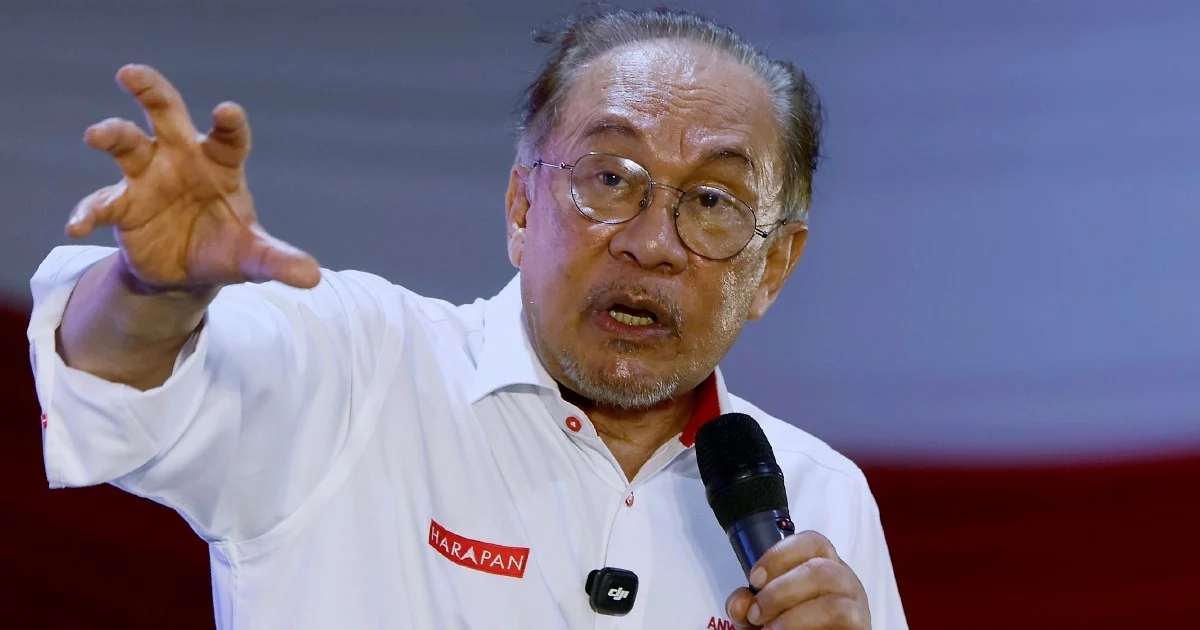
Prime Minister Datuk Seri Anwar Ibrahim has called on all political parties participating in the Johor state election to cease leveraging Datuk Seri Najib Razak's release as a tool for political campaigning. The warning, delivered during remarks in Kulai, represents an attempt by the federal leadership to establish boundaries around one of Malaysia's most contentious and divisive contemporary issues as the electoral contest heats up.
The former Prime Minister's release from Sungai Buloh prison in August 2024, following the annulment of his conviction in the landmark SRC International case, has remained a flashpoint in Malaysian politics. Najib's legal reversal came after years of litigation and public debate that fundamentally split the nation along political and ideological lines. Since his return to public life, competing political factions have sought to weaponise his status—either attacking the decision as a betrayal of accountability or hailing it as a vindication of injustice.
Anwar's intervention suggests that the federal government perceives the Najib issue as threatening to derail substantive policy discussions during the Johor campaign. The state election holds particular significance for Barisan Nasional, which has governed Johor uninterrupted since Malaysian independence. However, mounting pressure from opposition coalitions and internal party dynamics have created a more volatile electoral environment than in previous cycles. By discouraging the use of Najib's release as campaign material, the Prime Minister appears to be signalling concern that emotional appeals around his former predecessor could distract voters from evaluating parties on governance credentials and developmental records.
The timing of Anwar's statement is strategically notable. Recent weeks have witnessed intensifying rhetoric from various political quarters, with opposition figures invoking Najib's freedom as evidence of perceived double standards within the judiciary and the Pakatan Harapan-led administration. Meanwhile, defenders of the outcome have argued that the Federal Court's decision reflected legal merit rather than political interference. Each narrative carries substantial appeal to different voter segments, making the issue inherently volatile during an election period when partisan temperature runs highest.
For Malaysian voters in Johor and beyond, the Prime Minister's call represents a challenge to move beyond personalised attacks and historical grievances toward forward-looking evaluations of competing visions for governance. Johor's electorate encompasses diverse communities with varying perspectives on accountability, justice, and political rehabilitation. Some view Najib's restoration as evidence of the judicial system's capacity to correct errors, while others remain convinced it represents a diminishment of institutional integrity. The state election campaign inevitably forces these competing worldviews into the public arena.
Anwar's appeal also reflects broader anxieties within the coalition government about cohesion and messaging discipline during the campaign period. Multiple parties operating under different banners and ideological frameworks inevitably gravitate toward divisive issues when unified messaging proves elusive. By establishing a norm against exploiting Najib's release, the Prime Minister may be attempting to create space for government-aligned parties to consolidate messaging around economic performance, infrastructure development, and social service delivery—areas where incumbent administrations typically enjoy rhetorical advantages.
From a Southeast Asian perspective, Malaysia's approach to managing the political fallout from high-profile judicial decisions differs notably from neighbouring jurisdictions. The region has witnessed several instances of former leaders facing legal jeopardy, yet Malaysia's willingness to subject these matters to public debate during active election campaigns remains comparatively distinctive. Most established democracies in the region have developed stronger norms discouraging the instrumental weaponisation of legal proceedings for electoral advantage, though the practice remains far from extinct.
The Johor election itself represents a critical test for all governing coalitions. Barisan Nasional's unprecedented losing of Putrajaya in 2018, followed by a complex transition through various coalition arrangements, has created uncertainty about the party's foundational strength. Whether Johor voters prioritise traditional loyalty, economic considerations, or symbolic issues like the Najib case will substantially influence outcomes. The Prime Minister's intervention suggests awareness that the Najib issue cuts unpredictably across typical demographic and political lines, making it inherently dangerous for electoral calculations.
Opposition parties and political commentators have responded variously to Anwar's directive. Some view the call as consistent with efforts to elevate political discourse, while critics argue it represents an attempt to suppress legitimate public discussion of judicial accountability. The controversy itself underscores the profound polarisation that Najib's case has engendered in Malaysian public consciousness—so deep that even procedural calls for civility become contested political terrain.
Looking forward, the Johor campaign will ultimately demonstrate whether political parties respect Anwar's appeal or continue exploiting the Najib issue. Success in establishing campaign norms would represent a positive development for Malaysian electoral culture. Conversely, continued weaponisation of the case would confirm the extent to which institutional questions have become inseparable from partisan competition. The outcome carries implications extending well beyond Johor, potentially shaping how future electoral contests address similar highly polarised and historically significant matters.

