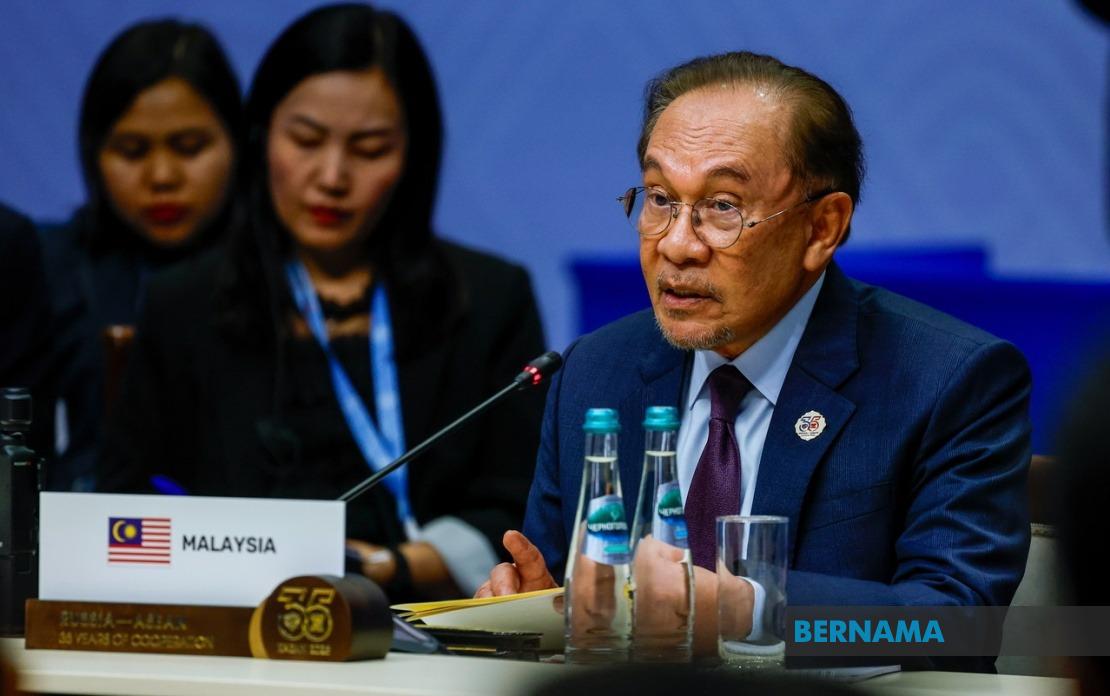
Prime Minister Datuk Seri Anwar Ibrahim has called for ASEAN and Russia to build a more robust strategic partnership, emphasising that sustained dialogue and peaceful resolution must remain central to addressing the world's mounting geopolitical fractures. Speaking at the ASEAN-Russia Commemorative Summit in Kazan on June 18, Anwar positioned the gathering as a crucial platform for both blocs to chart collaborative pathways through an increasingly volatile global landscape marked by competing interests and military posturing.
The summit, marking 35 years since ASEAN and Russia first formalised their relationship in Kuala Lumpur in 1991, brought together regional leaders including Philippines President Ferdinand Marcos Jr, who holds this year's ASEAN chairmanship, alongside delegations from all 10 ASEAN member states. The two-day gathering represents the highest-level mechanism for dialogue between the two sides, offering an opportunity to move beyond rhetoric and translate shared interests into concrete initiatives that can benefit their respective economies and populations.
Anwar underscored Malaysia's conviction that genuine and enduring peace emerges exclusively through constructive engagement, mutual comprehension, and adherence to the established international legal framework. This position, rooted in Malaysia's long-standing non-aligned foreign policy tradition, reflects Kuala Lumpur's determination to navigate between major powers without abandoning its principles regarding conflict resolution and respect for sovereign rights. The emphasis on dialogue carries particular weight given contemporary tensions between Western-aligned nations and Russia, with ASEAN nations increasingly seeking middle ground rather than picking sides in escalating confrontations.
The Malaysian premier identified several domains where ASEAN and Russia possess significant untapped potential for deepened collaboration. Trade and investment flows, though growing, remain relatively modest compared to ASEAN's engagement with other major powers, suggesting considerable room for expansion. The digital economy and emerging technologies represent another frontier, with both regions recognising that artificial intelligence, cybersecurity, and digital infrastructure will define competitive advantage in coming decades. Energy cooperation holds particular relevance for ASEAN, many of whose members face rising power demands and energy security concerns; Russia's substantial hydrocarbon resources and technological expertise in energy production align naturally with regional needs.
Food security emerged as another priority in Anwar's address, reflecting ASEAN's vulnerability to global supply disruptions and climate-induced agricultural challenges. The halal industry, a significant economic sector dominated by Muslim-majority ASEAN nations, represents an increasingly important collaboration vector, particularly given Russia's growing Muslim population and interest in halal-certified products. People-to-people exchanges, cultural cooperation, and educational partnerships would strengthen the human dimension of bilateral relations, fostering understanding that transcends governmental agreements and creates lasting foundations for partnership.
On Middle Eastern affairs, Anwar reiterated Malaysia's longstanding stance demanding an immediate halt to violence in Gaza, insisting that humanitarian corridors remain open for essential aid delivery, and advocating for Palestinian self-determination rights. These positions reflect Malaysia's historical solidarity with Palestinian causes and its broader commitment to supporting developing nations against what it views as unjust international arrangements. The prime minister additionally condemned the expansion of Israeli military operations into Lebanon and rejected any attacks on UNIFIL, the UN peacekeeping mission, signalling ASEAN's concerns about escalating regional militarisation and its potential consequences for global stability.
The summit is expected to produce four significant outcome documents that will shape bilateral cooperation architecture for years ahead. The Kazan Declaration commemorating 35 years of ASEAN-Russia relations will serve as a symbolic reaffirmation of partnership continuity. Separate joint statements on energy and cultural cooperation will establish specific frameworks for advancing these crucial sectors. Most substantially, a comprehensive action plan spanning 2026 to 2030 will provide detailed pathways for implementing the ASEAN-Russia Strategic Partnership, transforming general aspirations into measurable commitments with defined timelines and responsibilities.
These documents represent more than ceremonial outcomes; they constitute binding frameworks that will guide bureaucratic machinery and resource allocation across both blocs. The plan's forward-looking timeframe, extending to 2030, suggests an intention to build resilience and future-readiness into the partnership, accounting for anticipated technological shifts, demographic changes, and evolving security environments. By establishing concrete mechanisms and benchmarks, ASEAN and Russia signal seriousness about moving beyond episodic engagement toward sustained institutional cooperation.
For Malaysia and other ASEAN nations, this partnership carries distinct implications. As middle powers navigating between competing great-power interests, ASEAN states benefit from maintaining multiple partnerships rather than alignment with any single bloc. Strengthening ASEAN-Russia ties provides valuable leverage, diversifies economic opportunities, and amplifies ASEAN's collective voice in international forums. The emphasis on non-coercive cooperation, mutual benefit, and respect for international law reflects ASEAN's preference for rules-based engagement, even as global institutions face mounting strain and unilateral actions become increasingly common.
Anwar's framing of the partnership as fundamentally rooted in shared respect and mutual advantage distinguishes this engagement from transactional relationships where power disparities drive outcomes favourable to stronger parties. This approach aligns with ASEAN's foundational non-interference principle and its insistence that dialogue must supersede confrontation. As regional tensions mount and external powers expand their strategic footprints throughout Southeast Asia, such affirmations of dialogue-based diplomacy provide essential counterweights to militarisation trends.
The summit's timing carries significance beyond its ceremonial dimensions. With geopolitical competition intensifying across multiple domains—from Indo-Pacific maritime disputes to emerging technology standards—both ASEAN and Russia face pressures to clarify their strategic orientations and alliance commitments. By convening at the highest levels and producing substantial cooperative frameworks, both sides demonstrate commitment to pursuing shared interests despite international divisions. For ASEAN, which has long sought to maintain strategic autonomy amid great-power competition, such partnership initiatives reinforce the region's capacity to shape its own destiny rather than becoming merely a contested arena for external powers.
The comprehensive nature of proposed cooperation—spanning security dialogue, economic integration, technology development, and cultural exchange—suggests recognition that sustainable partnerships require multidimensional engagement. Focusing solely on security or commercial interests risks fragility; partnerships grounded in diverse collaborative ventures prove more resilient to disruption from any single sector. This holistic approach mirrors ASEAN's own institutional design, which emphasises connectivity across multiple domains as prerequisite for regional stability and prosperity. As both ASEAN and Russia face uncertain futures shaped by unpredictable technological change and shifting power distributions, deepening their partnership through such comprehensive frameworks provides each with valuable strategic flexibility and alternative pathways for advancing national interests.