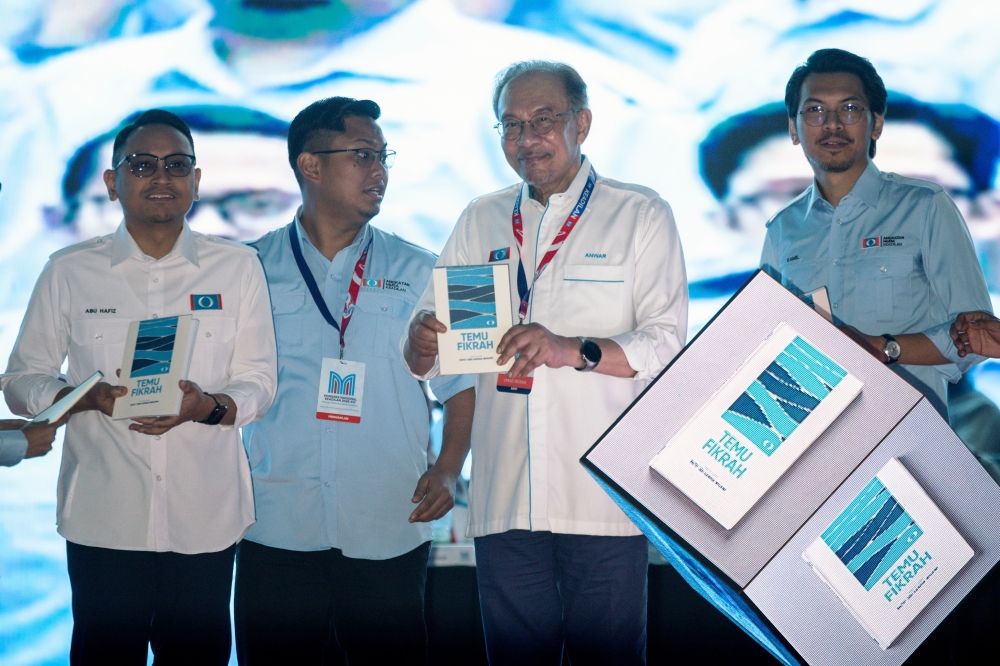
Prime Minister Datuk Seri Anwar Ibrahim launched Temu Fikrah in Melaka today, marking a significant moment for Parti Keadilan Rakyat's youth wing as it presents a document intended to shape both ideological direction and operational governance moving forward. The initiative represents more than a traditional party manifesto, instead positioning itself as a practical guide that young party members and activists can utilise when engaging communities and implementing the government's Madani framework at grassroots levels.
Temu Fikrah—literally meaning "gathering of ideas"—encapsulates PKR Youth's vision of bridging intellectual discourse with tangible action. Rather than confining its scope to campaign promises or electoral positioning, the document emphasises institutional courage in pursuing systemic reform and fostering creativity in problem-solving across diverse Malaysian communities. This dual mandate reflects broader generational shifts within PKR, where younger members increasingly demand frameworks that empower them to drive change beyond traditional party hierarchies.
The Madani governance philosophy undergirds the entire document's architecture. Introduced by the current administration as its guiding principle, Madani governance stresses people-centricity, transparency, and inclusive decision-making. By explicitly embedding these values into PKR Youth's manifesto, Anwar's party signals commitment to ensuring younger cadres understand governance not as top-down directives but as collaborative engagement with constituents. This approach positions the youth wing as frontline implementers rather than peripheral supporters, fundamentally redefining their role within party structures.
Courage emerges as a central pillar within Temu Fikrah's framework, addressing political realities that Malaysia's young activists encounter daily. The emphasis on courage—both intellectual and moral—acknowledges mounting pressures from competing ideologies and entrenched interests that often marginalise progressive voices. By explicitly championing this value, PKR Youth signals willingness to challenge conventional thinking and advocate for bold reforms, whether in education, economic restructuring or institutional accountability. This positioning particularly resonates with younger Malaysian voters who increasingly view political timidity as unacceptable.
Creativity constitutes the document's second major emphasis, reflecting recognition that conventional governance approaches often fail addressing contemporary challenges. The inclusion of creative thinking within official party guidance legitimises unconventional problem-solving methodologies and encourages experimentation within policy frameworks. For Malaysian youth facing climate disruption, digital transformation, and economic precarity, this emphasis suggests PKR acknowledges that inherited solutions require substantial reimagining. The signal carries particular weight in Southeast Asia's context, where traditional governance models frequently struggle adapting to rapid social and technological change.
Geographic specificity marks the Melaka launch as strategically significant beyond ceremonial considerations. Melaka holds particular historical importance within Malaysian political consciousness while remaining economically vital and demographically diverse. Launching Temu Fikrah in this location demonstrates PKR's commitment to engaging beyond metropolitan centres where youth activism concentrates. The choice suggests the youth wing intends channelling energy across Malaysia's various regions, recognising that rural and semi-urban communities harbour distinct challenges requiring place-based governance understanding rather than centralised diktat.
The manifesto-manual hybrid structure addresses practical gaps within traditional political documents. While conventional manifestos outline broad policy aspirations, they frequently offer limited guidance regarding implementation realities that ground-level activists encounter. Temu Fikrah's dual nature ostensibly provides PKR Youth members with both ideological clarity and operational frameworks, enabling them to translate national policy ambitions into local action plans. This integration of theory and practice represents organisational maturity, acknowledging that authentic political change requires bridging institutional vision with community-level capacity.
Anwar's personal involvement in the launch underscores the prime minister's investment in youth mobilisation and PKR's organisational future. As party president simultaneously holding national executive authority, Anwar's engagement signals that youth activism constitutes central rather than peripheral to PKR's trajectory. This positioning carries implications for how party resources flow, which candidates receive support, and ultimately how succession planning within Malaysia's political establishment may unfold. For younger party members, the gesture validates their concerns and organisational ambitions, potentially increasing youth retention within Malaysian political structures generally.
The document arrives amid broader regional conversations regarding youth disengagement from traditional political institutions. Across Southeast Asia, younger citizens increasingly question whether established parties adequately represent their interests or prioritise generational welfare. PKR's explicit attempt to provide young members operational agency and intellectual permission to drive innovation suggests calculated effort addressing disengagement risks. Whether Temu Fikrah successfully mobilises or merely performatively engages youth constituencies will significantly influence PKR's competitive positioning as demographic transitions reshape Malaysian electoral dynamics.
Implementation dynamics will ultimately determine Temu Fikrah's significance within Malaysian politics. Manifesto launches constitute obligatory moments within electoral cycles, yet rarely translate into sustained organisational change unless accompanied by resource allocation, institutional support, and genuine delegation of authority. Whether PKR's established echelons genuinely empower youth members to implement creative solutions or continue constraining youth voice through procedural gatekeeping will prove determinative. Malaysian political observers should monitor subsequent months closely to assess whether Temu Fikrah catalyses substantive youth empowerment or remains another well-intentioned document accumulating dust within party archives.

