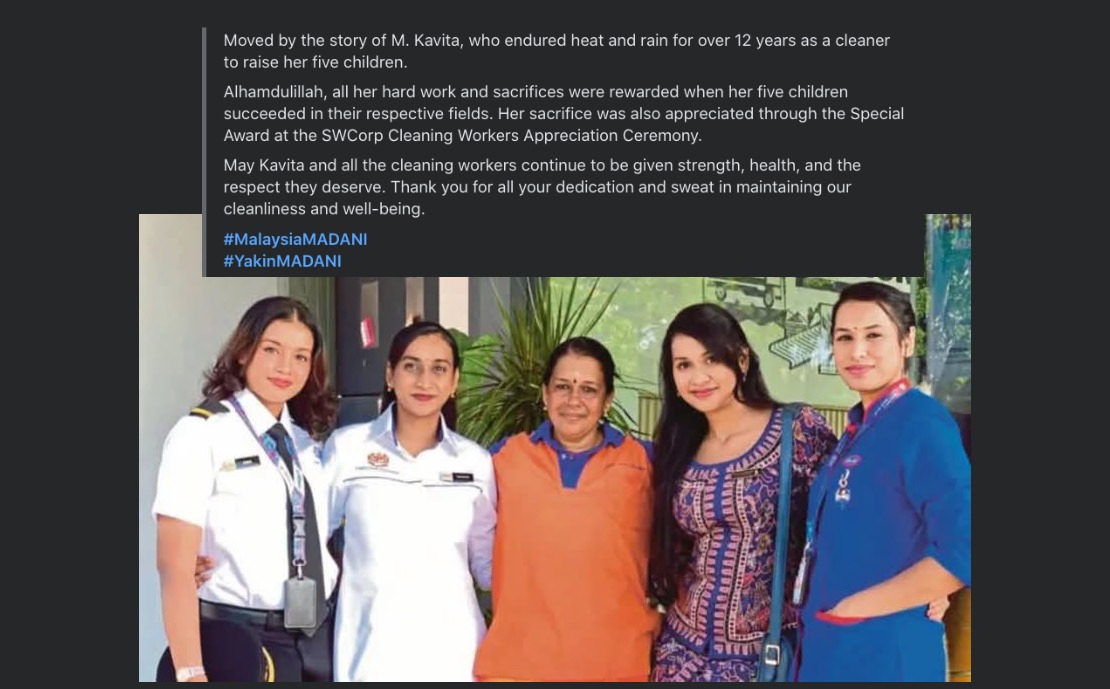
Prime Minister Datuk Seri Anwar Ibrahim has publicly acknowledged the extraordinary journey of M. Kavita, a dedicated street sweeper whose unwavering commitment to her family and work has become a powerful testament to perseverance and maternal sacrifice. Through a Facebook post shared today, Anwar drew attention to Kavita's more than 12 years of labour in challenging conditions, emphasising how her determination to provide for her five children ultimately enabled them all to establish successful careers across various professional fields.
Kavita's story resonates particularly strongly in Malaysia's contemporary social landscape, where frontline service workers often labour with minimal public recognition despite their crucial role in maintaining community health and public spaces. The Prime Minister's tribute underscores an important national conversation about valuing and respecting the contributions of cleaning staff and sanitation workers, occupations that remain foundational to urban hygiene and public welfare yet frequently receive limited social acknowledgment. By elevating Kavita's narrative at the highest political level, Anwar has effectively highlighted the dignity inherent in all forms of honest labour.
The financial and emotional dimensions of Kavita's achievement deserve particular emphasis for Malaysian audiences. Sustaining five children through a street sweeper's income—typically among the lower-paid positions in Malaysia's service sector—required extraordinary financial management, sacrifice of personal comforts, and relentless daily effort regardless of weather conditions. Her accomplishment in enabling all five children to pursue and achieve professional careers represents a remarkable intergenerational mobility story that defies conventional socioeconomic patterns in the country.
Kavita's recognition extended beyond the Prime Minister's acknowledgment when she received a Special Award at SWCorp's Cleaning Workers' Day Appreciation ceremony yesterday, signalling institutional recognition of her contributions to environmental sanitation and public health. This formal commendation from the waste management sector validates the importance of sustained commitment within essential service roles and demonstrates organisational awareness of exceptional dedication among their workforce.
The viral social media moment that initially brought Kavita widespread public attention occurred last month when her four daughters orchestrated a surprise birthday celebration at her workplace to commemorate her 50th birthday. The emotional intensity of that encounter—captured when the daughters appeared in their professional uniforms as a pilot, cabin crew member, and staff nurse—created an emotionally powerful visual representation of maternal sacrifice translated into professional accomplishment. The moment crystallised Kavita's achievement in tangible, relatable terms that resonated across Malaysia's diverse communities.
Kavita's situation as an employee of SWM Environment in Seremban places her within Malaysia's formal waste management and environmental services sector, suggesting she operates within a structured employment framework with some institutional protections and benefits. Her case illustrates both the possibilities and constraints within Malaysia's service economy, where formal sector employment offers greater stability than informal alternatives yet remains financially demanding for supporting dependents through education and professional development.
The Prime Minister's explicit expressions of gratitude toward street sweepers and cleaning workers broadly signals a deliberate policy position regarding the valorisation of essential service workers. Anwar's statement that these workers deserve "respect they deserve" implicitly acknowledges historical patterns of social marginalisation affecting sanitation workers across Southeast Asia, including Malaysia. By connecting individual achievement to systemic recognition, the Prime Minister's intervention carries implications for workplace dignity and social attitudes toward service sector employment.
For Malaysian readers and policymakers, Kavita's story raises important questions about wage equity, working conditions, and family support systems within the service sector. Her ability to raise five successful children despite significant financial constraints speaks to personal resilience but also implicitly questions whether the current wage structure and benefits for cleaning workers adequately reflect their economic and social contributions. The narrative invites examination of whether comparable dedication across different occupational sectors receives equivalent recognition and compensation.
The regional implications of highlighting frontline worker narratives cannot be overlooked in Southeast Asia's development context. Many nations across the region employ substantial populations in sanitation and environmental services, frequently including migrant workers with limited social protections. Elevating worker dignity through high-profile recognition, as demonstrated through Anwar's tribute, establishes precedent for regional attitudes toward essential service labour and potentially influences corporate and governmental approaches to worker welfare across the ASEAN community.
Kavita's story ultimately transcends individual achievement to embody broader themes of social mobility, maternal sacrifice, and the foundational importance of service workers to functioning urban societies. Her trajectory—from street sweeper to mother of professionally accomplished children—demonstrates that circumstantial economic limitations need not predetermined life outcomes when combined with determination and family cohesion. For Malaysian audiences navigating questions of economic inequality and social justice, Kavita's example provides both inspiration and a reminder that systemic respect for all workers remains an ongoing imperative.

