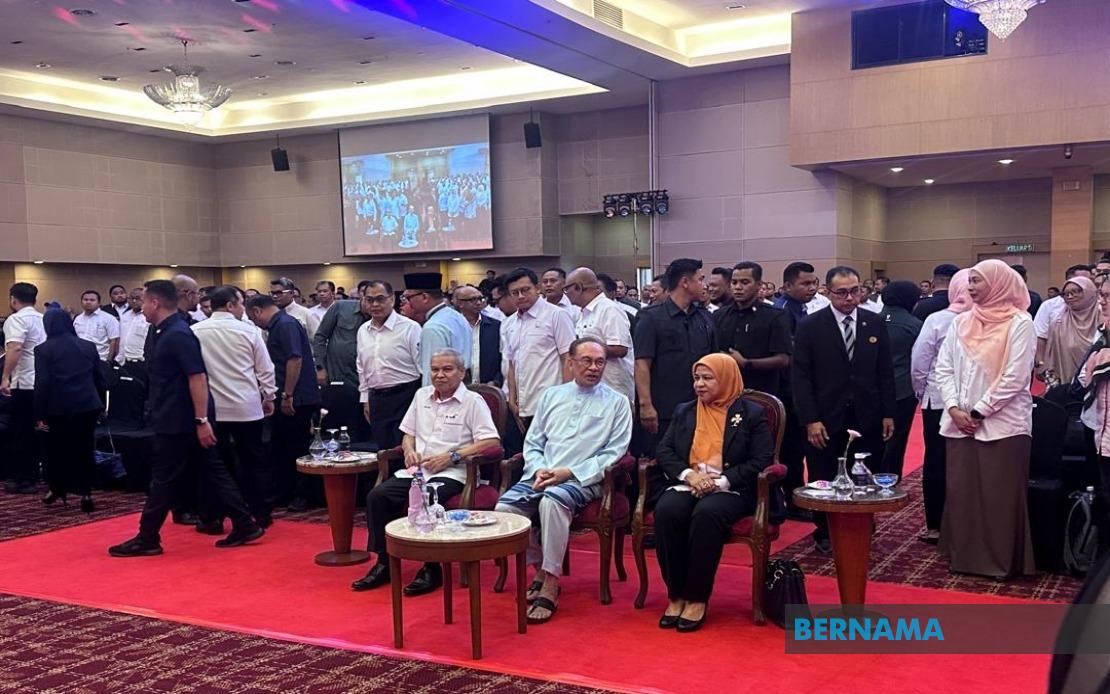
Prime Minister Datuk Seri Anwar Ibrahim has signalled patience with an ongoing investigation into the Federal Land Development Authority, refusing to rush announcements until a comprehensive review by a Special Task Force reaches completion. Addressing reporters at a management gathering in Bangi on August 21, Anwar outlined his cautious approach to one of Malaysia's most significant rural development institutions, stressing that premature disclosure would undermine the credibility of the investigative process.
The Special Task Force, now actively engaged in examining FELDA's operational framework, is expected to deliver its conclusions within the coming months. Anwar's measured stance reflects awareness that transparency must be balanced against the need for thoroughness—a lesson learned from previous institutional inquiries that faced criticism for perceived incompleteness. His refusal to set firm timelines also suggests the investigation may have uncovered complexities requiring deeper analysis than initially anticipated.
Anwar framed the inquiry's scope as encompassing multiple dimensions of institutional governance. Management practices, structural improvements, and the identification of historical shortcomings all feature prominently in the investigation's mandate. However, the Prime Minister emphasized that historical accountability, while necessary, takes secondary importance to evaluating current operational standards and establishing a sustainable framework for FELDA's future trajectory. This distinction carries significance for stakeholders uncertain whether the review represents a forensic accounting exercise or a modernization blueprint.
The timing of this investigation reflects broader concerns about FELDA's trajectory. Once envisioned as a flagship poverty-alleviation programme and rural development engine, the authority has faced mounting scrutiny over financial management, land utilization efficiency, and settler welfare outcomes. The formation of the Special Task Force itself signals recognition within government that institutional challenges require systematic examination rather than incremental adjustments. FELDA's historical importance to Malaysia's rural economy—and by extension, to the political constituencies dependent on its operations—makes the investigation outcomes politically sensitive.
Anwar's commitment to public disclosure, paralleling his invocation of the Royal Commission of Inquiry report on Tabung Haji, represents a significant departure from Malaysia's historical approach to institutional investigations. The Tabung Haji RCI, which exposed substantial governance failures within that pilgrim savings authority, established a precedent for comprehensive public reporting that appears to be shaping expectations around the FELDA inquiry. By voluntarily committing to similar transparency, Anwar seeks to preempt accusations of cover-ups while signalling that his administration takes institutional accountability seriously.
The attendance of FELDA Chairman Tan Sri Ahmad Badri Mohd Zahir and Director-General Datuk Dr Suzana Idayu Wati Osman at the Tenera Hotel gathering underscores the institutional stakes. Their presence alongside the Prime Minister suggests an effort to maintain stability within FELDA's leadership hierarchy while investigations proceed—a delicate balancing act that avoids simultaneously signalling loss of confidence in existing management while permitting fundamental examination of institutional practices. This approach acknowledges that FELDA's operational continuity depends on maintaining internal coherence during a period of external scrutiny.
The implications extend beyond FELDA itself. Land settlement schemes across Southeast Asia face comparable governance challenges, and Malaysia's handling of this investigation will inform how peer nations approach institutional reform within sprawling bureaucratic structures. FELDA's evolution from a development pioneer into an institution requiring remedial investigation mirrors broader patterns of organizational aging, where initial mandates become misaligned with contemporary socioeconomic realities. How Malaysian leadership addresses this disconnect carries lessons for regional policymakers wrestling with comparable legacies.
For Malaysian rural constituencies, particularly FELDA settlers and their descendants, the investigation outcome carries material consequences. Enhanced financial transparency, improved land-use efficiency, or restructured benefit distribution could substantially alter livelihoods. Conversely, findings that validate current arrangements would provide reassurance to communities concerned about institutional viability. The Special Task Force's conclusions will likely determine whether FELDA undergoes fundamental restructuring or emerges from scrutiny with renewed confidence in existing frameworks.
Anwar's stated approach—waiting for complete findings before public announcements—also reflects practical governance experience. Premature disclosure of preliminary findings invites misinterpretation, generates defensive institutional responses, and allows vested interests to mobilize political opposition before comprehensive reforms can be articulated. By withholding judgment until investigation completion, the Prime Minister preserves bandwidth for implementing recommendations without simultaneously battling entrenched resistance to preliminary criticisms.
The expectation that findings will reach the Prime Minister within months suggests the investigation has already compiled substantial preliminary documentation. Government task forces operating on compressed timelines typically conclude within quarterly cycles unless confronting extraordinary complexity. FELDA's geographic dispersal and organizational decentralization may complicate fact-gathering, but systematic management audits generally follow predictable trajectories. The anticipated timeline implies investigators are progressing toward synthesis rather than remaining in foundational data-collection phases.
As the Special Task Force continues its work, Malaysian observers should anticipate findings addressing three critical domains: financial stewardship, operational efficiency, and settler benefit realization. Each category presents distinct investigative challenges and reform opportunities. Financial scrutiny may expose historical budget deviations or misallocated resources; operational analysis may reveal structural inefficiencies in land administration; settler-focused examination may highlight benefit distribution disparities or inadequate support services. Anwar's emphasis on "current management and way forward" suggests the emerging recommendations will prioritize institutional modernization over historical recrimination.
The transparency commitment itself deserves scrutiny. Malaysian governments have historically controlled information flows around sensitive institutional matters, particularly where rural development programs intersect with political constituencies. Anwar's pledge to release findings "as soon as completed" represents a notable rhetorical commitment, though implementation will ultimately determine credibility. Should preliminary findings prove politically embarrassing or administratively inconvenient, pressure may mount to delay disclosure or present sanitized summaries. The coming months will test whether institutional reform rhetoric translates into sustained transparency practice.

