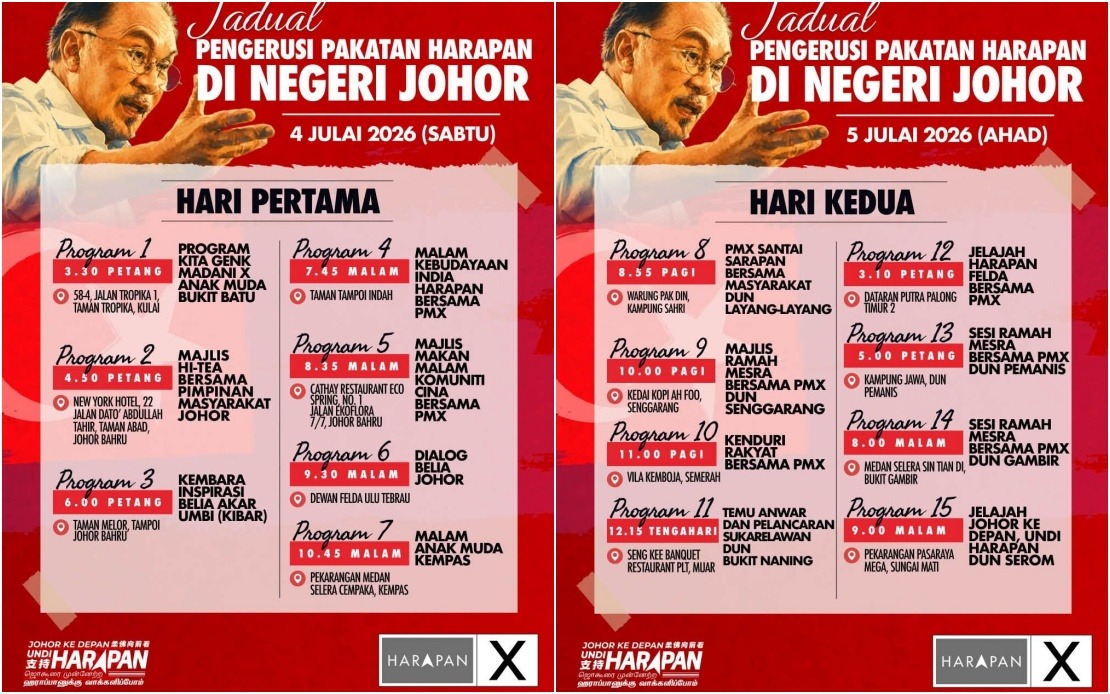
Pakatan Harapan chairman Datuk Seri Anwar Ibrahim is preparing for an exhaustive campaign sprint across Johor, with the party leadership committing to 15 separate engagements over the coming weekend as the coalition intensifies its push to secure the southern state ahead of voting on July 11. The ambitious schedule reflects the strategic importance PH places on Johor, where it is fielding 56 candidates in a contest that could significantly reshape the state's political landscape and signal broader momentum ahead of eventual federal elections.
Anwar's announcement of the weekend itinerary comes as polling day draws near, with early voting already scheduled for July 7. His decision to devote two full days to grassroots engagement across multiple constituencies underscores the competitive nature of the contest and the need to energise party machinery and reach undecided voters in the final stretch of campaigning. The sheer density of his schedule—nearly eight events per day—demonstrates the high-octane nature of modern Malaysian political campaigns, where leaders must maintain visibility across dispersed urban and rural constituencies simultaneously.
The programme lineup reveals a deliberate strategy to engage diverse demographic segments within Johor's electorate. Saturday's schedule begins in Kulai with the Kita Genk MADANI initiative targeting younger voters, before transitioning through community leader engagements and cultural events catering to Indian and Chinese communities. This segmented approach reflects the coalitional nature of Malaysian politics, where success requires building support across ethnic lines and generational cohorts. By evening, Anwar moves through youth-focused dialogues and neighbourhood-level gatherings, demonstrating how contemporary campaigns blend large public events with intimate community interactions.
Sunday's itinerary maintains similar momentum but expands the geographic reach, spanning constituencies including Layang-Layang, Senggarang, and Bukit Naning. The inclusion of 'kenduri rakyat' (community feasts) and volunteer launch events suggests an emphasis on grassroots activation—mobilising party supporters and sympathisers who will conduct door-to-door outreach in the final days before polling. These neighbourhood-level gatherings often prove decisive in tight contests, as they create personal connections between voters and the political machinery.
The choice to incorporate cultural and religious observances—evident in programmes honouring Indian cultural traditions and community dinners—reflects the electoral mathematics of multiethnic Johor. Non-Malay communities, particularly Indian and Chinese voters concentrated in urban and semi-urban areas, represent a crucial swing demographic whose support can determine outcomes in marginal constituencies. PH's emphasis on inclusive 'Madani' governance messaging, woven throughout the weekend's events, attempts to appeal to this coalition of voters with promises of equitable development and representation.
Anwar's personal engagement at this scale serves multiple strategic functions beyond direct voter contact. His physical presence in Johor signals the headquarters' investment in the state contest and lifts morale among party activists and candidates who derive confidence from seeing senior leadership bearing the campaign burden. For television and social media coverage, each event generates promotional material that extends beyond those physically present, multiplying the campaign's reach across traditional and digital platforms. The invitation to all Johor voters to join the programmes, issued via Facebook, demonstrates how modern campaigns integrate social media announcements with ground mobilisation.
The timing of this blitz is strategically significant. With voting less than ten days away, the window for meaningful campaign intervention narrows considerably. Campaigns at this stage aim less to convince deeply committed voters than to consolidate support among the persuadable middle, suppress turnout among opposition sympathisers, and maximise get-out-the-vote efforts. The intensity of Anwar's schedule suggests PH believes the contest remains fluid and that visible leadership commitment can still shift outcomes, particularly in constituencies rated competitive.
Johor's political significance extends beyond the state itself. As the second-largest state by parliamentary seats, Johor's outcome carries implications for federal-level politics. PH's performance here tests its ability to expand beyond its traditional urban strongholds into the more mixed terrain of southern Johor, where Barisan Nasional and Perikatan Nasional maintain residual strength. A strong PH showing would validate the coalition's claim to national viability; conversely, losses would embolden opposition narratives about PH's declining appeal.
The coalition faces considerable headwinds in Johor, where local grievances over development distribution, infrastructure quality, and economic opportunities have periodically favoured opposition narratives. Additionally, intra-coalition tensions within PH—particularly between its component parties competing for candidacies and resources—can undermine unity messaging if not carefully managed. Anwar's personal involvement attempts to paper over such divisions and present a unified front to voters, though internal cohesion remains an ongoing challenge for any coalition government.
For Malaysian voters observing this campaign, Anwar's intensive weekend schedule illustrates the extraordinary demands placed on senior political figures during election periods, where candidates must campaign across multiple constituencies whilst simultaneously managing national party affairs. The breadth of the 15-programme itinerary also highlights how Malaysian electoral contests have become highly professionalised affairs, with detailed timetables, multimedia coordination, and targeted demographic engagement replacing earlier, more ad hoc campaigning approaches.
The 16th Johor state election occurs within a broader context of Malaysian politics adjusting to post-2022 dynamics, where coalition architectures have shifted and voter preferences remain comparatively volatile. Johor represents testing ground for whether PH can consolidate its federal-level gains at the state level, particularly in states where it was historically weak. Anwar's weekend commitment demonstrates the leadership's recognition that such consolidation requires sustained effort, personal sacrifice, and ground-level engagement with constituents across the full spectrum of Johor's diverse communities and constituencies.

