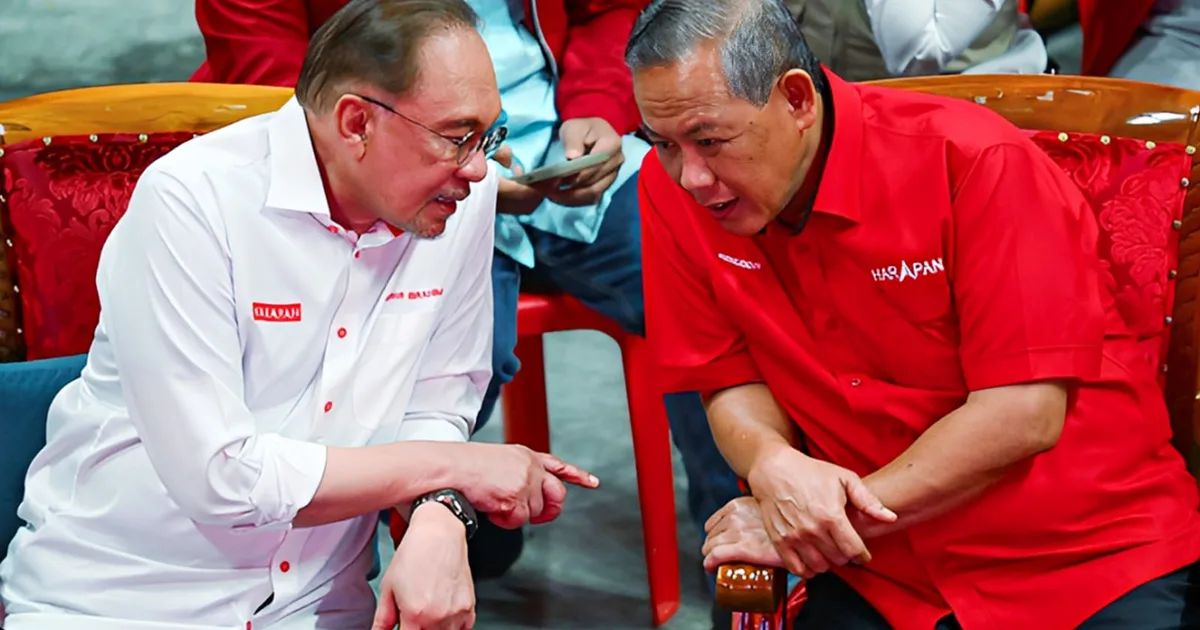
PKR president Anwar Ibrahim has underscored the ongoing relevance of former Negeri Sembilan menteri besar Aminuddin Harun to the party's future, positioning him as a crucial figure in shaping the next wave of political leaders within the coalition. Rather than stepping aside completely after his electoral loss, Anwar argues that Aminuddin's experience and character make him indispensable to the mentoring process that will define PKR's trajectory in the coming years.
The PKR leader highlighted a particular quality in Aminuddin that he believes deserves emulation throughout the party structure: the former menteri besar's approach to handling defeat. Where many politicians respond to electoral losses with recriminations, internal blame-shifting, or public displays of bitterness, Aminuddin instead demonstrated a composed acceptance of the outcome without directing criticism at colleagues or party machinery. This restraint and maturity, according to Anwar, represents a standard that party members would benefit from adopting more widely.
For Malaysian observers, Anwar's remarks carry significance beyond the immediate PKR context. The political culture across the country has frequently been marked by intense factionalism and personal grievances following electoral setbacks. Leaders departing from office often become focal points for blame and recrimination rather than bridge-builders and educators. Aminuddin's approach therefore stands as a notable counterpoint to patterns that have periodically undermined institutional stability in Malaysian politics.
The emphasis on mentorship also reflects broader challenges facing PKR as a party. Having emerged during the reform movement of the late 1990s and early 2000s, PKR now faces the task of transitioning from a movement built around anti-establishment sentiment to a mature political organization capable of sustaining governance. This requires developing experienced administrators and political operators who can guide newcomers through the complexities of electoral politics, coalition-building, and executive responsibility.
Aminuddin's tenure as menteri besar of Negeri Sembilan, though ending in the 2022 general election when BN-aligned parties regained control of the state, provided him with practical experience in state-level administration. He navigated budgeting challenges, infrastructure development, and coalition politics during a period when Negeri Sembilan was governed by Pakatan Harapan. This hands-on background distinguishes him from purely theoretical or activist-oriented figures, making his counsel potentially valuable to younger politicians seeking to understand the mechanics of government.
The question of succession and institutional memory has become increasingly acute for coalition parties in Malaysia. PH's experience in federal government from 2018 to 2022, while limited in duration, created a cohort of officials with direct experience in higher-level administration. However, the loss of federal power created a generational challenge: how to retain and deploy that experience while building capacity among newer members who lack equivalent exposure. Anwar's invocation of Aminuddin suggests a conscious effort to preserve institutional knowledge rather than allow it to dissipate or concentrate within informal networks.
Moreover, Aminuddin's willingness to accept electoral reversal without recrimination speaks to questions of party cohesion that have periodically destabilized both PKR and its coalition partners. Transitions from government to opposition can trigger internal instability as disappointed members recalibrate their calculations or exit for opportunities elsewhere. Leaders who demonstrate composure during such moments help prevent cascading departures or public divisions that would further weaken the organization. In this sense, Aminuddin's conduct following the 2022 elections offered practical lessons in maintaining institutional discipline.
For Southeast Asian readers observing Malaysian politics from abroad, the PKR situation illustrates broader regional dynamics around political succession and institutional development. Across the region, newly democratized or reform-oriented parties have frequently struggled with the transition from opposition movements to governing organizations. The tension between ideological purity and pragmatic governance, between revolutionary zeal and administrative competence, has shaped outcomes in countries from Indonesia to the Philippines. PKR's approach to retaining and deploying experienced figures like Aminuddin represents one regional variant in grappling with these tensions.
Anwar's framing of Aminuddin as a mentor rather than a figurehead also suggests a deliberate choice about how to value political experience in the contemporary moment. There exists a tendency in populist-influenced politics globally to dismiss experienced hands as representatives of a compromised past. Anwar's approach instead privileges the transfer of practical knowledge and ethical conduct across generations. This reflects perhaps a maturing perspective within PKR about the relationship between idealism and institutional competence.
The remarks also come within a broader context of PKR attempting to consolidate its position within the government coalition. With Anwar as prime minister since late 2022, PKR has moved from being a relatively junior coalition partner to the leading political force in PH. This elevated position demands greater organizational sophistication and a deeper bench of capable administrators. Tapping Aminuddin's experience and example represents part of this effort to strengthen internal capacity and reduce dependency on personalities from other coalition partners.
Further, Aminuddin's role as a potential mentor to younger leaders offers PKR a pathway toward addressing generational turnover without the destabilizing effects that often accompany political transitions. By institutionalizing the transfer of wisdom and experience rather than allowing it to remain purely personal and informal, the party can reduce the risks associated with retirements or unexpected departures. This institutional approach contrasts with more personality-driven models that have characterized some aspects of Malaysian politics.
Looking forward, whether Aminuddin actually accepts or already exercises such a mentoring role remains to be seen. Anwar's public endorsement of his continued relevance, however, signals clearly that PKR intends to retain the political value of experienced figures even when they no longer hold executive positions. This approach, if executed effectively, could strengthen the party's institutional resilience and provide younger politicians with pathways to develop competence beyond their immediate constituencies. For a political organization still defining its mature identity, such intergenerational knowledge transfer may prove as important as electoral victories in determining long-term viability.

