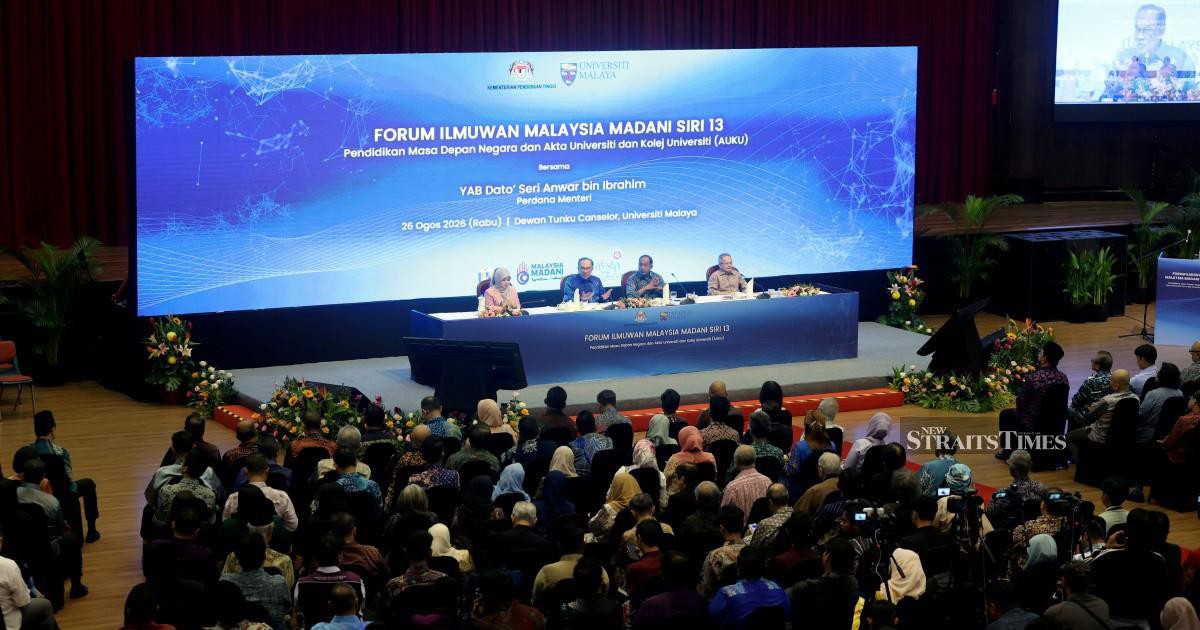
Prime Minister Datuk Seri Anwar Ibrahim has appealed for patience from Malaysia's university community, signalling that the government requires adequate time and political space to navigate the repeal of AUKU—the Administrative Provisions of Universities Act 1971—through a comprehensive reform framework currently under development.
The appeal represents a carefully calibrated message from the federal government, which has long faced pressure from student activists and civil society organisations over the law, widely viewed as a vestigial instrument of authoritarian governance that severely restricts academic freedom and student activism on Malaysian campuses. Rather than committing to an immediate or unilateral abolition, Anwar's statement indicates a methodical approach designed to address the legislation alongside complementary measures addressing related governance and institutional structures.
AUKU has remained a lightning rod for criticism since its original enactment half a century ago. The law prohibits university students and staff from engaging in political activities, attending rallies without institutional approval, and pursuing certain forms of political expression deemed incompatible with academic environments. Critics argue the provision has fundamentally stunted the development of student leadership, democratic participation, and intellectual inquiry within tertiary institutions, distinguishing Malaysia's regulatory environment from peer democracies across the region.
The government's gradualist stance reflects genuine constitutional and administrative complexities underlying any legislative repeal. AUKU does not exist in isolation; dismantling it necessarily requires parallel consideration of university governance frameworks, institutional autonomy protocols, student conduct standards, and the division of authority between federal and state authorities over educational policy. A precipitous or partial repeal risks creating regulatory vacuums that could invite unintended consequences or litigation from universities seeking clarity on permissible student activities.
Moreover, Anwar's request for stakeholder trust signals recognition that comprehensive tertiary education reform commands attention from multiple constituencies with occasionally divergent interests. University administrators have historically expressed concern that unrestricted student political mobilisation could compromise institutional governance and focus. Parents and employers worry about the academic quality implications of heightened campus activism. Student leaders demand genuine democratic space, not merely performative concessions. Any sustainable reform must navigate these competing pressures through broad-based consultation rather than unilateral decree.
The timing of the appeal carries particular significance. Malaysia's coalition government, formed in 2022, has prioritised democratic and institutional reforms as central to its legitimacy narrative, distinguishing its approach from its predecessors. Yet the government also operates within constraints: managing multiple coalition partners with differing constituencies, addressing Malaysia's pressing economic challenges, and maintaining institutional stability. Educational reform, while symbolically important, competes for limited legislative and political capital with budgetary pressures, infrastructure development, and immediate governance challenges.
For Malaysian university students, already among Southeast Asia's most politically conscious yet institutionally constrained cohorts, Anwar's statement offers both encouragement and a sobering reminder that legislative change proceeds incrementally within democratic systems. Countries across the region—from Thailand to Indonesia—have grappled with similar tensions between academic freedom and institutional order, though each has ultimately moved toward permitting greater student political participation. Malaysia's trajectory suggests movement in this direction, albeit measured and deliberate.
The government's planned comprehensive improvement measures likely encompass not merely AUKU's repeal but reconstruction of student conduct codes, enhanced institutional autonomy frameworks, clarified protocols distinguishing appropriate campus speech from prohibited activities, and potentially reforms to university governance structures to enhance student representation. Such holistic reform demands detailed legislative drafting, internal government coordination, and extensive stakeholder engagement—processes inherently consuming considerable time.
Fundamentally, Anwar's appeal constitutes an implicit contract between government and the student movement: demonstration of good faith commitment to reform in exchange for acceptance that political and administrative constraints preclude overnight transformation. Whether this compact holds depends substantially on the government's ability to demonstrate concrete legislative progress within a foreseeable timeframe. Extended delays risk eroding student confidence and reviving the perception that reform rhetoric masks genuine indifference to tertiary education liberalisation.
The broader regional context underscores the stakes. Malaysia has positioned itself as a democratic alternative to authoritarian governance models across Southeast Asia. Yet restrictive laws like AUKU stand at odds with this branding, signalling that Malaysian democracy remains circumscribed compared to regional peers. Repealing or substantially reforming the legislation would align Malaysian practices more closely with stated democratic values while sending important signals to international observers regarding institutional development. Conversely, indefinite postponement risks validating scepticism about the government's commitment to genuine democratic deepening beyond electoral competition.
Student and civil society organisations have begun responding to Anwar's statement with cautiously optimistic engagement, recognising that the threshold question now shifts from whether reform will occur to when and according to what timeline. This represents incremental progress in Malaysia's perpetually fraught student-government relations, positioning the coming months as critical for translating political messaging into tangible legislative movement on one of Malaysian higher education's most contentious issues.

