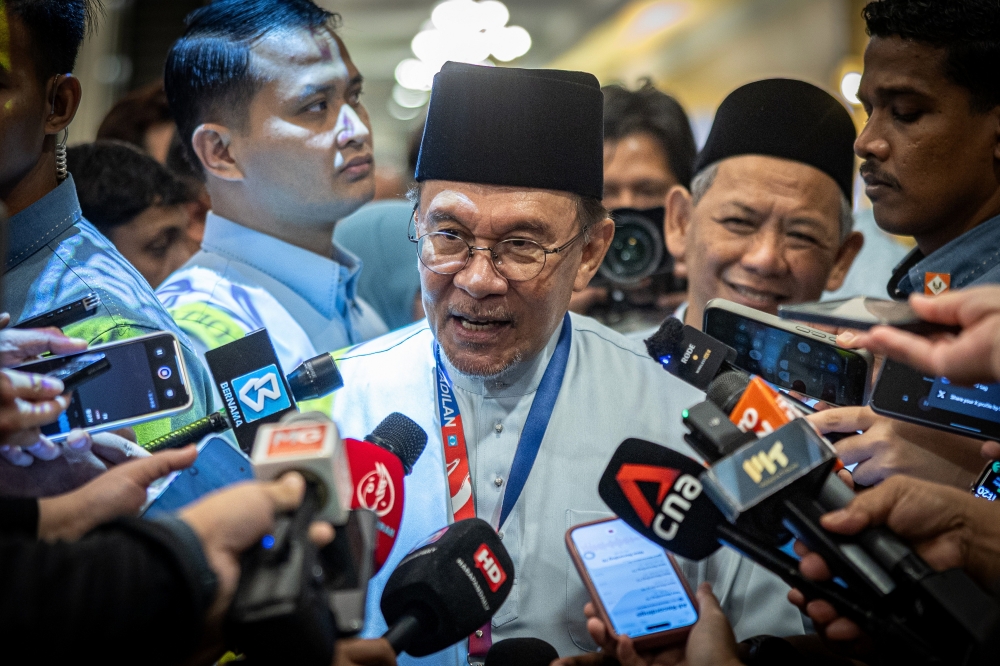
Prime Minister Datuk Seri Anwar Ibrahim has moved swiftly to quash persistent speculation about internal tensions within Malaysia's ruling coalition, declaring his steadfast commitment to peaceful and collaborative governance. Speaking in Melaka on August 15, Anwar addressed mounting whispers about his relationship with Deputy Prime Minister Datuk Seri Zahid Hamidi by emphasizing that he operates according to principles of civility and institutional respect, regardless of political differences that may emerge behind closed doors.
The Prime Minister's carefully calibrated remarks came in direct response to suggestions made by Khairy Jamaluddin, the former Health Minister and a prominent figure within the United Malays National Organisation (UMNO), who had publicly alluded to friction between the two highest officials in government. Khairy's comments had injected fresh uncertainty into an already delicate political environment, where observers have long questioned the durability of the coalition that brought Anwar to power in November 2022. By directly addressing these claims in his characteristic measured tone, Anwar sought to restore confidence in the administration's internal cohesion at a time when external economic pressures and upcoming electoral considerations demand unified political leadership.
Anwar's invocation of "the peaceful path" represents more than rhetorical flourish in the Malaysian political context. The phrase carries historical weight, echoing his longstanding advocacy for institutional democracy and the rule of law over factional maneuvering. Throughout his career, particularly during his imprisonment and subsequent rehabilitation, Anwar has positioned himself as a champion of democratic principles and non-confrontational problem-solving. His public reaffirmation of this philosophical commitment signals to coalition partners, notably the multi-ethnic Democratic Action Party (DAP) and Amanah, that he remains committed to the consensual mode of governance that has sustained the Pakatan Harapan-led coalition against considerable odds.
The context surrounding Khairy's remarks illuminates the underlying fault lines that persist within Malaysia's governing structure. UMNO, Anwar's own party, maintains a complex relationship with the Prime Minister—while providing crucial parliamentary support and key ministerial positions, the party retains its traditional base and ideological interests that sometimes diverge from coalition priorities. Zahid Hamidi, despite occupying the Deputy Prime Minister's office, leads UMNO as its president and commands substantial loyalty from party stalwarts who view the current arrangement as temporary accommodation rather than a permanent realignment. Within this framework, suggestions that Zahid might distance himself from Anwar or harbor alternative political ambitions are never entirely implausible, making Khairy's insinuations particularly potent despite their vagueness.
Anwar's dismissal of these claims, however, should not be read as naive optimism or mere public relations management. The Prime Minister has demonstrated throughout his tenure an acute understanding of coalition dynamics and the necessity of maintaining constructive relationships even amid substantive disagreements. His willingness to publicly address the matter, rather than allowing rumors to circulate unchecked, reflects a strategic calculation that transparency and firmness serve his interests better than ambiguity. By anchoring his position in principles rather than specific grievances, Anwar created space for reconciliation should genuine tensions emerge while simultaneously signaling to Zahid and other coalition partners that political stability remains the paramount concern.
The broader implications of this exchange extend beyond immediate questions of personal dynamics between two senior politicians. Malaysia's economic trajectory, confrontation with inflationary pressures, and the complex process of institutional reform all require sustained governmental focus and coalition cooperation. Any significant rupture between Anwar and Zahid would reverberate through parliamentary calculations, potentially jeopardizing the thin majorities upon which several legislative initiatives depend. Furthermore, opposition parties and various interest groups have consistently sought to exploit any hint of governmental fracture to advance their own agendas. Anwar's public reaffirmation of unity thus serves a defensive function, reducing openings for destabilization efforts while maintaining the coalition's ability to govern effectively.
Khairy's own position within UMNO and his relationship with Zahid add another layer of complexity to these political maneuvers. As a reform-minded figure who has occasionally criticized party orthodoxy, Khairy occupies a somewhat liminal position within UMNO's hierarchies. His decision to speak publicly about potential rifts between Anwar and Zahid could reflect genuine concern about coalition stability, personal positioning within party dynamics, or strategic positioning ahead of internal UMNO power contests. The fact that Anwar felt compelled to respond directly suggests that Khairy's comments struck a nerve or resonated with existing concerns among political observers, even if the Prime Minister's ultimate assessment differs substantially.
Looking forward, Anwar's performance in maintaining coalition unity will likely determine both the government's legislative effectiveness and its electoral prospects. Malaysia approaches important state elections and eventual federal parliamentary contests within a compressed timeframe, making political stability a precious commodity. The Prime Minister's repeated emphasis on peaceful cooperation and institutional respect reflects recognition that his coalition lacks the supermajority that would permit him to govern indifferently to internal disagreements. Instead, Anwar must continually tend to relationships across parties with differing ideological moorings, temperaments, and organizational interests, using persuasion and consensus-building rather than coercion.
The episode underscores a fundamental reality of Malaysian politics in this era: governance depends less on hierarchical command structures than on the maintenance of intricate networks of political understanding and mutual benefit. Anwar's dismissal of Khairy's rift claims represents not a statement of fact regarding non-existent tensions, but rather a recommitment to the principles and practices through which coalition governance can be sustained despite inevitable frictions. Whether this approach ultimately succeeds will depend not merely on Anwar's rhetorical skills, but on his capacity to deliver material benefits and institutional stability that give coalition partners concrete reasons to maintain their political commitment.

