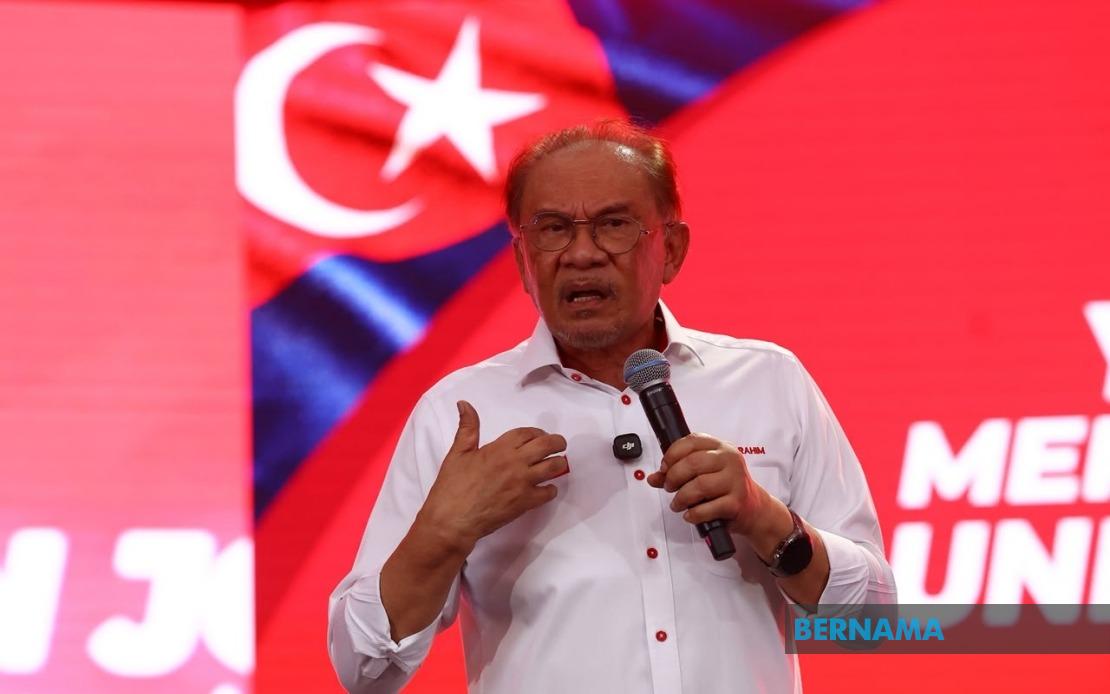
Prime Minister Datuk Seri Anwar Ibrahim moved swiftly to counter swirling social media rumours on Monday, categorically denying accusations that he had acquired a brand-new BMW for his own use. Speaking at a campaign rally in Senggarang, Batu Pahat, during the run-up to Johor's 16th state election, Anwar characterised the allegations as baseless falsehoods designed to undermine his public image. His response reflected growing concern among senior government figures about misinformation spreading rapidly through digital platforms, particularly during high-stakes electoral periods.
The Prime Minister's rebuttal centred on a central distinction: the vehicle in question, he maintained, was not newly purchased but rather a pre-existing government asset already held within the state apparatus. Anwar pointedly questioned why detractors would fabricate narratives contradicting his well-documented commitment to championing the economically disadvantaged. The juxtaposition between claims of poverty alleviation and alleged luxury consumption clearly rankled the Premier, who used the platform to address what he viewed as a credibility assault.
Addressing the broader question of official vehicles, Anwar provided transparency regarding the Mercedes-Benz he currently operates. He disclosed that this automobile represents a royal gift from His Majesty Sultan Ibrahim, King of Malaysia, and crucially, he stressed that formal registration falls under the Prime Minister's Department rather than his private name. This distinction carries significant weight in Malaysian governance frameworks, where the separation between personal property and state resources carries both legal and ethical implications. By emphasising institutional rather than personal ownership, Anwar sought to demonstrate adherence to principles of transparent stewardship of public resources.
The clarification underscored Anwar's broader positioning on financial accountability. In his statement, he explicitly contrasted his approach with what he characterised as corrupt practices by others, directly alleging that some officials engage in embezzlement and misappropriation of public funds. This rhetorical strategy—simultaneously defending his own record whilst attacking perceived malfeasance among competitors—formed part of a calculated campaign narrative centred on governance integrity and institutional responsibility.
The Prime Minister's Department and the Ceremonial and International Conference Secretariat Division released an official statement preceding Anwar's remarks, providing institutional backing to his position. Their announcement clarified that the BMW in question constituted an existing government asset rather than a recent acquisition, explicitly noting that the vehicle fell under BIUPA's administrative purview. The department designated the automobile as part of official government logistics arrangements, situating its use within standard operational protocols rather than exceptional or inappropriate procurement.
The controversy emerged from allegations gaining traction across social media platforms, highlighting the increasingly influential role digital networks play in shaping political narratives in Malaysia. During election cycles, such rumours carry amplified potency, potentially swaying voter perceptions of leadership conduct and personal integrity. The speed with which both Anwar and government apparatus responded suggests awareness of the reputational stakes involved when luxury asset ownership becomes contested in the court of public opinion.
Anwar's campaign appearance in Senggarang occurred within the framework of broader Pakatan Harapan mobilisation efforts ahead of Saturday's polling. The coalition fielded candidates across all 56 state legislative seats, reflecting comprehensive engagement in what represented a significant mid-term electoral test. Present alongside Anwar were Communications Minister and PH spokesperson Datuk Fahmi Fadzil, along with coalition candidates contesting the Senggarang, Semerah, and Penggaram constituencies—Onn Abu Bakar, Mohd Khuzzan Abu Bakar, and Felicia Poh Rui Ling respectively.
For Malaysian voters, the incident illuminates broader governance questions about official resource management and the boundaries separating public and private interests. While vehicle allocations may appear procedurally mundane, they carry symbolic weight regarding ministerial conduct and adherence to taxpayer stewardship principles. The controversy also reflects heightened public scrutiny of leadership practices, particularly concerning assets and expenditures that might be perceived as inconsistent with declared policy priorities around inclusive economics and poverty reduction.
The episode reveals vulnerabilities in contemporary political communication, where unverified claims circulate with remarkable speed through digital channels before official rebuttals can take effect. For Anwar's administration, managing such narratives represents an ongoing challenge as opposition voices leverage social platforms to construct alternative interpretations of government conduct. The rapid institutional response—through formal departmental statements combined with direct Prime Ministerial clarification—attempted damage limitation whilst reaffirming commitment to transparent governance standards.
Moving forward, the Johor state election will partly serve as a referendum on public confidence in Pakatan Harapan's stewardship and messaging credibility. Whether such controversies influence voter calculations remains uncertain, though the coalition's decision to field candidates comprehensively across all constituencies suggests confidence in their electoral positioning despite periodic reputational challenges.

