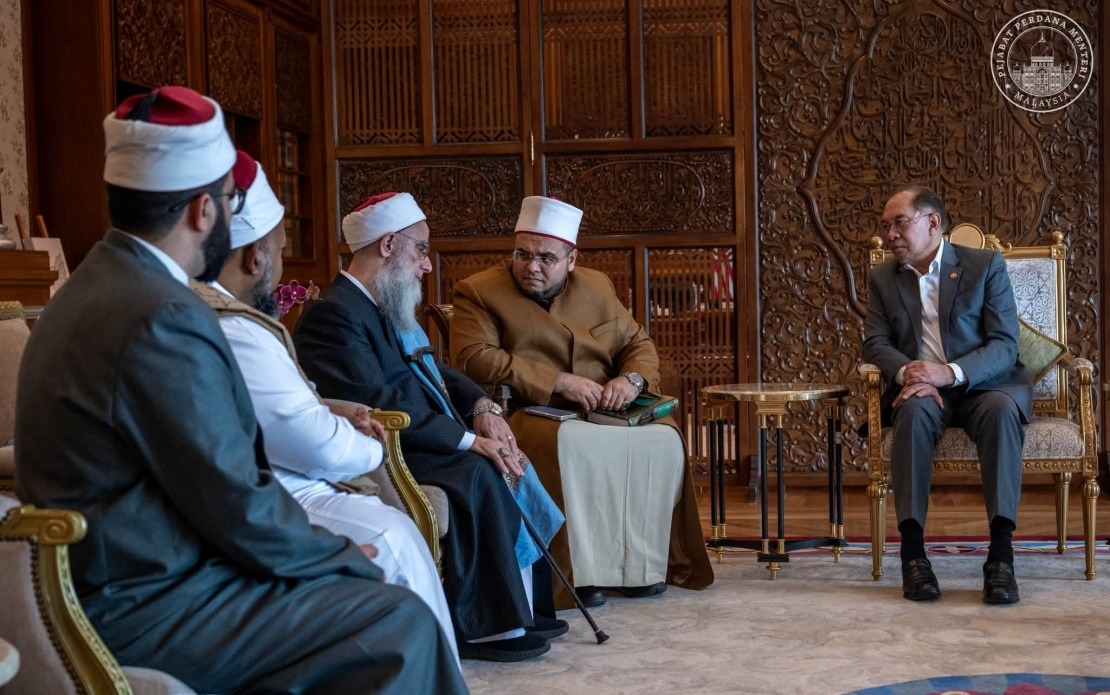
Prime Minister Datuk Seri Anwar Ibrahim received a courtesy visit from Sheikh Dr Mustafa An-Nadwi Al-Hasani Mansurah, a prominent Egyptian Islamic scholar, at his office in Putrajaya on Friday. The meeting underscored Malaysia's continued engagement with influential voices in the Islamic intellectual sphere, reflecting the nation's position as a bridge between regional and global Islamic thought leaders.
In remarks shared on social media, Anwar characterised Sheikh Dr Mustafa as a scholar of considerable standing whose work centres on elevating moral standards, cultivating intellectual rigour, and advancing hadith scholarship. The Prime Minister's recognition of the visitor's credentials highlights Malaysia's diplomatic and cultural ties within the wider Islamic world, particularly with Egypt, which remains a significant centre of Islamic learning and theological discourse.
Sheikh Dr Mustafa represents an intellectual lineage rooted in the teachings of Sheikh Abul Hasan Ali al-Nadwi, himself a world-renowned Islamic scholar and orator whose influence extended across multiple continents. By acknowledging this scholarly pedigree, Anwar positioned the visiting scholar within a tradition that emphasises measured discourse and nuanced understanding of Islamic principles. This genealogy of knowledge carries substantial weight within Islamic academic circles, particularly among those advocating for reasoned interpretation over dogmatism.
The Prime Minister's public comments reflect broader concerns about the state of contemporary discourse in information-saturated societies. Anwar drew a pointed contrast between the sensationalism that dominates modern media landscapes and the quiet, deliberate pursuit of wisdom and learning that characterises scholarly traditions. His metaphor of knowledge arriving "like the morning dew"—subtle yet life-giving—suggests philosophical alignment between the Malaysian leader and the visiting scholar on matters of intellectual integrity and the role of wisdom in public life.
During their discussion, Anwar and Sheikh Dr Mustafa exchanged perspectives on pressing contemporary issues, though specific details of these exchanges were not disclosed. The timing of the visit, occurring within a broader programme of knowledge sessions throughout Malaysia, suggests the scholar was undertaking a speaking tour aimed at engaging with Malaysian Muslim audiences and intellectual communities. Such visits serve multiple functions: they provide platforms for Islamic thought leaders to disseminate ideas, they strengthen diplomatic and cultural bonds between nations, and they offer Malaysian scholars and students opportunities for direct engagement with internationally recognised figures.
The nature of Anwar's reception underscores the Malaysian government's interest in engaging with Islamic intellectuals who advocate for moderation, wisdom and compassionate approaches to faith matters. In a regional context where Islamic discourse sometimes becomes polarised between competing ideological positions, hosting scholars known for intellectual balance and moral emphasis carries symbolic significance. It signals Malaysia's commitment to a particular vision of Islamic thought—one grounded in classical learning traditions while remaining engaged with contemporary challenges.
Anwar's prayer for Sheikh Dr Mustafa's continued wellbeing and for blessings upon his scholarly work represents conventional diplomatic courtesy while also reflecting genuine philosophical alignment. The Prime Minister's specific mention of praying for the scholar's ability to continue "guiding the community with wisdom, moderation and compassion" emphasises virtues that Malaysian leadership seeks to promote domestically. These three qualities—wisdom, moderation, and compassion—recur frequently in Anwar's public statements and represent core components of his vision for Malaysia's development and social cohesion.
From a broader Southeast Asian perspective, such visits illustrate how Islamic scholarship networks operate across national boundaries, creating intellectual communities that transcend state borders. Malaysia's role as a host to visiting Islamic scholars strengthens its position within these networks and reinforces its credibility among Muslim intellectual circles globally. The visit also reflects Malaysia's capacity to attract prominent international figures, enhancing the nation's soft power and cultural standing.
The exchange of views on current affairs suggests substantive engagement rather than ceremonial protocol. In an era when prime ministers navigate complex challenges ranging from economic pressures to social cohesion concerns, consultation with respected Islamic scholars can provide alternative perspectives and moral frameworks for understanding contemporary problems. The Malaysian government's openness to such dialogue reflects confidence in engaging with external voices and intellectual traditions.
Sheikh Dr Mustafa's knowledge sessions throughout Malaysia represent an investment in intellectual capacity-building within the local Muslim community. By facilitating such visits, the Malaysian government enables its citizens—particularly students and religious scholars—to interact with internationally recognised figures. This direct exposure to global Islamic intellectual discourse helps prevent intellectual isolation and encourages engagement with diverse schools of Islamic thought and interpretation.

