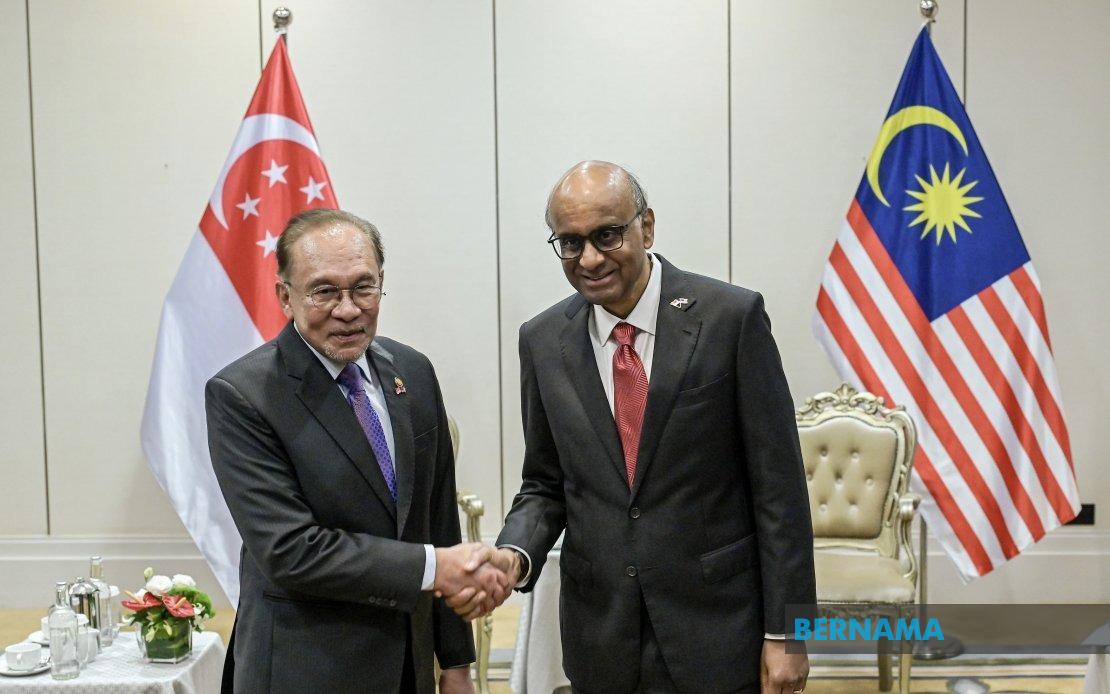
Prime Minister Datuk Seri Anwar Ibrahim held a 40-minute bilateral meeting with Singapore President Tharman Shanmugaratnam on Monday, marking a significant moment in Malaysia-Singapore relations during the president's three-day state visit to Malaysia. The encounter brought together senior government officials from both nations, including Foreign Minister Datuk Seri Mohamad Hasan, Investment, Trade and Industry Minister Datuk Seri Johari Abdul Ghani, and Entrepreneur and Cooperatives Development Minister Steven Sim Chee Keong, signalling the high-level importance placed on the engagement.
The courtesy call followed a formal state welcoming ceremony held earlier at Istana Negara, where President Tharman received full ceremonial honours from the Yang di-Pertuan Agong Sultan Ibrahim. This elaborate reception protocol reflects the depth of bilateral protocols and the significance of the visit, which runs from July 13 to 15 at the royal invitation. The programme constitutes a reciprocal gesture, acknowledging His Majesty's own state visit to Singapore from May 6 to 7, 2024, and demonstrates the sustained commitment both nations have to strengthening high-level diplomatic engagement.
The timing of President Tharman's visit arrives as Malaysia and Singapore navigate an increasingly complex regional economic landscape. Singapore holds the position of Malaysia's second-largest trading partner globally, a relationship that extends beyond mere commerce to encompass strategic cooperation across investment, infrastructure, and technology sectors. Within the broader ASEAN context, Singapore ranks as Malaysia's leading trading partner among member states, underscoring the outsized economic importance of the city-state to the Malaysian economy and its role as a regional commercial hub.
Bilateral trade flows between the two countries have demonstrated robust momentum, reaching RM402.35 billion (US$93.97 billion) in 2025, representing a measured 1.5 per cent increase from the preceding year. While this growth rate suggests a stabilising commercial relationship, the year-to-date figures paint a more dynamic picture of economic engagement. From January to May of this year, bilateral trade surged 14.5 per cent to RM189.90 billion (US$47.87 billion), compared with RM165.93 billion (US$37.65 billion) during the equivalent five-month period in 2024.
This accelerating pace of mid-year trade expansion signals that both economies have found renewed momentum following what appears to be a moderation in the overall 2025 annual growth rate. The sharp uptick in the first five months suggests that trade pipelines remain active and that commercial relationships are deepening across multiple sectors. For Malaysian policymakers and business stakeholders, this trajectory offers encouragement that the structural economic ties binding the two nations continue to provide reliable returns despite global economic headwinds that have characterised recent years.
The meeting between Anwar and President Tharman provides an opportune moment for addressing shared strategic concerns and exploring avenues for deeper collaboration. Key issues likely under discussion include facilitating greater investment flows, particularly in Malaysia's priority sectors such as digital transformation, renewable energy, and advanced manufacturing. Singapore's position as a financial centre and technology hub makes it a natural partner for Malaysian efforts to enhance competitiveness and attract high-value economic activity.
Beyond trade and investment mechanics, the state visit carries significance for regional stability and cooperation. Malaysia and Singapore share maritime boundaries in the Strait of Malacca, one of the world's most crucial shipping lanes, and maintain overlapping economic zones that require constant diplomatic attention. Regular high-level engagement at the level of heads of state ensures that bilateral mechanisms remain functional and that emerging challenges can be addressed before they escalate into broader disputes.
For Malaysian readers and businesses, the implications of sustained bilateral cooperation with Singapore extend to practical matters affecting daily economic activity. Smoother trade corridors, enhanced regulatory cooperation, and deeper investment ties translate into lower transaction costs for Malaysian exporters and greater opportunities for Malaysian firms seeking to establish regional operations. Additionally, robust Malaysia-Singapore ties provide a stabilising force within ASEAN, important for maintaining the bloc's cohesion and effectiveness at a time when regional geopolitical competition is intensifying.
The personal relationship between Malaysia's Prime Minister and Singapore's President carries weight in institutional relationships between governments. Presidential visits of this nature, complete with full ceremonial protocols and high-level ministerial attendance, are carefully choreographed to reinforce commitment and establish personal rapport among decision-makers. Such connections often prove decisive when bilateral relationships face friction or when sensitive matters require nuanced handling between governments operating in close geographic and economic proximity.
Looking ahead, the strengthening trade trajectory and high-level diplomatic engagement evident in President Tharman's visit suggest both nations recognise the mutual benefits of deepened cooperation. As regional competition intensifies and global economic uncertainties persist, Malaysia and Singapore's ability to maintain and expand their bilateral relationship will be increasingly important. The 14.5 per cent mid-year trade growth and the diplomatic protocols on display underscore that despite occasional differences, both nations view their interconnected destiny as a source of shared prosperity and regional stability.

