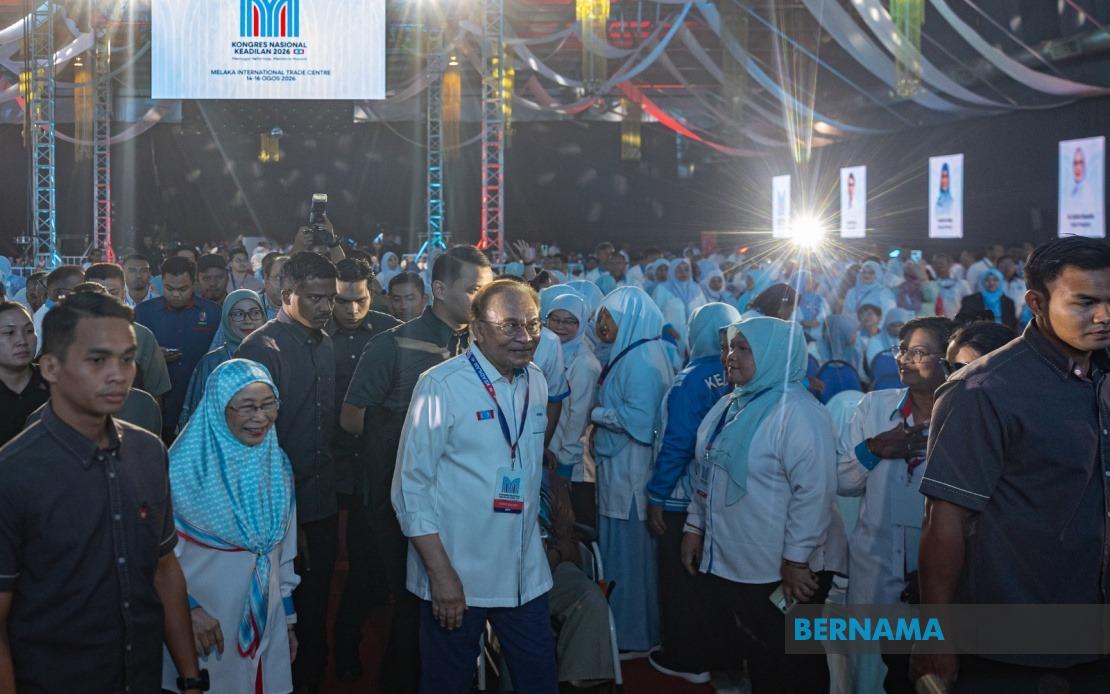
Prime Minister Datuk Seri Anwar Ibrahim has doubled down on his administration's commitment to sustaining its working relationship with UMNO-Barisan Nasional at the Federal level, framing the partnership as essential to Malaysia's political stability and economic advancement. Speaking at the PKR National Congress 2026 in Melaka on August 16, Anwar stressed that pragmatic cooperation remains the cornerstone of his governance philosophy, even as recent political developments have prompted speculation about potential fractures in the Unity Government coalition.
Anwar's remarks come at a politically delicate moment when questions about the durability of the Federal-level arrangement between his Pakatan Harapan alliance and UMNO-BN have intensified. The Prime Minister sought to address these concerns head-on, signalling that neither personal grievances nor jostling for political position should dictate the coalition's trajectory. This messaging is particularly significant given Malaysia's complex political landscape, where coalition stability has historically been fragile and subject to sudden shifts when political actors prioritise factional interests over broader national considerations.
Central to Anwar's argument is his conviction that electoral politics and personality-driven rivalries must yield to the imperatives of good governance. He articulated a vision in which decision-making is anchored to what benefits the Malaysian people and strengthens the nation, rather than advancing individual political careers or settling old scores. This appeal to higher principles reflects an attempt to establish a more institutionalised approach to coalition management, moving beyond the transactional and often unpredictable dynamics that have characterised Malaysian politics for decades.
The emphasis on economic growth as a binding force between the Unity Government and UMNO-BN is particularly noteworthy for Malaysian readers. With inflation affecting household purchasing power, employment uncertainty in certain sectors, and the need for sustained infrastructure investment, the Prime Minister is essentially arguing that political rupture would jeopardise the economic agenda that both coalitions claim to support. A breakdown in Federal-level cooperation could stall critical policy initiatives, deter foreign investment, and destabilise financial markets—outcomes that would ultimately harm ordinary Malaysians regardless of their political affiliation.
Anwar's positioning also carries implications for regional stability. ASEAN's effectiveness and Malaysia's ability to play a constructive role in regional affairs depend partly on domestic political coherence. Prolonged political uncertainty or frequent coalition reshuffles can diminish a country's diplomatic clout and its capacity to coordinate multilateral responses to regional challenges. The Prime Minister's reaffirmation of commitment to UMNO-BN cooperation therefore signals to neighbouring countries that Malaysia remains a stable partner committed to continuity in its regional and international engagements.
The timing of these remarks at a PKR party congress is strategically significant. By making his statement before the party faithful rather than in Parliament or through a prepared press release, Anwar is effectively binding PKR members to the coalition framework. This approach serves to moderate potential dissent within Pakatan Harapan more broadly, as party activists might otherwise question why their coalition should accommodate UMNO, a party that held power for six decades before 2018 and which many PKR supporters view with deep historical suspicion.
However, the necessity of Anwar reiterating this commitment suggests underlying tensions do exist. The fact that he felt compelled to address recent developments and to explicitly state that political decisions should not be driven by anger or personal interests indicates that some PKR members or broader coalition partners have questioned the wisdom of continued collaboration with UMNO-BN. These internal pressures reflect genuine ideological differences and historical grievances that cannot simply be wished away through appeals to rational self-interest.
For Southeast Asian observers, the sustainability of Malaysia's Unity Government remains an open question. While Anwar's message emphasises stability, the coalition model itself—where Pakatan Harapan and UMNO-BN share power without being fully integrated—creates ongoing potential for tension. Unlike a single-party government, a broad coalition requires constant negotiation and mutual forbearance, and these qualities can erode over time as electoral cycles approach and political actors calculate their individual advantage.
Anwar's framing also implicitly acknowledges that the Malaysian electorate is watching closely. By publicly committing to cooperation with UMNO-BN, he is making a statement about voter confidence and political continuity. If the coalition were to collapse, it would likely trigger a major political crisis, necessitate new elections, and potentially hand power to a different configuration—outcomes that many ordinary Malaysians wish to avoid. The Prime Minister's emphasis on prosperity through economic growth resonates with voter priorities, and by linking stability to economic performance, he strengthens the case for maintaining the status quo.
Looking ahead, the durability of this commitment will be tested by concrete circumstances. The next general election cycle, potential by-elections, and any major policy disagreements between coalition partners will reveal whether Anwar's appeal to principle and pragmatism can sustain cooperation or whether underlying political forces will eventually force a realignment. For now, however, the Prime Minister has sent a clear signal: the Unity Government, with all its imperfections, remains his preferred framework for governing Malaysia.

