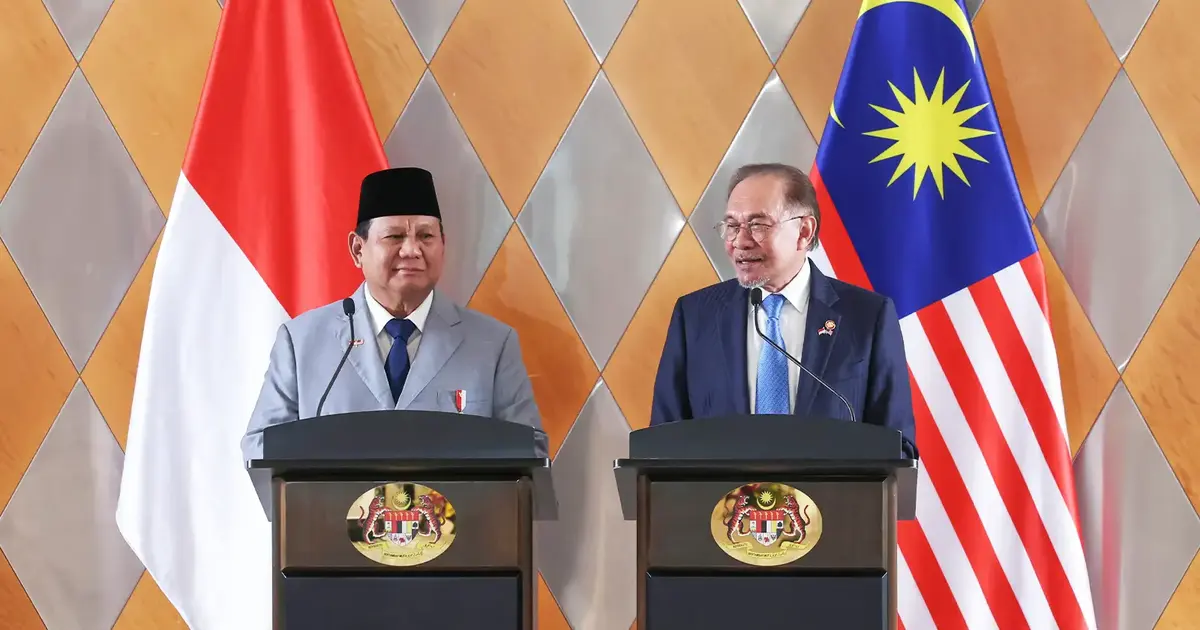
Prime Minister Anwar Ibrahim has escalated concerns about the Malaysian federal land scheme Felda's involvement in a major Indonesian investment, reaching out directly to Indonesian President Prabowo Subianto about the troubled Eagle High venture. The correspondence signals growing anxiety within Malaysia's top leadership about a transaction that threatens to drain more than RM2 billion from resources meant for the farming community.
The Eagle High project represents a substantial commitment of Felda funds in Indonesia, and according to Anwar's assessment, the current trajectory poses existential financial risks to an organisation that serves hundreds of thousands of smallholders and their families across Malaysia. The Prime Minister's intervention underscores the political sensitivity of any development that could undermine the livelihoods and retirement security of Felda settlers, a constituency with deep roots in Malaysian agriculture and significant electoral influence across rural constituencies.
The scale of potential loss that Anwar has highlighted—exceeding RM2 billion—would represent a catastrophic depletion of Felda's reserves and investment capital. For context, such a loss would substantially impair the organisation's capacity to fund development programmes, infrastructure improvements, and social services that settlers have come to depend upon. The contrast between the potential RM2 billion exposure and the possibility of recovering only RM200 million illustrates the severity of the downside scenario that has prompted ministerial action.
Felda, established decades ago as a cornerstone of Malaysia's rural development strategy, operates as a cooperative enterprise managing land and providing support services to settler families. Any significant financial distress would ripple across multiple dimensions of settler welfare, from replanting initiatives to healthcare subsidies and pension contributions. This explains why the Prime Minister felt compelled to engage his Indonesian counterpart at the highest diplomatic level, treating the matter not merely as a commercial dispute but as one affecting bilateral relations and rural communities in Malaysia.
The decision to write to Prabowo rather than handle the matter through conventional bureaucratic channels suggests that standard mechanisms may have proven insufficient to address the issue satisfactorily. Direct presidential engagement indicates that Anwar regards this as requiring senior-level political intervention and problem-solving capacity that only top leadership can provide. Such correspondence also reflects the broader reality that cross-border investments by Malaysian entities sometimes encounter complexities that transcend normal corporate governance frameworks.
The Eagle High project's trajectory raises broader questions about due diligence processes that preceded Felda's substantial capital commitment. Investors and stakeholders will inevitably scrutinise how such a significant outlay was approved, what risk assessments were conducted, and whether adequate safeguards and exit strategies were embedded in the investment structure from inception. These questions extend beyond Felda's management to encompass oversight responsibilities of government bodies and the boards that govern such entities.
For Malaysian readers, particularly those with family connections to Felda communities, this situation embodies the vulnerability of large institutional investments to adverse developments, whether through market conditions, operational challenges, or unforeseen circumstances. The farming sector remains economically fragile despite decades of government support, making the loss of substantial institutional capital especially damaging to settlers whose income alternatives remain limited.
The Indonesian dimension adds complexity, as managing expectations and outcomes in cross-border ventures requires coordination across different regulatory frameworks, legal systems, and commercial practices. Prabowo's response to Anwar's concerns will likely shape both the trajectory of the Eagle High resolution and the broader tone of Malaysian-Indonesian economic cooperation, an area where agricultural and agro-industrial ventures have historically played important roles.
The timing of this correspondence may also reflect growing recognition that early intervention offers the best prospect for minimising ultimate losses. The difference between losing RM2 billion and recovering RM200 million—a net loss of RM1.8 billion—versus achieving better recovery rates through effective negotiation and restructuring could prove decisive for Felda's financial health and its capacity to serve settler communities effectively over the medium to long term.
Regionally, this situation underscores the risks that large state-linked enterprises in Southeast Asia face when investing across borders, particularly when projects encounter difficulties. Other regional governments and institutions managing similar cross-border portfolios will be watching to understand how Malaysia's leadership addresses this challenge and whether bilateral mechanisms prove effective in resolving complex investment disputes.
Moving forward, the outcome of Anwar's engagement with Prabowo will test the strength of Malaysia-Indonesia relations and the willingness of both nations to cooperate constructively on economic matters affecting their citizens. The resolution should ideally establish a template for addressing comparable issues, while also reinforcing the importance of rigorous governance frameworks for major institutional investments that carry significant implications for vulnerable constituencies.

