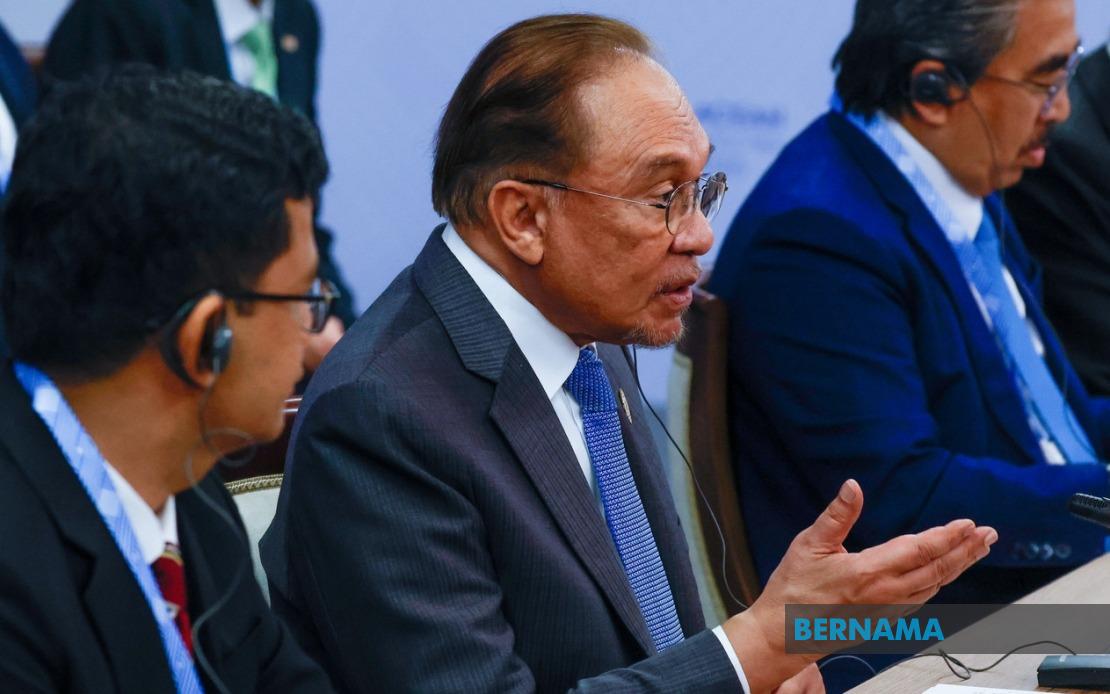
Prime Minister Datuk Seri Anwar Ibrahim has publicly lauded Russian President Vladimir Putin for the Kremlin's unwavering diplomatic approach to two of the Middle East's most consequential contemporary challenges: the Gaza conflict and the broader geopolitical tensions centred on Iran. The commendation came during a bilateral meeting in Kazan on Wednesday evening, where Anwar seized the opportunity to articulate Malaysia's alignment with Russia's foreign policy positions on these volatile regional matters.
In his opening remarks, Anwar explicitly acknowledged what he characterised as Russia's principled consistency on both fronts. The Malaysian premier's words reflected a deliberate diplomatic gesture, signalling not merely bilateral friendship but also Malaysia's positioning within the broader multipolar global order. By invoking Russia's steadfastness on Gaza and Iran, Anwar reinforced Malaysia's historical commitment to principled foreign policy, particularly regarding Palestinian rights and regional stability—issues that resonate deeply with Malaysia's domestic constituencies and its standing within the Islamic world.
Anwar's commendation of Russia's position on Gaza carried particular significance given the scale of humanitarian devastation and the polarisation of global opinion surrounding the conflict. Russia has consistently called for a ceasefire, emphasised the need for unrestricted humanitarian access to Palestinian civilians, and advocated for diplomatic solutions rather than military escalation. These positions align with Malaysia's own diplomatic rhetoric, which has historically championed Palestinian self-determination and criticised unilateral military actions. By publicly endorsing Russia's approach, Anwar reinforced Malaysia's credentials as a nation committed to international law and humanitarian principles.
Equally important to Anwar's remarks was his acknowledgement of Russia's relationship with Iran and Moscow's advocacy for dialogue over confrontation. The Iranian nuclear question and regional security dynamics involving Tehran have long been central to great power competition in the Middle East. Russia's approach—maintaining substantive ties with Iran while simultaneously advocating for negotiated settlements and diplomatic engagement—represents a pragmatic middle ground that distinguishes Moscow from more hardline positions. Anwar's explicit praise for this stance underscored Malaysia's preference for multilateral dialogue and its aversion to zero-sum geopolitical frameworks that characterise much of contemporary international relations.
The Prime Minister extended his commendation beyond formal diplomatic protocol by framing Russia's positions as worthy of admiration not merely from Malaysia but from broader swathes of global opinion. His invocation of popular Malaysian sentiment and reference to unnamed "many others" suggested that Russia's foreign policy approach enjoys legitimacy and support beyond governmental circles. This rhetorical move elevated the discussion from bilateral state interests to questions of principle and international ethics—territory where Russia has sought to distinguish itself as a defender of multipolarity against what it characterises as Western hegemony.
Geopolitically, Gaza and Iran represent focal points where the interests and ideologies of major powers—including the United States, Russia, and China—intersect and often collide. For Malaysia, a Southeast Asian nation with significant Muslim populations and historical ties to both the Arab world and Asia, these Middle Eastern issues carry domestic political resonance. By publicly aligning Malaysia with Russia's diplomatic positions, Anwar navigated a delicate balance between maintaining Malaysia's international partnerships, responding to domestic constituencies invested in Palestinian rights and regional stability, and positioning Malaysia as an independent actor capable of formulating its own foreign policy judgements.
Russia's consistent support for Palestinian humanitarian needs and opposition to unilateral military actions reflects Moscow's broader foreign policy philosophy, which emphasises respect for sovereignty, international law, and the principle of non-interference in internal affairs. These principles, while sometimes selectively applied, form the rhetorical foundation for Russia's challenge to what it views as Western-led international order. Malaysia, despite its different geopolitical location and strategic considerations, shares some of these concerns about preserving the autonomy of smaller and medium-sized nations in an increasingly multipolar world.
Anwar's explicit reference to Russia's maintenance of close diplomatic and economic relations with Tehran, coupled with its advocacy for dialogue, reflected recognition of a sophisticated diplomatic approach. Rather than adopting either the confrontational stance of some Western powers or the aligned position of Iran's closest allies, Russia has positioned itself as a power capable of engaging substantively with multiple parties and pursuing negotiated outcomes. For Malaysia, which aspires to similar diplomatic flexibility and credibility with diverse global actors, this Russian approach offers both practical lessons and ideological alignment.
The timing of these remarks in Kazan, during a formal bilateral engagement, suggested deliberate strategic communication. Malaysia has long sought to develop its relationship with Russia across multiple dimensions—economic, technological, and diplomatic. Anwar's public commendation of Putin's foreign policy positions on Middle Eastern issues served multiple functions simultaneously: strengthening bilateral rapport, demonstrating Malaysia's independence in foreign policy formulation, signalling alignment with Russia's broader geopolitical vision, and maintaining Malaysia's standing with Muslim-majority nations and non-aligned movements that view these Middle Eastern issues as tests of commitment to principles.
The broader implications for Southeast Asia merit consideration. Malaysia's positioning itself as a nation that appreciates Russia's principled approach on global issues carries subtle messages to other regional powers about Malaysia's foreign policy orientation. In an era of intensifying great power competition, particularly involving China and the United States, Malaysia's deliberate cultivation of balanced relationships with multiple powers—including Russia—reflects its strategic hedging approach. By publicly endorsing Russia's positions on specific issues while maintaining dialogue with other global actors, Malaysia reinforces its image as a thoughtful, principled nation rather than a client state of any particular power.
Anwar's remarks also underscore an important dimension of contemporary Malaysian foreign policy: the integration of humanitarian and strategic concerns. Malaysia's historical advocacy for Palestinian rights, its engagement with Iran, and its cultivation of relationships with Russia all reflect a foreign policy that attempts to reconcile ideological commitments with strategic interests. The Prime Minister's explicit commendation of Russia's consistency on Gaza and Iran positions Malaysia within a broader coalition of nations that have resisted what they perceive as pressure to align with particular great power blocs on these issues.