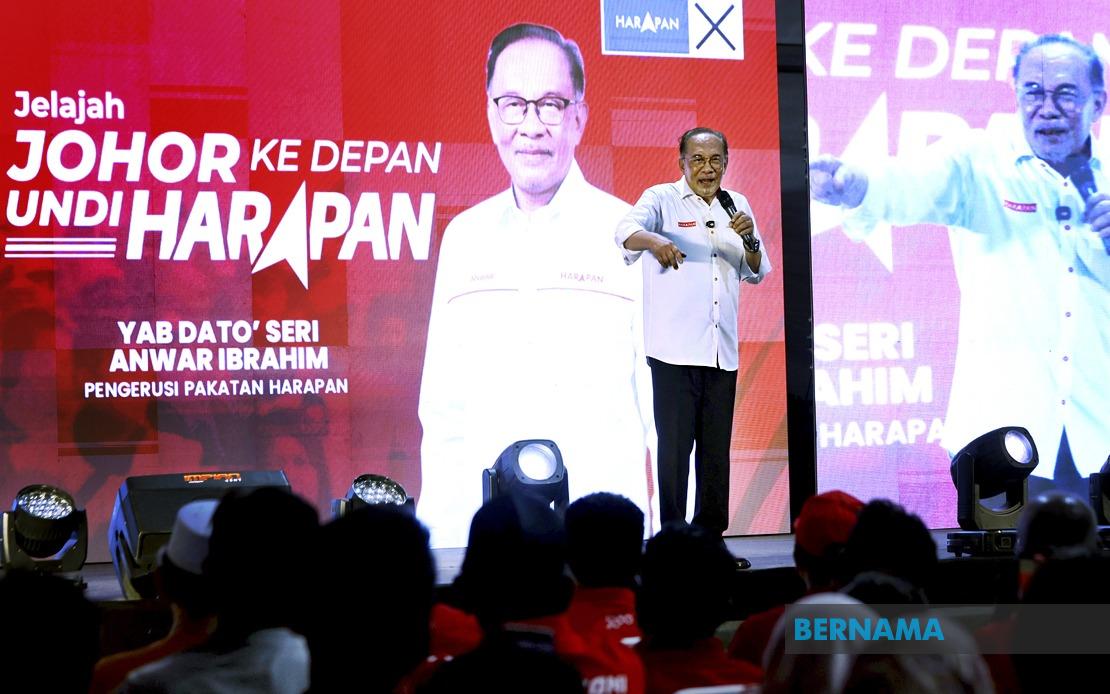
Prime Minister Datuk Seri Anwar Ibrahim has drawn a firm line between the government's anti-corruption agenda and the corrupt practices of previous administrations, declaring that the era of systematic plunder and patronage networks has conclusively ended. Speaking during a campaign event in Sungai Mati, Muar, as part of the Johor State Election drive, Anwar positioned clean governance as a cornerstone principle transcending race and political affiliation, signalling a departure from governance models that historically prioritised insider enrichment over public accountability.
The Prime Minister's remarks underscored the MADANI administration's stated priority of reconstructing Malaysia's institutional framework to eliminate embedded corrupt practices. Anwar elaborated that this reconstruction extends beyond symbolic gestures to tangible resource stewardship, emphasising that every ringgit of state revenue must be redirected toward genuine public benefit rather than siphoned through networks of beneficiaries. This framing represents a direct indictment of previous governance structures where government contracts, resource allocation, and financial privileges flowed systematically toward politically connected networks, a dynamic that has long constrained Malaysia's developmental trajectory and international standing.
Central to Anwar's messaging was a deliberate rejection of identity-based political appeals that he suggested had historically masked predatory governance. He articulated that leadership quality should be evaluated through the lens of personal integrity and ethical conduct rather than communal categorisation, implicitly criticising opposition narratives that weaponise racial sentiment to deflect from accountability questions. His statement that he welcomes Malay, Chinese, and by extension all Malaysian leaders who demonstrate honesty and reject corruption represents an attempt to reframe the political landscape around institutional performance rather than demographic affiliation—a strategically significant position given Malaysia's communal political history.
The distinction Anwar drew between the "old culture of plunder" and the current governance model carried substantial symbolic weight. He specifically condemned the practice of leveraging governmental authority for family wealth accumulation and nepotistic contracting arrangements, practices that remain freshly visible in recent Malaysian political discourse and court proceedings. By naming these behaviours explicitly and characterising them as incompatible with contemporary governance standards, Anwar positioned the MADANI government as explicitly discontinuous with earlier administrations, a claim that carries implications both for public confidence and for ongoing legal proceedings against figures from previous regimes.
Anwar's assurance that no official would receive governmental protection from corruption charges represents a significant commitment within Malaysia's political context, where historical patterns have often seen senior figures shielded from accountability through various institutional mechanisms. This pledge carries particular weight given Malaysia's chequered history with high-profile corruption cases and the perception among many Malaysians that political proximity determines prosecutorial outcomes. Whether such protection materialises in practice will substantially influence public assessment of whether systemic reform is genuinely occurring or represents rhetorical repositioning.
The Prime Minister characterised opposition criticism during this period as driven primarily by factional ambitions to reclaim federal power rather than principled governance concerns. This framing attempts to delegitimise opposition narratives by attributing them to self-interest rather than ideological conviction, a rhetorical manoeuvre designed to maintain unified government messaging during an election cycle. However, such characterisations also risk reducing substantive governance debates to partisan posturing, potentially obscuring legitimate accountability questions that transcend electoral competition.
Anwar's emphasis on systemic administrative cleanup rather than selective prosecutions suggests an institutional approach to anti-corruption efforts. This approach theoretically addresses root conditions enabling corruption rather than merely removing individual actors, though implementing such systemic change requires sustained bureaucratic reform, resource reallocation toward oversight mechanisms, and potentially uncomfortable institutional restructuring that may face resistance from entrenched interests. The viability of such reform remains contingent upon consistent political will and adequate institutional capacity.
The Johor State Election campaign context provided the immediate backdrop for these remarks, with the polling date set for July 11 and 172 candidates competing for 56 state seats. Anwar's intensive campaign schedule—completing 15 engagements over two days alongside Penang Chief Minister Chow Kon Yeow and Ledang MP Syed Ibrahim Syed Noh—reflected the strategic importance of Johor to Pakatan Harapan's broader coalition maintenance. For Malaysia's broader electorate, these campaign statements signal the government's messaging priorities heading into electoral contests and offer a window into how the administration intends to justify its record and future direction to voters.
For Southeast Asian observers, Anwar's emphasis on institutional legitimacy and corruption-fighting represents a contemporary positioning within regional patterns where multiple governments have adopted anti-corruption rhetoric as a governing principle. The credibility of such commitments varies substantially across the region, often determined by whether proclaimed principles translate into measurable institutional change and consistent application across political hierarchies. Malaysia's trajectory in implementing systemic anti-corruption reform will carry implications not only for domestic governance but for regional perceptions of whether democratic transitions can deliver substantive institutional improvement.
The racial inclusivity language Anwar employed—explicitly welcoming honest leaders from all communities—addresses a persistent tension in Malaysian politics between merit-based governance principles and communal political structures. Whether such rhetoric meaningfully influences political behaviour or remains declarative depends on whether institutional reforms follow that genuinely de-prioritise patronage networks organised along ethnic lines. Such institutional reorientation would represent a significant departure from established Malaysian political practice and faces substantial structural obstacles.
Looking forward, the transformation from campaign commitments to institutional reality will determine whether Anwar's anti-corruption pledges represent a genuine governance inflection point or constitute strategic political communication designed to consolidate electoral support. The specific mechanisms through which systemic administrative cleanup will occur, the institutional actors responsible for implementation, and the resource commitments underlying such initiatives remain incompletely detailed in campaign messaging. These implementation details will ultimately determine whether Malaysia's governance trajectory genuinely diverges from historical patterns or reproduces them under different rhetorical framing.

