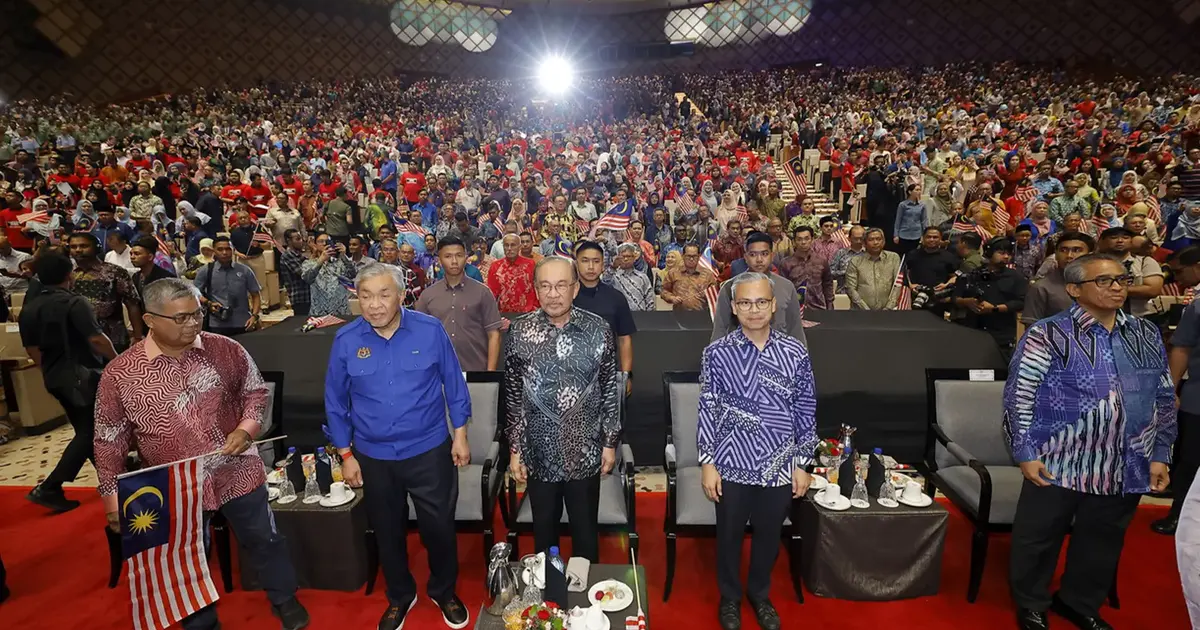
Prime Minister Anwar Ibrahim has announced that substantial sums held by the state through confiscation will be channeled back to ordinary Malaysians, signalling a significant shift in how accumulated assets from enforcement actions are deployed. The commitment reflects the administration's foundational belief that the country's financial resources and accumulated wealth must ultimately serve the broader population rather than remaining locked away in government coffers or institutional reserves.
This initiative represents more than a simple budgetary reallocation. It underscores Anwar's vision for a more inclusive economic model where proceeds from anti-corruption drives, asset seizures, and financial penalties are recirculated into the hands of citizens who have been disproportionately affected by years of institutional mismanagement and financial impropriety. The approach challenges conventional government practice, where seized assets traditionally flow into consolidated revenue accounts with minimal transparency regarding their ultimate application.
The scale of the undertaking is considerable, involving billions of ringgit that have accumulated through various enforcement mechanisms. These funds represent decades of court-ordered confiscations, penalty collections, and asset recoveries that had previously been absorbed into state treasuries without direct benefit to the average Malaysian. By committing to their redistribution, Anwar positions his administration as fundamentally different from its predecessors in its treatment of public resources recovered through legal processes.
For Malaysian taxpayers and lower-to-middle-income households, the pledge carries immediate practical implications. Such redistribution could take multiple forms, ranging from direct cash transfers to funding for social safety net programmes, healthcare initiatives, education subsidies, or infrastructure projects concentrated in underserved communities. The mechanism of return remains to be detailed, but the principle has been clearly established: these are not funds to be retained by the government apparatus but rather assets to be mobilised for public welfare.
The announcement also addresses longstanding public concerns about opacity in asset management. Malaysians have frequently questioned how government confiscates wealth from corruption and corporate malfeasance while ordinary citizens struggle with stagnant wages and rising living costs. Anwar's statement tacitly acknowledges this frustration and positions wealth recovery and redistribution as central to correcting systemic inequities. This represents a rhetorical and policy realignment from previous administrations that treated confiscated assets as discretionary government funds.
Regionally, the Malaysian approach may influence how other Southeast Asian nations contemplate their own seized asset management. As countries across the region intensify anti-corruption efforts and asset recovery campaigns, the question of how recovered funds should be deployed has become increasingly pressing. By explicitly linking confiscated wealth to public benefit rather than state coffers, Anwar's position offers a template for democratic governance that prioritises citizen welfare over institutional accumulation.
The timing of this commitment also carries political weight. It arrives during a period when Malaysia's economy faces headwinds from global inflation, regional competition, and domestic fiscal constraints. By pledging to return seized assets to the rakyat, Anwar addresses public frustration about economic stagnation and inequality without requiring new taxation or budgetary reallocation from core government functions. The move allows the administration to demonstrate responsiveness to popular grievances while exercising stewardship over resources already in state custody.
Implementation challenges remain substantial. Determining fair distribution mechanisms across a population of over 33 million presents logistical and administrative hurdles. Questions of eligibility, verification, and equity in allocation will require careful design to prevent fraud and ensure that vulnerable populations—whom the policy ostensibly targets—actually benefit from redistribution schemes. The government must also balance transparency about fund sources and sizes against legitimate security concerns regarding the disclosure of enforcement action details.
The philosophical underpinning of this initiative reflects Anwar's broader economic agenda, which emphasises inclusive growth, human capital development, and reducing wealth concentration. Throughout his career, he has articulated concerns about how rapid development and financial liberalisation can benefit narrow elites while marginalising ordinary workers and small farmers. This commitment to redistributing seized assets aligns with those longstanding convictions and positions his government as explicitly rejecting the notion that the state should accumulate wealth separate from its citizens' welfare.
Beyond the immediate financial implications, the statement signals commitment to institutional reform. If billions in seized funds are to be returned rather than retained, government agencies and enforcement bodies must operate with the understanding that their asset recovery efforts serve public benefit rather than bolstering internal budgets. This reorientation could influence prioritisation of enforcement actions and resource allocation within anti-corruption and regulatory agencies.
The announcement will require follow-up detail regarding timelines, beneficiary identification, and distribution methodologies. As the government develops specific policies to operationalise the commitment, scrutiny from both supportive constituencies and sceptical observers will intensify. Nevertheless, the declaration establishes a principle: that seized wealth, recovered through the nation's legal mechanisms, belongs fundamentally to the rakyat and should be deployed accordingly.

