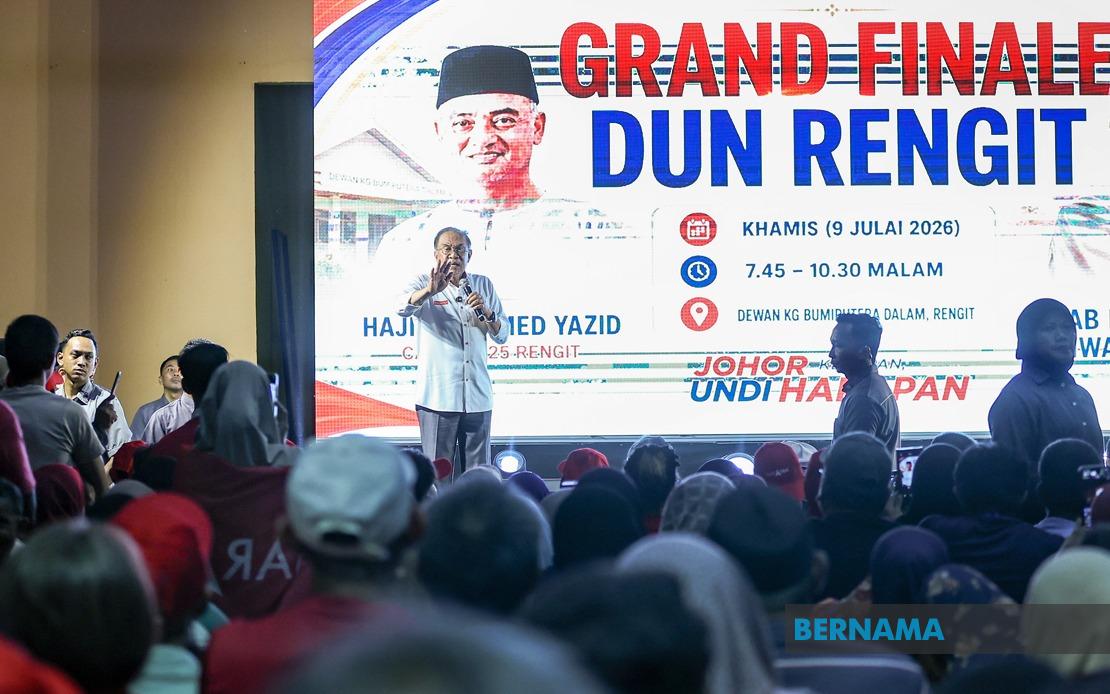
Prime Minister Datuk Seri Anwar Ibrahim has committed to resolving long-standing infrastructure failures affecting residents in Rengit, declaring that basic amenities must align with Johor's development status. Speaking at a Pakatan Harapan campaign event in Batu Pahat on July 9, Anwar emphasised that access to functional healthcare and reliable water supply represent fundamental rights that demand immediate government intervention rather than protracted delay.
The prime minister's remarks reflected frustration with the deteriorating state of public services in the constituency. He highlighted the contradiction between residents seeking treatment and facilities that themselves require rehabilitation, using pointed language to underscore the urgency of infrastructure renewal. His framing elevated basic services from administrative concerns to matters of governance integrity and social equity, positioning infrastructure investment as central to the coalition's electoral platform in Johor.
Anwar situated healthcare and water provision within a broader governance philosophy emphasising foundational development priorities. He explicitly identified housing, education, and health infrastructure as domains where government must maintain consistent focus, suggesting these pillars form the basis for broader economic and social progress. This hierarchical approach to governance priorities reflects federal policymaking frameworks that often compete for budgetary allocation, with the prime minister signalling where his administration believes resources should concentrate.
The campaign event served as one of three Pakatan Harapan gatherings Anwar attended across Johor that evening, demonstrating the coalition's intensive electoral mobilisation before Saturday's 16th state election. The 'Serumpun Kasih Sejiwa Harmoni Grand Finale' programme brought together party machinery, local representatives, and constituency candidates under centralised messaging focused on infrastructure competence and developmental delivery. Such coordinated events typically reinforce voter messaging and consolidate party organisation ahead of polling.
Also participating in the Rengit event were Sri Gading MP Aminolhuda Hassan, who holds the position of Johor Parti Amanah Negara chairman, and the coalition's Rengit constituency candidate Yazid Abu Bakar. Their attendance alongside the prime minister represented institutional validation of local candidates and symbolised coalition unity in pursuit of the seat. The hierarchy of speaker participation typically signals party and federal prioritisation of particular constituencies deemed strategically significant.
Anwar directed explicit warnings toward government officials and community leaders regarding ethical conduct, cautioning against position abuse for personal enrichment. This rhetoric about integrity appears designed to contrast coalition governance with perceptions of incumbent mismanagement, framing electoral choice as substantively about administrative quality and official accountability. Such messaging resonates particularly in constituencies experiencing service delivery failures, where residents may attribute infrastructure neglect to corruption or indifference rather than resource constraints.
The prime minister employed strategic framing suggesting that electoral alignment between state and federal governance structures facilitates more efficient development implementation. This argument implicitly criticises power fragmentation across different political administrations, suggesting that coalition control of both state and federal levels enables coordinated infrastructure planning and integrated budget deployment. For Malaysian voters, this represents a familiar campaign argument regarding administrative coordination benefits, though its persuasive power varies based on voters' perceptions of actual implementation outcomes.
Packetan Harapan's electoral strategy in Johor involves contesting all 56 state seats with candidates distributed across coalition component parties according to pre-negotiated power-sharing arrangements. The coalition fields 20 Parti Keadilan Rakyat candidates, 19 from Parti Amanah Negara, and 17 from Democratic Action Party representatives. This distribution reflects negotiated balance among coalition partners, with seat allocation typically reflecting party size and electoral organisational capacity. A total of 172 candidates across all parties contest the 56 available seats, indicating competitive multi-cornered contests throughout the state.
The timing of Anwar's Rengit appearance reflects strategic campaign allocation during the final campaign period, with federal leadership engagement typically concentrated on constituencies deemed competitive or symbolically significant. His emphasis on resolving infrastructure deficits suggests either that Rengit residents have mounted sustained complaints regarding service quality or that coalition strategists identified infrastructure messaging as electorally resonant in this particular area. Voter receptivity to infrastructure pledges depends substantially on whether residents perceive problems as technical failures or politically motivated neglect.
For Malaysian and Southeast Asian observers, the Johor election represents a significant state-level contest within Malaysia's broader political dynamics. Infrastructure competence and service delivery quality increasingly dominate Malaysian electoral discourse, reflecting voter prioritisation of tangible governance outcomes over ideological appeals. Anwar's specific focus on healthcare and water services in Rengit exemplifies this voter-driven shift toward practical governance metrics as primary electoral considerations.
The coalition's intensive campaign mobilisation across multiple constituencies demonstrates recognition that Johor represents a strategically crucial state election. Electoral outcomes in this economically significant state influence broader perceptions of federal government momentum and coalition viability. Campaign messaging emphasising infrastructure repair and service reliability indicates coalition strategists believe voters prioritise functional governance over other considerations, suggesting broader campaign strategy will likely concentrate on implementation records and development delivery capacity.
Anwar's campaign visit reflects the primacy accorded to federal prime ministerial presence in Malaysian state elections, where such appearances traditionally generate significant media attention and local validation for candidates. His specific pledges regarding Rengit's infrastructure problems create measurable commitments against which post-election governance performance will be evaluated. Residents and political observers will subsequently monitor whether promised facility upgrades and water supply improvements materialise, making infrastructure pledges double-edged electoral instruments that demand serious implementation follow-through to maintain coalition credibility.

