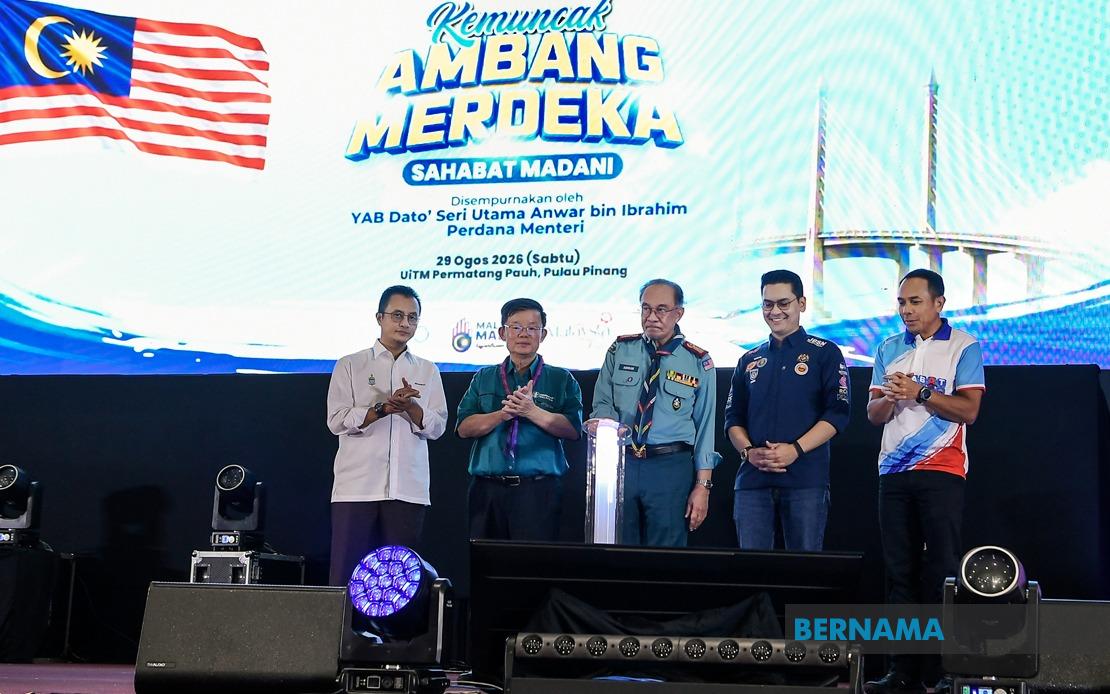
Prime Minister Datuk Seri Anwar Ibrahim has formally inaugurated Sahabat MADANI, a sweeping national volunteer movement designed to mobilise citizens across ethnic, religious and socioeconomic divides around shared community goals. The launch, held at Universiti Teknologi MARA (UiTM) Permatang Pauh in Bukit Mertajam as part of the Ambang Merdeka Sahabat MADANI 2026 programme, marks a significant expansion of grassroots civic engagement under his administration's "Malaysia MADANI" agenda of inclusive prosperity.
The initiative has already demonstrated considerable momentum, with the Implementation Coordination Unit of the Prime Minister's Department (ICU JPM) reporting that 11,060 volunteers have registered across the country. This impressive uptake suggests substantial public appetite for structured channels through which ordinary Malaysians can contribute directly to addressing social challenges. The registration figures underscore growing interest in government-sponsored volunteering at a time when many nations struggle to mobilise sustained citizen participation in public service.
At its core, Sahabat MADANI represents an attempt to operationalise the government's broader Malaysia MADANI framework—a policy platform centred on equitable development and social harmony. Rather than concentrating poverty alleviation and community development exclusively through state bureaucracies, the volunteer movement distributes responsibility across a network of engaged citizens. This decentralised approach aligns with emerging global best practices in development work, which increasingly emphasise community-led solutions tailored to local contexts rather than top-down interventions.
The volunteer network will concentrate on several concrete service categories identified by the ICU JPM as priorities. Supporting vulnerable groups represents the foundational pillar, recognising that Malaysia's social safety net contains significant gaps despite decades of development. Beyond immediate relief, the initiative targets educational deficits by focusing on children who have abandoned schooling, a persistent challenge particularly among marginalised communities in both urban and rural areas. Young people represent another strategic emphasis, with the programme aiming to create pathways toward employment and entrepreneurship—addressing underemployment and limited economic mobility that fuel social discontent.
The disaster response capacity built into Sahabat MADANI carries particular relevance for Southeast Asia's disaster-prone region. Malaysia faces recurring challenges from flooding, landslides and other climate-related emergencies that frequently overwhelm official emergency services. A well-organised volunteer corps capable of rapid mobilisation during crises could substantially improve response times and reach, particularly in remote areas where government resources arrive more slowly. This dual-purpose framework—combining routine community service with emergency preparedness—maximises the network's utility across varying circumstances.
Critically, Sahabat MADANI explicitly frames volunteering as a mechanism for promoting intercommunal understanding and social cohesion. The programme's emphasis on bringing together people from different ethnic, religious and social backgrounds addresses one of Malaysia's most enduring governance challenges: managing pluralism in a manner that prevents sectarian tensions from destabilising society. By creating practical contexts where ordinary citizens from diverse communities work together toward common objectives, the initiative attempts to build social capital across traditional dividing lines. Such direct interpersonal contact, research consistently demonstrates, tends to reduce prejudice more effectively than rhetorical appeals to unity.
The governance structure emphasises coordination, transparency and results-oriented delivery—elements that the ICU JPM presentation suggests will distinguish Sahabat MADANI from less formalised volunteer efforts. By integrating government resources, volunteer labour and community knowledge within a single institutional framework, the initiative potentially creates more efficient and responsive service delivery than either sector could achieve independently. Government agencies bring institutional capacity and funding, volunteers contribute local knowledge and accessibility, while communities ground decision-making in genuine needs rather than bureaucratic assumptions.
The timing of the Sahabat MADANI launch, coinciding with National Day observances, carries deliberate symbolic weight. By framing volunteering as an expression of national independence and civic responsibility, the government situates community service within patriotic discourse. This rhetorical positioning may enhance recruitment and sustain engagement by elevating volunteer work beyond individual altruism toward collective nation-building. Such framing proves particularly potent in Malaysia, where appeals to national unity and common purpose resonate across diverse communities as a counterbalance to more divisive political messaging.
Young people receive particular attention in Sahabat MADANI messaging, reflecting government concern about youth alienation and vulnerability to extremist or divisive ideologies. By channelling youthful energy toward constructive civic participation, the programme aims to provide positive social belonging and purpose. This preventive approach recognises that young people excluded from mainstream economic opportunities and social integration become susceptible to radicalisation. Sahabat MADANI thus functions simultaneously as a development intervention, a social cohesion strategy and a security initiative.
For Malaysian observers, the Sahabat MADANI experiment warrants close monitoring as a potential model for scaling civic participation beyond traditional mechanisms. Southeast Asian governments frequently struggle to balance democratic participation with effective governance, and volunteer movements offer potential pathways toward deeper citizen engagement without requiring fundamental institutional reorganisation. If Sahabat MADANI successfully mobilises its enrolled volunteers toward measurable community improvements while maintaining intercommunal harmony, the model could influence development approaches across the region.
The initiative's success ultimately depends on whether the 11,060 registered volunteers sustain active participation beyond the launch enthusiasm and whether coordinating structures remain responsive to volunteer input and community needs. Government-led volunteer programmes sometimes falter when bureaucratic procedures frustrate grassroots energy or when volunteer labour becomes instrumentalised for government objectives rather than community priorities. Sahabat MADANI's emphasis on community-identified needs and transparent coordination represents an attempt to avoid such pitfalls, though implementation across diverse regions will determine whether principles translate into practice. The coming months will reveal whether this ambitious nationwide movement can translate registration numbers into sustained, impactful service delivery.

