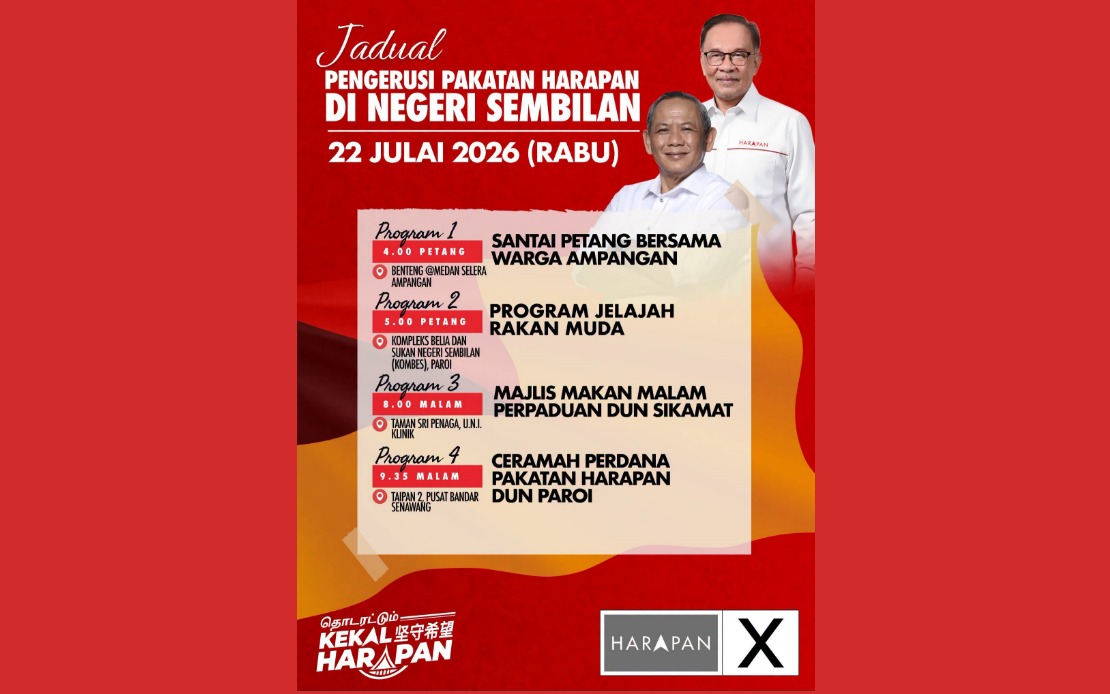
Prime Minister Datuk Seri Anwar Ibrahim is intensifying Pakatan Harapan's campaign efforts in Negeri Sembilan, with the PKR leader scheduled to visit four separate constituencies as the coalition seeks to maintain its grip on state power. The personal involvement of the premier on the fifth day of the campaign represents a significant escalation in PH's strategy to consolidate support across the central region, signalling the coalition's determination to prevent any erosion of its existing base.
Anwar's itinerary focuses on grassroots engagement and youth mobilisation, reflecting PH's broader campaign architecture in the state election. Beginning at 4 pm at Benteng @ Medan Selera Ampangan with a casual community gathering styled as 'Santai Petang Bersama Warga Ampangan', the Prime Minister will then move to the Negeri Sembilan Youth and Sports Complex in Paroi for the 'Jelajah Rakan Muda' youth-focused programme at 5 pm. This dual approach targeting both general voters and younger demographics underscores PH's need to maintain electoral enthusiasm across age groups, particularly among first-time and younger voters who have proven volatile in recent Malaysian electoral cycles.
The evening programme builds momentum through what PH terms a 'mega ceramah' or public rally format, a traditional but still-effective campaign tool in Malaysian politics. Between the youth engagement and the evening rally, Anwar will attend a Sikamat constituency unity dinner, an event designed to strengthen local party organisation and reinforce solidarity among party members and allied representatives. The Paroi mega ceramah at Pusat Bandar Senawang represents the centrepiece of his Negeri Sembilan visit, where the Prime Minister can deliver PH's key messaging directly to larger audiences and generate the media coverage necessary to amplify campaign reach beyond those physically present.
Anwar's personal presence carries particular symbolic weight in this election. As PKR president and premier, his appearance in Negeri Sembilan demonstrates central leadership commitment to retaining the state and provides cover for incumbent Menteri Besar Datuk Seri Aminuddin Harun, who leads a state government that has governed since the 2018 political transition. For voters assessing whether to maintain the incumbent administration, the visible support of the national leader provides reassurance that PH remains united and confident in its Negeri Sembilan operation.
The coalition is contesting all 36 state seats, with seat distribution reflecting the careful balance PH maintains among its three component parties. The 16 PKR candidates form the largest contingent, followed by 11 from DAP and nine from Amanah. This allocation reveals which constituencies each party views as strategically important, with PKR's larger presence reflecting its status as the dominant coalition component and its particular organisational strength in certain Negeri Sembilan areas. The distribution also navigates the delicate internal coalition dynamics that have occasionally surfaced tensions between parties on policy and seat allocation matters.
PH's campaign messaging centres on a 10-point manifesto launched earlier in the week, framing the election as a choice between development and inclusivity under continued PH stewardship versus alternatives. The manifesto's emphasis on state development and inclusivity targets swing voters and aims to differentiate PH from opposition narratives, positioning the coalition as the vehicle for continuing economic progress and social cohesion. Anwar's direct involvement in campaigning serves to elevate these policy messages beyond state-level discourse, connecting Negeri Sembilan's election to broader national governance themes.
The timing of this campaign push reflects the electoral calendar's strategic imperatives. Early voting occurs on July 28, with polling day set for August 1, meaning PH has limited time to drive home its message and mobilise supporters. The fifth day of campaigning represents a critical juncture where initial momentum must be sustained and any wavering supporters reassured or retrieved. Anwar's intervention suggests coalition strategists detected either significant opportunity or genuine concern about turnout or vote consolidation, prompting central leadership deployment.
For Malaysian observers, the Negeri Sembilan election carries implications beyond state governance. As one of Malaysia's smaller states, Negeri Sembilan's electoral outcome provides early signals about voter sentiment toward the PH-led federal government. Poor performance would undermine claims of national momentum, while strong retention would suggest PH's 2022 federal election recovery remains intact. Regional players including Selangor and Perak will scrutinise the result as an indicator of electoral viability in similar demographic and geographic contexts, making this seemingly local contest a referendum on broader coalition health.
The campaign also reflects evolution in Malaysian political practice. The emphasis on youth engagement through dedicated 'Jelajah Rakan Muda' programming and the mega ceramah format indicates PH's attempt to blend traditional grassroots campaigning with messaging architecture suitable for younger voters navigating digital media environments. Anwar's willingness to undertake extensive ground-level campaigning, visiting four venues in a single afternoon, demonstrates the labour-intensive nature of Malaysian electoral competition and the premium placed on visible leader presence in swaying undecided voters.
Opposition forces will undoubtedly counter with their own campaign activities, but PH's early deployment of its most senior figure signals confidence in the coalition's organisational capacity. Whether Anwar's Negeri Sembilan appearance translates into tangible electoral gains will emerge on August 1, but the decision to commit prime ministerial time and attention underscores the political significance both PH and observers attach to maintaining state-level control in this central region.

