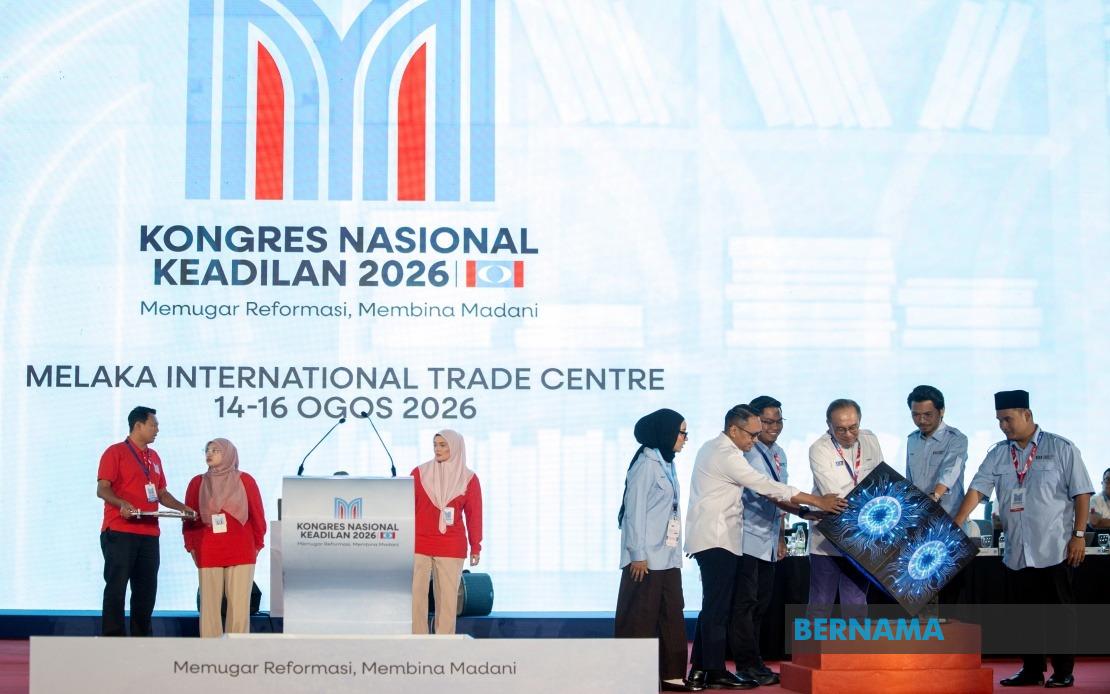
Prime Minister Datuk Seri Anwar Ibrahim marked a significant moment in PKR's institutional development by formally launching a major intellectual publication in Melaka, signalling the party's commitment to structured ideological transmission to its younger members. The 113-page document, compiled collaboratively by Angkatan Muda Keadilan (AMK) chief Muhammad Kamil Ahmad Munim and executive committee member Ashraf Ahmad Hadi, represents a deliberate effort to consolidate contemporary policy thinking within the party's youth framework.
Anwar framed the timing of this publication as deliberately aligned with broader institutional shifts within the government, though he was careful to distinguish between the substantive intellectual content and superficial political messaging. In his foreword remarks, the Prime Minister characterised the initiative as fundamentally different from transient campaign slogans or technical policy papers devoid of deeper meaning. Instead, he positioned the work as part of a larger philosophical project centred on what he termed civilisational renewal—a concept that extends beyond electoral politics to address systemic deficiencies accumulated over decades of governance.
The notion of re-humanising national development carries particular weight in Malaysia's context, where rapid industrialisation and modernisation have often proceeded at the expense of social cohesion and ethical governance. By invoking this language, Anwar appears to be articulating PKR's response to widespread public concerns about corruption, institutional decay, and the erosion of public trust in state institutions. For Malaysian readers accustomed to incremental policy adjustments, this rhetorical framing suggests a more fundamental recalibration of how the party conceptualises its role in national transformation.
Crucially, Anwar directed pointed messaging toward the youth cadres themselves, reminding them that their engagement with party structures carries moral obligations beyond mere career advancement or factional loyalty. He explicitly warned against what he termed complacency and the celebration of superficial achievements—language that resonates with critiques of Malaysia's political establishment, where institutional positions have historically been treated as sinecures rather than platforms for substantive reform. This exhortation signals anxiety within PKR leadership about ensuring generational continuity of the party's reform mandate.
The intellectual foundations outlined in the publication reflect the accumulated lessons and strategic reorientation that PKR has undergone since its establishment during the 1998 Reformasi movement. By consciously connecting contemporary youth training to historical struggles for democratic renewal and institutional accountability, the party appears intent on preventing dilution of its core identity as Malaysia's political system incorporates its once-revolutionary elements into mainstream governance structures. This tension between maintaining oppositional moral clarity and exercising executive power remains unresolved within PKR's institutional culture.
Anwar's emphasis on the extraordinary creativity and intellectual courage required from younger generations speaks to the genuine complexity of Malaysia's current political economy. The accumulation of structural injustices and financial leakages across decades of governance cannot be remedied through conventional administrative means. Instead, they require cadres capable of thinking beyond existing institutional frameworks, imagining alternative arrangements, and possessing sufficient moral fortitude to resist co-optation by vested interests. This framing implicitly acknowledges that governance reform depends less on individual leaders than on sustained commitment from trained party structures.
The concept of spiritual resilience introduced by Anwar adds a religious-ethical dimension often missing from technocratic policy discussions. For a Muslim-majority nation where political legitimacy remains intertwined with Islamic values, this language roots political reform in moral rather than purely instrumental justifications. It distinguishes PKR's appeal from that of opposition parties that have attempted to mobilise anti-establishment sentiment without offering coherent alternative visions of state purpose and societal organisation.
The publication's explicit dual function—as both a cadre-building tool and institutional memory device—addresses a practical vulnerability within Malaysian political parties. Generational transmission of party ideology often fails due to inadequate documentation and the dominance of personalised, leader-centric political cultures. By institutionalising knowledge about the party's historical struggles, foundational principles, and the meaning of Reformasi within a comprehensive written resource, AMK creates a potential buffer against institutional amnesia and fragmentation across time.
For Malaysian observers tracking PKR's evolution as it transitions from perpetual opposition to incumbent government authority, this publication initiative warrants close attention. It suggests internal debate about how to maintain reform commitments while wielding state power—a recurrent challenge for progressive parties entering establishment politics. Whether the cadre-building exercise succeeds in producing members genuinely internalising these principles, rather than instrumentalising party affiliation for personal advancement, will significantly shape PKR's capacity to deliver on its long-standing reform promises and remain a credible vehicle for institutional change across Malaysia's political system.
The launch also reflects broader Southeast Asian patterns whereby political parties increasingly attempt to systematise their ideological content through published materials, recognising that verbal transmission and personalised mentorship prove insufficient for maintaining coherent party platforms across dispersed membership bases and evolving electoral contexts. For regional parties navigating similar transitions from opposition to governance, the success or failure of PKR's cadre-building model may offer instructive lessons about sustaining reform momentum within institutionalised political structures.

