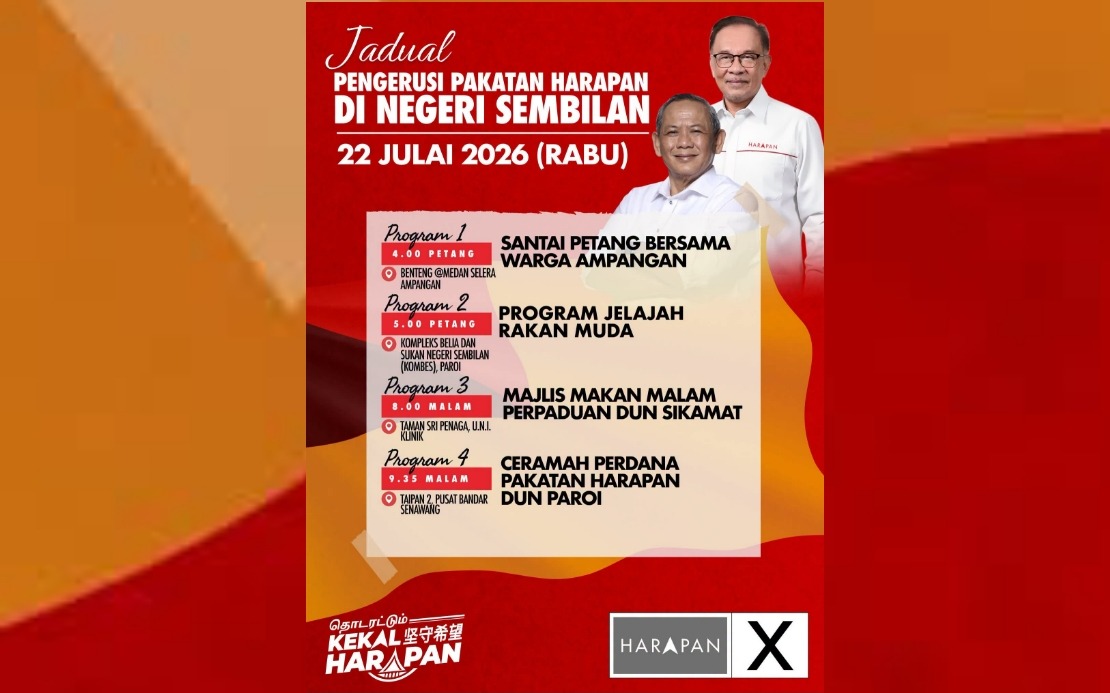
Prime Minister Datuk Seri Anwar Ibrahim is set to intensify Pakatan Harapan's campaign push in Negeri Sembilan tomorrow with a comprehensive four-location tour spanning Seremban and Paroi constituencies. The visit, which will commence at 4 pm according to a Facebook announcement from the premier's office, represents his maiden swing through the state since the 16th Negeri Sembilan State Election campaign officially kicked off, signalling the coalition's determination to consolidate support in the crucial polling week ahead.
The itinerary reflects a carefully calibrated strategy designed to maximize visibility across distinct voter segments and constituencies. By scheduling events from late afternoon through evening, the Pakatan Harapan machinery appears intent on capturing engagement across different demographic windows—from those finishing work to evening gatherings where community participation typically peaks. The concentration of stops within the Seremban and Paroi territories suggests these constituencies represent critical battlegrounds where the coalition believes sustained momentum and high-profile endorsements can meaningfully influence voter sentiment heading into the final campaign stretch.
The evening's centrepiece will be a Unity Dinner scheduled for 8 pm at Taman Sri Penaga in the Sikamat State Legislative Assembly division. Such dinners serve dual purposes in Malaysian electoral politics: they function as fundraising mechanisms for campaign machinery while simultaneously providing platforms for leadership to communicate directly with party loyalists and swing voters. Anwar's attendance underscores the significance Pakatan Harapan attaches to maintaining cohesion across its component parties during state-level contests, where fractious coalition dynamics can prove electorally costly.
Following the dinner, Anwar will proceed to the Paroi DUN Pakatan Harapan Grand Rally at Taipan 2 in Senawang Town Centre. Grand rallies represent the traditional apex of campaign theatre in Malaysian elections, occasions where party machinery mobilizes support through mass gatherings, rousing speeches, and visible demonstrations of organizational capacity. The shift from an intimate dinner setting to a large-scale public rally suggests a deliberate messaging transition—from reinforcing coalition unity to broadcasting broader appeal and momentum to undecided voters and the media covering the election.
Negeri Sembilan occupies a distinctive political position within Malaysia's electoral landscape. The state has historically exhibited pendular voting patterns, swinging between coalition groupings based on local grievances, personality factors, and national political currents. Recent years have seen the state experience flux in political alignment, making it neither safely Barisan Nasional nor solidly Pakatan Harapan territory. This volatility explains why prime ministerial intervention occurs relatively late in the campaign cycle—it signals that party strategists regard the outcome as genuinely competitive rather than predetermined.
The timing of Anwar's visit reflects the electoral calendar's endgame phase. The Election Commission has designated July 28 for early voting, providing a glimpse into voter sentiment precisely as Anwar launches his ground campaign. Early voting patterns frequently serve as bellwethers for general election performance, and strategists monitor these preliminary results intently when calibrating final-week messaging and resource allocation. The Premier's two-day lead before early voting enables his team to respond to any emerging trends detected from preliminary turnout or constituency-level data.
Polling day itself remains scheduled for August 1, providing a ten-day window for intensive campaigning following early voting. Within this compressed timeframe, prime ministerial appearances carry amplified significance. Media coverage accompanying Anwar's visits generates free campaign exposure across news cycles, extends Pakatan Harapan messaging into households that might not attend rallies, and reinforces perceptions of the coalition's organizational strength and internal cohesion. For undecided voters, prime ministerial endorsement carries particular weight in influencing final voting decisions.
Anwar's assumption of both Pakatan Harapan chairmanship and PKR presidency means his political capital and credibility are directly invested in campaign outcomes. Strong performances in state elections historically strengthen a coalition chairman's hand in internal party negotiations and inter-party dynamics. Conversely, disappointing results create space for criticism regarding strategic direction and leadership effectiveness. This personal dimension adds urgency to Anwar's visible campaign presence beyond routine electoral participation by senior party figures.
The Negeri Sembilan contest occurs within a broader Southeast Asian context where coalition governance and state-level electoral dynamics increasingly shape national political trajectories. Malaysia's federal structure means state governments control significant budgetary resources, development priorities, and patronage mechanisms. Victories or defeats in state contests reverberate through federal-state relations and influence coalition parties' internal balance of power during negotiations over ministerial portfolios, policy emphasis, and strategic direction. A strong Pakatan Harapan performance tomorrow would validate Anwar's leadership direction and electoral appeal, while setbacks would invite questions about coalition viability and cohesion heading into eventual federal elections.
The campaign tour also reflects evolving approaches to political communication in Malaysia. Social media announcements like the Facebook post announcing Anwar's itinerary represent how contemporary political figures construct campaign narratives and shape media agendas. By publicizing detailed schedules in advance, campaign teams invite media attendance while enabling supporters to plan attendance and amplify reach through organic social sharing.
Regional observers view Negeri Sembilan elections as indicators of broader voter sentiment across Malaysia's more competitive constituencies. The state's socio-economic composition—encompassing urban, semi-urban, and rural areas with diverse occupational profiles—mirrors characteristics of swing regions nationally. Performance metrics here translate into broader interpretations about coalition strength and voter satisfaction with governmental performance at federal and state levels.

