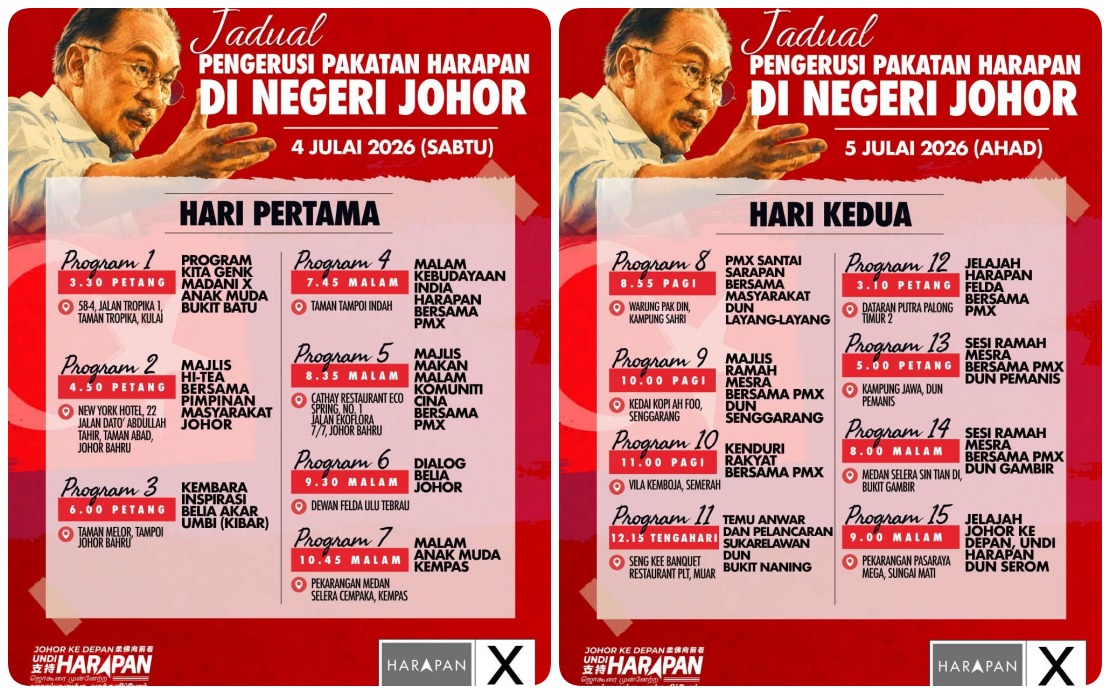
Prime Minister Anwar Ibrahim is throwing his considerable political weight behind Pakatan Harapan's campaign for the 16th Johor state election, embarking on an ambitious seven-event schedule across the state on July 4. The itinerary reflects a strategic push to energise voters in a crucial electoral contest that will test the coalition's electoral machinery and grassroots support in one of Malaysia's most politically significant states.
The whirlwind campaign day, documented on the Prime Minister's official Facebook page, demonstrates PH's determination to contest every available seat in the state assembly. Anwar's schedule targets multiple voter demographics, beginning with direct voter engagement before progressing to a formal high tea with community leaders at a hotel in Johor Bahru at 4.50 pm. This layered approach—combining grassroots contact with meetings involving established civic figures—illustrates the coalition's recognition that electoral success requires mobilising both ordinary citizens and influential community voices.
The campaign strategy extends beyond traditional daytime activities to capture the youth vote, a demographic that has emerged as increasingly pivotal in Malaysian electoral contests. A dedicated Johor Youth Dialogue session at Felda Ulu Tebrau Hall scheduled for 9.30 pm shows Anwar's intent to directly address younger voters' concerns and policy priorities. This late-evening programme indicates the campaign team's understanding that young people often prefer evening events and suggests confidence in the ability to sustain voter enthusiasm into the night.
Anwar's personal involvement signals the national importance of the Johor contest to PH's broader political ambitions. The Prime Minister's decision to dedicate two consecutive days—with eight additional programmes planned for July 5—underscores that Johor is no peripheral sideshow but rather central to the coalition's political calculations heading into what could be a decisive electoral period. For Malaysian observers, this intensity of prime ministerial campaigning typically indicates high stakes and expectations regarding performance.
The coalition's candidate distribution across the 56 state assembly seats reveals careful internal negotiations among PH's three constituent parties. PKR is fielding 20 candidates, Amanah 19, and DAP 17, a formula that reflects both party sizes and historical contributions to the coalition. This balanced approach aims to prevent inter-coalition tensions from undermining the unified front necessary to capture the state, a recurring challenge for PH in previous electoral contests.
The broader electoral context involves 172 candidates competing across all 56 seats, indicating a crowded field that could fragment votes across multiple parties and independents. This competitive landscape makes voter mobilisation and direct appeals by senior party figures particularly consequential. Anwar's personal campaigning provides a counterweight to potential voter fragmentation and aims to consolidate PH support within the coalition's target constituencies.
Johor's political significance extends beyond state-level implications. The state has historically served as a bellwether for national electoral trends and holds considerable weight within Malaysia's federal framework. A strong PH performance could reinforce the coalition's credentials as a viable national alternative and strengthen Anwar's position within Malaysian politics. Conversely, a disappointing result could embolden opposition forces and create internal pressure within PH's ranks, making the election a critical test for the government's overall political health.
The campaign schedule also reflects modern electoral realities, combining traditional community engagement with digital outreach. The reliance on Anwar's Facebook page to publicise the itinerary indicates the campaign's awareness that social media remains a critical information channel for Malaysian voters across age groups. This multi-platform approach—physical events complemented by digital documentation and distribution—represents contemporary best practices in electoral campaigning throughout Southeast Asia.
The voting calendar itself creates additional strategic considerations. With early voting scheduled for July 7 and the main election on July 11, the campaign period is compressed, making high-profile appearances by national figures like Anwar essential for maintaining momentum and securing media coverage. Every campaign day takes on enhanced significance when the election window is narrow, explaining the ambition of the itinerary and the necessity for sustained engagement through consecutive days.
For regional observers, the Johor election illuminates broader patterns of Malaysian electoral competition and the continued centrality of political personalities in driving voter behaviour. Anwar's prominent campaigning role demonstrates how Malaysian politics remains substantially personalised around individual leaders and their perceived capacity to deliver governance benefits. The Prime Minister's direct engagement with voters—from community leaders to youth—reflects a calculation that personal connection and visible commitment influence electoral outcomes more powerfully than institutional or policy-based messaging alone.
The election also occurs within Malaysia's complex ethnic and religious political dynamics, with Johor's diverse population requiring messaging that resonates across communities. Anwar's strategy of engaging multiple voter segments through different event formats suggests an attempt to build a genuinely cross-communal coalition rather than pursuing narrow sectional advantage. Success in assembling such a coalition would validate PH's governing model and provide evidence that Malaysian voters can be mobilised around inclusive, non-communal political platforms.
Looking ahead, the intensity of this campaign effort will be judged against actual electoral results on July 11. The seven events on July 4 and eight planned for July 5 represent significant resource allocation and opportunity cost for the Prime Minister, who must balance national governance responsibilities with campaign imperatives. Should this investment translate into strong electoral gains, it will reinforce the value of top-level political engagement in Malaysian campaigns and likely inspire similar strategies in future state-level contests throughout the country.

