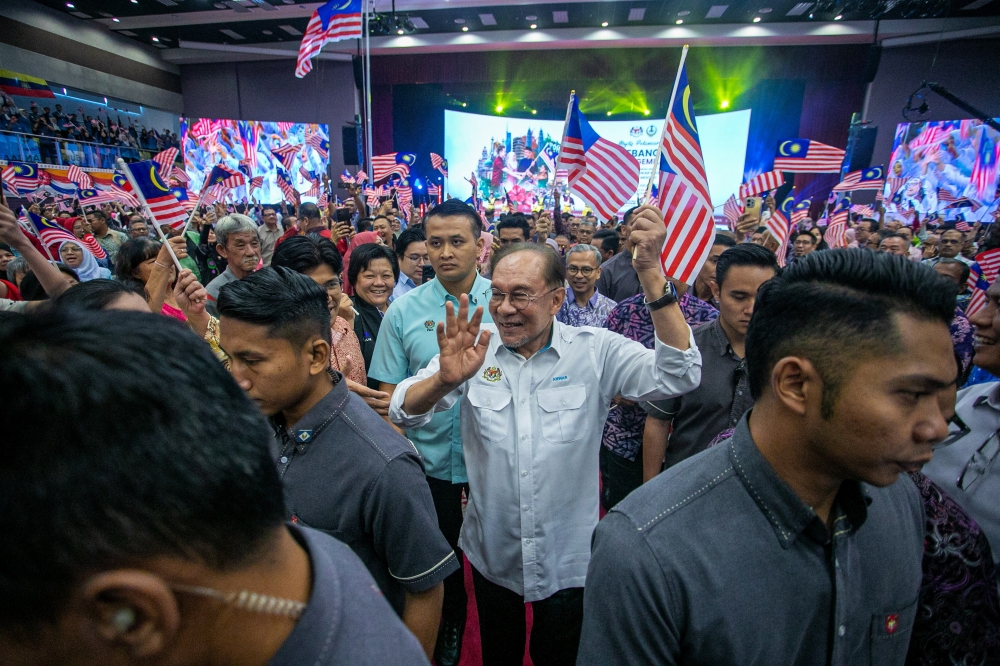
Prime Minister Datuk Seri Anwar Ibrahim has issued a measured but pointed reminder to members of his administration and other government leaders, urging them to exercise restraint when participating in political campaigns. Speaking in Ipoh on July 19, Anwar sought to establish clear parameters around how serving officials should conduct themselves during electioneering periods, balancing the rights of individuals to engage in political activity against the need to preserve institutional integrity and public trust.
The prime minister's remarks underscore a persistent tension within Malaysian politics: the challenge of managing partisan competition while maintaining the neutrality and professionalism expected of the civil and political apparatus. Anwar's statement signals an attempt to impose discipline within his own ranks, recognising that unchecked campaigning by office-holders can blur the lines between state resources and political advantage, a concern that has periodically surfaced in Malaysian electoral cycles.
While Anwar explicitly permitted his colleagues and subordinates to campaign for their preferred parties, he was equally emphatic that there remained limits to what was acceptable conduct. The specifics of what constitutes crossing that line—whether involving misuse of government facilities, leveraging official authority for partisan gain, or failing to uphold the constitutional separation between state functions and party politics—remained somewhat undefined in his remarks, though the historical context of Malaysian electoral disputes provides ample guidance on such matters.
The warning appears particularly relevant given Malaysia's complex political landscape, where coalition arrangements frequently shift and where questions about the propriety of government officials' political activities have occasionally triggered public controversy. Anwar's administration, which itself represents a relatively recent political realignment following the 2022 elections, may be especially conscious of the need to maintain credibility with the electorate by demonstrating that power is not being misused for narrow party advantage.
Government leaders occupying ministerial positions or holding other senior posts occupy a peculiar position within democratic systems. They retain their rights as citizens to support parties and causes, yet they also command resources, visibility, and authority that could potentially be deployed to advantage in political contests. Anwar's instruction implicitly acknowledges this tension and seeks to ensure that the machinery of government remains available equally to all political forces, rather than becoming an instrument of the ruling coalition's electoral strategy.
For Malaysian readers and observers, the statement carries broader implications about institutional health and the maturity of the country's democracy. Successive governments have faced accusations—some substantiated, others contested—of using government resources or administrative procedures to benefit allies or disadvantage opponents. The perception that such practices occur, even if particular allegations are disputed, tends to erode public confidence in both governmental institutions and electoral processes more broadly.
The timing of Anwar's remarks may also reflect anticipated electoral activity. While no date has been formally announced for the next general election, political temperatures typically rise during periods when such contests appear imminent. Advance clarification of expectations regarding official conduct can help prevent crises that might otherwise erupt if individual ministers or leaders exceed boundaries only to face subsequent correction or sanction.
Implementation of Anwar's guidance will likely depend significantly on the executive's willingness to hold account those who violate its spirit, even if they are politically important figures or allies. The credibility of such directives often rests less on their initial issuance than on whether transgressions are subsequently addressed through meaningful consequences. This represents a test that Malaysian administrations have not always passed consistently.
Malaysian political culture has evolved substantially over recent years, with increased scrutiny from civil society organisations, media outlets, and the broader public regarding questions of institutional integrity and the propriety of government action. Younger voters in particular tend to place considerable weight on such concerns when deciding their electoral preferences. Anwar's positioning on this issue may therefore serve both principled governance objectives and astute political calculation, as maintaining the appearance and reality of institutional impartiality can enhance his coalition's standing with a substantial segment of the electorate.
The prime minister's statement also reflects recognition that political competition within democratic systems functions most effectively when conducted according to mutually accepted rules and norms. While Malaysian politics encompasses genuine ideological and policy differences between competing coalitions, the broader stability and legitimacy of the system depends on acceptance of electoral outcomes and restraint in deploying state power for partisan purposes. Anwar's reminder to his colleagues can be understood as an attempt to reinforce those foundational norms.
Moving forward, the extent to which government officials heed this guidance will become apparent through their behaviour during campaign periods. Public controversies involving accusations of misuse of official position or resources will test whether Anwar's administration demonstrates the seriousness of his stated commitment to maintaining appropriate boundaries. The broader implication of his remarks is that Malaysia's democratic institutions and practices remain works in progress, requiring ongoing vigilance and conscious effort to maintain standards of institutional integrity and political fairness.

