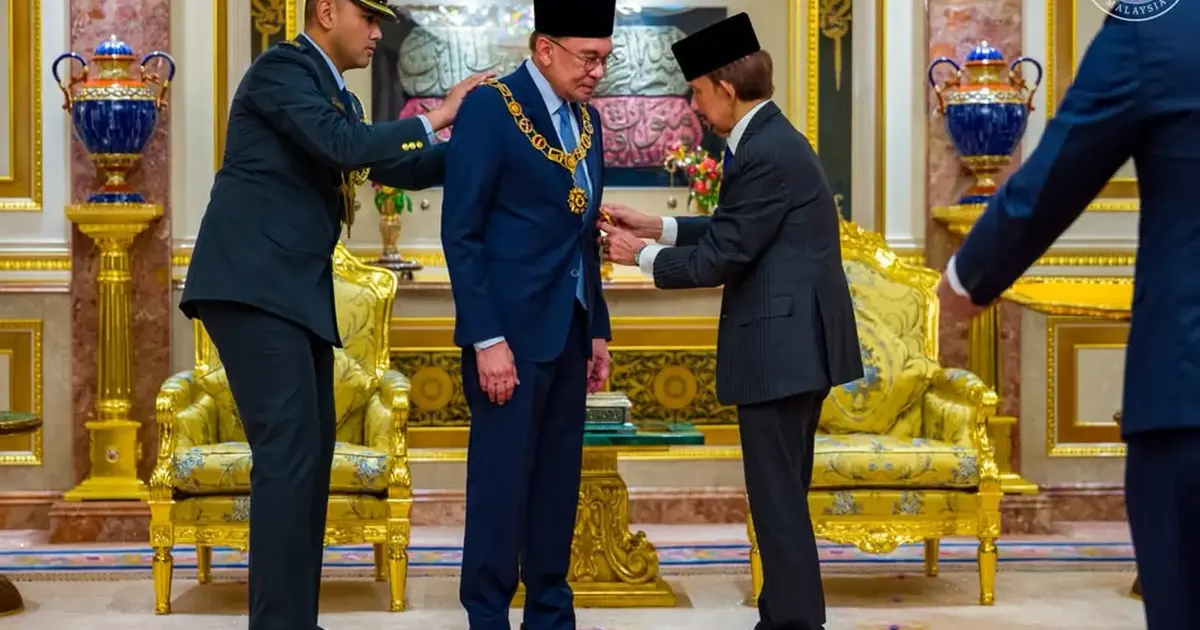
Prime Minister Anwar Ibrahim has received the Darjah Kerabat Laila Utama Yang Amat Dihormati (D.K.), one of Brunei's most prestigious royal honours, from Sultan Hassanal Bolkiah. The conferment underscores the deepening diplomatic bonds between Malaysia and Brunei, two neighbouring nations with longstanding historical and cultural connections across the South China Sea.
The D.K. honour represents a significant diplomatic gesture, typically bestowed upon foreign leaders and dignitaries who have contributed to strengthening bilateral relations or demonstrated exceptional service to the state. By awarding this distinction to Anwar, Sultan Hassanal Bolkiah has signalled Brunei's recognition of Malaysia's leadership and its commitment to regional cooperation and partnership at the highest levels.
This honour arrives during a period of renewed emphasis on close ties between Kuala Lumpur and Bandar Seri Begawan. Both nations share membership in the Association of Southeast Asian Nations (ASEAN) and maintain active diplomatic engagement on matters ranging from trade and investment to security and cultural exchanges. The recognition reflects the personal standing Anwar has cultivated on the regional stage since assuming office, positioning Malaysia as a key partner in Brunei's diplomatic framework.
For Malaysia, such accolades from neighbouring monarchies carry symbolic weight beyond ceremonial value. They validate the government's foreign policy direction and demonstrate acceptance within the regional hierarchy of states. In an era where Southeast Asia navigates complex geopolitical pressures from major powers, bilateral honours between ASEAN nations reinforce the principle of mutual respect and sovereign equality that underpins the region's collective identity and institutional coherence.
The Darjah Kerabat system in Brunei represents a carefully calibrated structure of national honours that reflects the Sultanate's constitutional framework and values. Anwar's receipt of this award places him among a select group of international statesmen formally recognised by Brunei's monarchy, a distinction that carries influence within diplomatic circles and regional power dynamics. Such honours have historically served as markers of preferred relationships, signalling to both domestic and international audiences the importance Brunei places on particular bilateral partnerships.
Malaysia-Brunei relations encompass several substantive areas of cooperation. Trade volumes between the two nations remain significant, with Malaysian businesses operating across various sectors in Brunei, particularly in services and light manufacturing. Energy cooperation, particularly involving the petroleum and liquefied natural gas sectors, continues to feature prominently in bilateral discussions. Additionally, security cooperation and intelligence sharing on transnational issues such as piracy, trafficking, and terrorism represent critical dimensions of their partnership.
The conferment also reflects broader ASEAN dynamics, where ceremonial honours often signal alignment on key regional issues and reinforce solidarity among member states. As Malaysia holds positions within various ASEAN mechanisms and takes active roles in regional forum discussions, recognition from sister states enhances the country's diplomatic standing and soft power influence. This is particularly relevant given Malaysia's efforts to mediate regional disputes and contribute meaningfully to the ASEAN Regional Forum and East Asia Summit processes.
On the Malaysian domestic front, such international honours serve to bolster a prime minister's authority and international profile. They provide tangible evidence of Malaysia's diplomatic effectiveness and its valued position within the regional community. For Anwar, who has worked to restore Malaysia's international standing following previous years of diplomatic challenges, such recognition from immediate neighbours carries particular significance in demonstrating that his administration's policies have successfully rebuilt trust and confidence among key regional partners.
The honours system in Brunei, like those in Malaysia and other ASEAN nations, reflects the continued centrality of monarchy in Southeast Asian governance and diplomacy. By maintaining elaborate systems of honours and ceremonial recognition, these states reaffirm the role of their rulers as guardians of state prestige and architects of diplomatic relations. The bestowal of honours upon foreign leaders thus becomes an instrument of statecraft, carefully managed to convey messages about alliance preferences, shared values, and mutual respect.
Looking forward, this honour is likely to strengthen personal rapport between Anwar and Sultan Hassanal Bolkiah, potentially creating additional channels for dialogue on matters of mutual concern. Such personal connections among senior leaders often translate into pragmatic cooperation on specific issues and facilitate smoother resolution of any bilateral complications that may arise. The symbolic capital generated by this recognition may also provide political benefits domestically, as Malaysia's leadership can point to such acknowledgements as evidence of restored international respect and effective regional diplomacy.
The award also carries implications for broader Southeast Asian integration. As the region continues to navigate economic challenges, geopolitical uncertainties, and the need for coordinated responses to transnational issues, strengthened bilateral relationships between member states create a more cohesive ASEAN capable of speaking with unified voice and pursuing collective interests. Brunei's recognition of Anwar thus contributes, however subtly, to the broader project of regional solidarity and cooperation that remains central to ASEAN's founding principles and contemporary strategic interests.

